
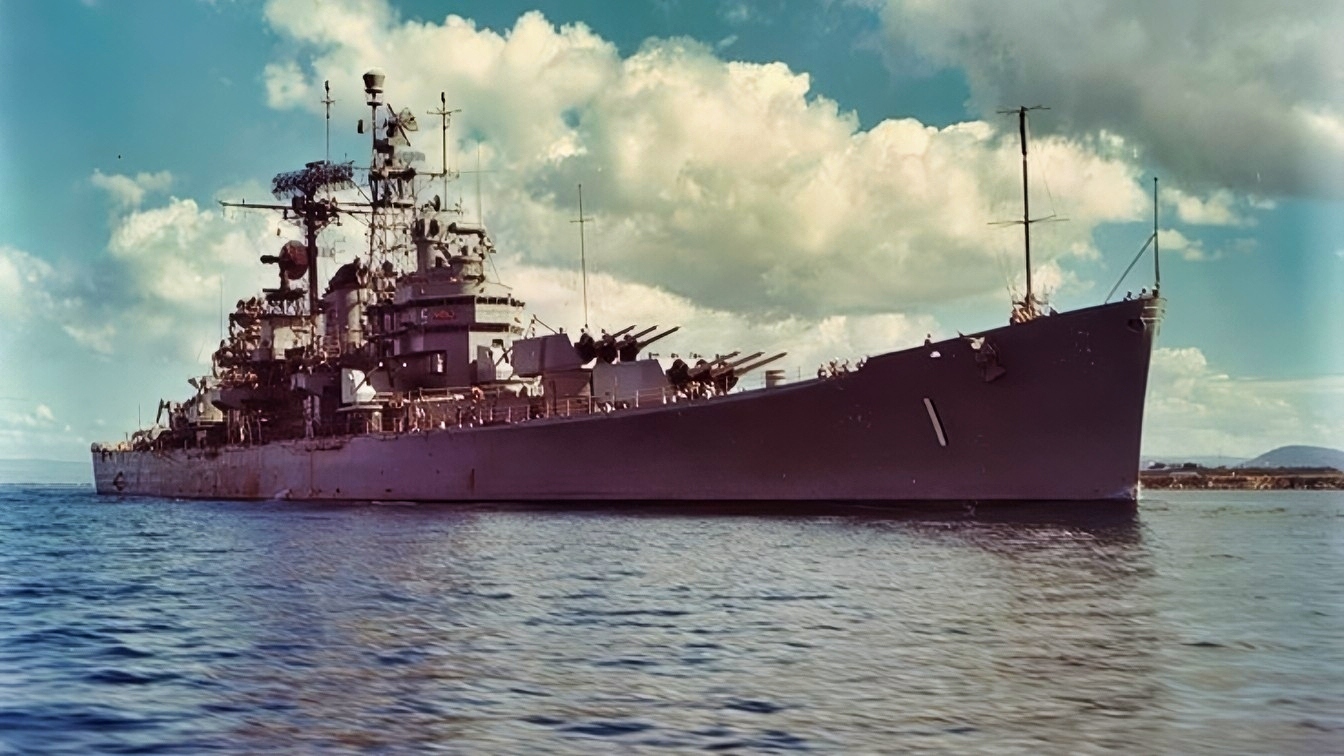
 USS Boston US Navy Warship Creative Commons
Summary and Key Points: Brandon J. Weichert traces USS Boston (CA-69) and USS Canberra (CA-70), 673-foot, 17,000-ton Baltimore-class heavy cruisers with nine 8-inch guns, through their SCB 48 conversion into the first guided-missile cruisers: the aft turret gave way to two twin-arm RIM-2 Terrier launchers, Boston recommissioned as CAG-1 on November 1, 1955, Canberra followed in 1956, the obsolete Terriers lost out to the 8-inch guns in Vietnam, both regained CA designations in May 1968, both decommissioned in 1970.
Why the USS Boston and Baltimore-Class Warships Look Like Mini Iowa-Class Battleships
The Baltimore-class heavy cruisers were among the most powerful conventional cruisers the United States built during World War II. A total of 14 were built.
Each carried nine eight-inch guns arranged in three triple turrets, supported by 12 five-inch dual-purpose guns (and numerous smaller antiaircraft weapons).
These warships displaced 17,000 tons (fully loaded) and measured 673 feet, and could reach around 33 knots.
A History of Greatness
USS Boston (CA-69) entered service in June 1943, at the height of America’s involvement in World War II. The warship participated in major operations against Japan.
USS Canberra (CA-70) followed the Boston into service four months later in October 1943. Both magnificent ships survived the war and entered America’s reserve fleet.
The jet age changed the Navy’s overall requirements for warships.
A New Life at War
Conventional naval artillery had limited utility against high-speed jet-powered aircraft that could attack US Navy ships from greater distances and altitudes.
As a result, the Navy needed weapons that could engage hostile warplanes before they could approach American carrier formations.
So, rather than wait for new warships, the Navy opted to modify the existing cruisers they had in abundance.
In January 1952, nine years after the class’s original two ships left the shipyards, the Navy redesignated the USS Boston as a CAG-1 (or guided-missile heavy cruiser).
The redesignation project was named SCB 48. During the conversion, the Navy essentially turned the Boston into an entirely new warship, primed for the first phase of the nuclear-and-jet age of the Cold War.
These old Baltimore-class heavy cruisers became the Boston-class guided-missile cruisers.
The RIM-2 Terrier
The Navy removed the Boston’s triple eight-inch gun turret and replaced it with two twin-arm launchers for the RIM-2 Terrier surface-to-air missile (SAM).
The RIM-2 was an early Cold War missile and one of the Navy’s first operational shipboard surface-to-air guided missile systems.
Early Terrier variants used radar beam-riding guidance, which required a shipboard fire-control radar to direct the missile toward its target.
Terrier missiles provided greater engagement envelopes (when compared to conventional short-range antiaircraft artillery).
Later variants then employed better propulsion, guidance, and interception capabilities.
The Boston-class showcased how large, existing warships could use guided missiles without abandoning their conventional artillery entirely.
Still, the early Terriers had real limits.
Early Terrier systems required robust radar, large magazines, dedicated launchers, and frequent maintenance.
They could not engage multiple targets well (because of limits in existing guidance equipment).
Then, the Navy removed the ship’s ammunition-handling arrangements and redesigned them to accommodate missile magazines and the equipment that supported these new systems.
Reconfiguring for the Future
From there, the Navy installed entirely new radars, missile-guidance systems, fire-control equipment, and electronic systems to ensure the USS Boston was primed to fight the wars of the future rather than a redux of WWII.
The Navy also substantially reconfigured the aft superstructure.
The forward two triple eight-inch turrets remained operational, leaving the converted cruisers with six heavy naval guns.
The result was a bizarre hybrid.
It was WWII-era battleship artillery technology fused with emerging Cold War guided missiles.
By 1955, her retrofit was completed, and she returned to service on November 1 of that year. Another ship of the class, the USS Canberra, followed the same redevelopment program a year thereafter.
For the first time, the Navy had operational guided-missile cruisers, originally WWII cruisers converted rather than built entirely new.
By the 1960s, rapid advances in missile technology were making the modified Boston-class ships obsolete.
The Navy considered reconstructing them to better defend against modern missiles.
That redesign never came, though.
Because newer missiles offered improved performance and more advanced radar systems made fleet air defenses more effective, the Navy grew concerned that the USS Boston and USS Canberra were becoming increasingly irrelevant.
The Vietnam War
Just as the death knell sounded for these iconic warships, the Vietnam War offered them yet another lease on life.
Unlike modern missile-heavy warships, the Boston-class still carried its original eight-inch guns. During the Vietnam War, the two cruisers supported US forces ashore.
With those eight-inch guns, these warships could bombard coastal defenses. They could also break up enemy troop concentrations.
Plus, these ships could hit distant land targets from the safety of the sea ahead of advancing American ground forces.
In fact, in May 1968, the Navy reclassified ships as conventional heavy cruisers, thereby restoring their original “CA” designations.
That decision reflected the declining usefulness of their original Terrier installations and the continuing importance of their naval gunfire capabilities.
Indeed, the Navy even removed the missile equipment, returning the USS Boston and Canberra to their original WWII mission: serving as conventional gun cruisers.
End of an Era
Ultimately, the Navy determined that upgrading these magnificent WWII-era ships again to make them more useful in the constantly evolving Cold War era was too expensive.
When the Navy considered upgrading the two ships again, more advanced missile-equipped cruisers (and destroyers) were already coming online, designed around more advanced air-defense systems.
So, the Navy decommissioned USS Canberra on February 2, 1970. The Navy decommissioned USS Boston three months later.
Both were eventually scrapped.
About the Author: Brandon J. Weichert
Brandon J. Weichert is the Senior National Security Editor at 19FortyFive.com. He also manages The Weichert Brief on Substack. Weichert also hosts “National Security Talk” on Rumble. He is the author of four bestselling national security books, most recently A Disaster of Our Own Making: How the West Lost Ukraine (Encounter Books). Follow him via Twitter/X @WeTheBrandon.