
US Sea Drones Just Changed the Iran Fight
 Alexandra Reeves
US Sea Drones Just Changed the Iran Fight
Washington has found a very American way to copy Ukraine: take an ugly, expendable unmanned boat, point it at a harder target, and make the cost curve somebody else’s problem.
According to Defence Blog, U.S. Central Command used one-way attack sea drones against Iranian targets on Sunday for the first time in the current conflict. CENTCOM’s strike package also included fighter aircraft, naval vessels and one-way aerial drones, but the sea drones are the part that matters. They mark the moment when the Gulf fight stopped being only an air-and-missile exchange and became a test bed for attritable maritime strike.
That sounds technical. It is not. It is a political signal wrapped in a cheap hull.
The New Weapon Is the Message
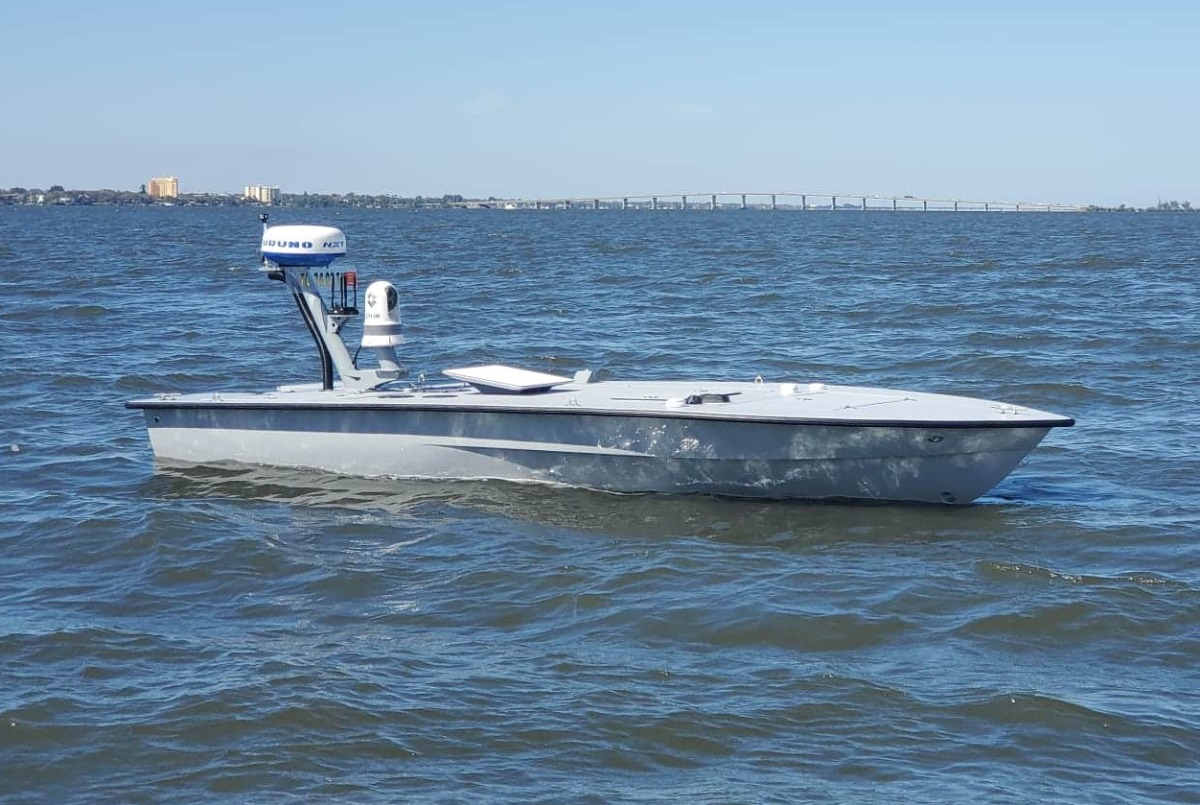
CENTCOM said its forces struck Iranian air-defence systems, coastal radar sites, missile and drone capabilities, and small boats. The stated purpose was to degrade Iran’s ability to threaten civilian mariners and commercial shipping in the Strait of Hormuz, the narrow passage that usually carries roughly a fifth of global oil traffic.
The command did not identify the sea-drone model, manufacturer or number used. That silence is itself useful. It tells Tehran that the United States is willing to reveal the category of capability while hiding the inventory. It also tells U.S. industry that unmanned surface vessels are no longer a PowerPoint solution waiting for a future war with China. They are being used now.
Defence Blog reported that the Pentagon has evaluated one-way attack sea-drone designs from several firms, including Saronic Technologies, MARTAC, Blue Ops, Sierra Nevada and UFORCE. The same report noted that Saronic received a $392 million Navy production deal to move its Corsair unmanned vessel from prototype to fielded status in under a year. MARTAC’s MUSKIE M18, meanwhile, has been advertised for one-way missions, with burst speeds above 93 km/h, payload capacity up to 453 kg and open-ocean range around 926 km.
None of that proves which system hit Iran. It does show the direction of travel. The U.S. Navy is no longer treating unmanned surface attack as an exotic Ukrainian improvisation. It is treating it as a procurement lane.
Ukraine Wrote the Manual
The obvious comparison is the Black Sea. Ukraine used relatively cheap unmanned surface vessels to make Russia’s Black Sea Fleet behave like a force under siege. Large ships left port less often. Sevastopol became less comfortable. The psychological effect mattered almost as much as the physical damage.
Iran is not Russia, and the Gulf is not the Black Sea. The Strait of Hormuz is narrower, busier and more politically combustible. Still, the logic carries over. A one-way maritime drone does not need to sink a major combatant to be useful. It can force an adversary to disperse patrol craft, keep radars active, defend piers, escort small boats and waste expensive interceptors against cheap attackers.
That is the part Washington has often been slow to learn. For two decades, the United States built exquisite systems for wars in which it controlled the tempo. Iran, the Houthis and Russia’s drone suppliers have shown the opposite model: mass, uncertainty and low-cost pressure. The sea-drone debut suggests the Pentagon is finally willing to use the same grammar.
Hormuz Makes Everything Political
The strategic setting is what makes this more than a weapons story. Defence Blog reported that Sunday’s operation was the fourth round of American strikes since Tehran resumed attacks on commercial shipping around July 7. Task & Purpose separately reported that U.S. forces launched a fresh round of strikes after earlier exchanges between the two countries, while CENTCOM framed the campaign as an effort to protect mariners and commercial vessels transiting the strait.
Iranian claims are harder to verify. The Islamic Revolutionary Guard Corps said it struck American facilities across the Gulf, including targets in Bahrain, Kuwait, Jordan, Oman and Qatar. Al Jazeera carried some of those Iranian statements, but U.S. confirmation has lagged or contradicted parts of Tehran’s account. That does not make the claims irrelevant. In a regional crisis, perception can move faster than battle-damage assessment.
Markets noticed. Defence Blog cited Brent crude rising 3.92 percent to $78.99 a barrel on Sunday as traders weighed renewed uncertainty over Hormuz. President Donald Trump told CNN the strait remained open, while Iranian officials claimed they had effectively closed it. Ship-tracking reportedly showed traffic slowing sharply. That gap between official confidence and commercial caution is where the real pressure lives.
Insurance firms, tanker operators and Gulf governments do not need a formal blockade to change behaviour. They need risk. A handful of small boats, coastal radars and drone-launch sites can create enough doubt to raise costs across the energy market.
Iran Now Has a Defensive Math Problem
For Tehran, the U.S. use of sea drones complicates an already crowded defensive picture. Iranian coastal forces now have to watch for aircraft, cruise missiles, aerial drones, naval gunfire and unmanned surface attackers. The defensive chain is messy: detect a low-profile craft, classify it, decide whether it is a civilian vessel or weapon, and kill it before it reaches a pier, patrol boat or radar site.
That is not easy in congested waters. It is especially awkward for Iran because the regime has spent years building its own asymmetric maritime doctrine around swarms of small craft, mines, missiles and drones. The United States is now borrowing part of that playbook and adding better sensors, communications and strike coordination.
Here is the uncomfortable bit for Washington’s allies: this will not stay in the Gulf. NATO navies watching the Iran fight should assume similar systems will appear in the Baltic, the Black Sea, the Red Sea and around critical undersea infrastructure. Cheap maritime attack platforms are becoming normal. Ports, logistics hubs, fuel depots and ships at anchor are all becoming more vulnerable.
The Bigger Lesson for NATO
The U.S. Navy’s sea-drone debut does not mean unmanned boats are magic. They can be jammed, intercepted, spoofed or destroyed. Their payloads are limited compared with missiles. Their effectiveness depends on targeting, weather, sea state and communications. Anyone selling them as a replacement for manned fleets is selling nonsense.
But they change the economics of harassment and denial. A defender has to be right repeatedly. The attacker only has to get one craft through at the right moment. That is exactly why Ukraine’s Black Sea campaign mattered, and it is why CENTCOM’s first use of attack sea drones against Iran deserves more attention than another line item in the strike tally.
The immediate question is whether Sunday’s operation was a one-off demonstration or the start of a sustained American maritime-drone campaign. The next things to watch are Iranian adaptations around coastal radar and small-boat dispersal, insurance and tanker flows through Hormuz, and whether CENTCOM begins releasing more detail on unmanned surface systems after the first operational use.
The bigger conclusion is simpler. The United States spent years warning allies about cheap drones in other people’s hands. Now it is using the same idea in one of the world’s most sensitive waterways. That may be good military adaptation. It is also an admission that the expensive navy has entered the cheap-drone war, and there is no going back.
U.S. Central Command employed one-way attack sea drones against Iranian targets in the Strait of Hormuz on Sunday, marking a significant shift in military operations. The strikes targeted Iranian air-defense systems and coastal radar sites to reduce threats to civilian shipping. This operation is part of a broader campaign following increased Iranian attacks on commercial vessels since July 7.
- U.S. Central Command used sea drones for the first time against Iranian targets.
- The operation aimed to degrade Iran's threat to civilian shipping in the Strait of Hormuz.
- The Pentagon is evaluating various sea-drone designs from multiple firms.
- The operation was part of a series of American strikes since July 7.
- Iranian claims of striking U.S. facilities have not been confirmed.