
USS Theodore Roosevelt Leaves the South China Sea and Exposes America’s 2026 Carrier Gap
 Marcus Chen
USS Theodore Roosevelt Leaves the South China Sea and Exposes America’s 2026 Carrier Gap
Theodore Roosevelt Carrier Strike Group pulled into Singapore on November 6, according to USNI News. The port call is routine. The timing is not. Reports that the strike group is the last stop before moving toward the Middle East mean the U.S. Navy is about to trade visible combat power in the South China Sea for a requirement elsewhere.
That is the real story. A carrier does not have to be attacked to leave a gap. It only has to sail away.
The Deployment Is a Fleet-Management Problem
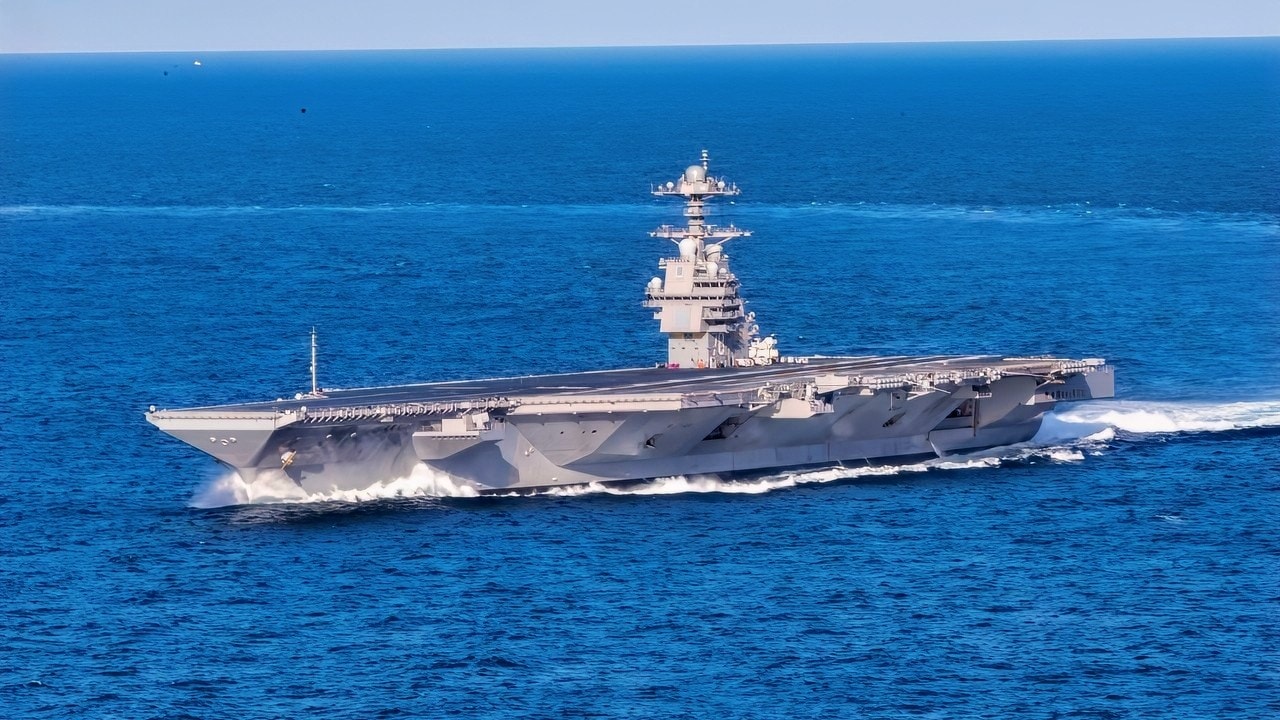
The Theodore Roosevelt Carrier Strike Group is built around a Nimitz-class nuclear aircraft carrier, supported by an embarked carrier air wing, surface escorts, and an aircraft-capable logistics chain. Its value is not just the number of F/A-18E/F Super Hornets and E-2D Hawkeyes on the flight deck. It is the ability to combine air defense, strike, surveillance, electronic warfare, and command-and-control in one mobile formation.
But one carrier strike group cannot be in two theaters. A move toward the Middle East does not prove that Washington has abandoned the Indo-Pacific. It does show that the Navy is managing a finite pool of high-end hulls against competing crises. The carrier is a 100,000-ton solution to a problem that may exist thousands of miles away, and every movement creates a coverage decision in the theater it leaves.
Recent reporting from The War Zone described Singapore as the group’s last stop before a possible movement toward the Middle East. That is a more useful signal than the port call itself. Singapore is a logistics node at the intersection of the Indian Ocean and the South China Sea. A carrier there can support several options. A carrier headed west has fewer options for immediate presence near Taiwan or the Philippines.
Why the South China Sea Notices
China does not need to sink a carrier to gain from its absence. The People’s Liberation Army can use the change in American presence to increase maritime patrols, air sorties, and pressure on regional partners while staying below the threshold that would trigger a major U.S. response.
That is the logic of a pressure campaign. It is not about winning a single engagement. It is about forcing the other side to spend readiness, fuel, flight hours, and political attention. Taiwan recently reported a surge of Chinese aircraft and naval activity, as covered by the South China Morning Post. Those sorties are not proof of an imminent invasion, but they make the absence of an American carrier more operationally relevant.
The gap is partly psychological and partly practical. A carrier’s aircraft can patrol, defend, strike, and reassure allies. Land-based aircraft and submarines may offer more survivable firepower in a war, but they are less visible during a crisis. Deterrence often depends on what an adversary believes Washington can do in the next six hours, not what it could assemble after six weeks.
Three Carriers Do Not Equal Three Available Carriers
Coverage of a possible “carrier gap” often counts hulls. That is the wrong calculation. The useful number is the count of carriers that are deployed, trained, supplied, and politically available for the mission.
- Deployed: The carrier must already be in or near the theater.
- Ready: Its air wing, escorts, and replenishment ships must be able to operate at a wartime tempo.
- Available: The White House and combatant commanders must be willing to accept the risk of using it there.
A carrier leaving the South China Sea can therefore reduce regional options even if the Navy still has other carriers at sea. A second strike group may be in the Indian Ocean. A third may be in maintenance or training. On paper, the force exists. In a crisis, distance and readiness turn paper strength into a much smaller number.
Anyone who has served on a destroyer understands the practical constraint: a ship’s combat system may be sophisticated, but the formation still depends on fuel, munitions, maintenance windows, escorts, and a steady flow of intelligence. A carrier strike group is not a floating permanent base. It is a high-demand formation that must be moved, protected, and replenished.
What Washington Should Do Next
The answer is not to keep every carrier in the South China Sea. That would be predictable, expensive, and vulnerable to China’s growing missile and surveillance network. The answer is to make carrier absence less consequential.
That requires three measures. First, the U.S. should keep more long-range fires, tankers, unmanned aircraft, and air-defense units distributed across Japan, the Philippines, Guam, and other access points. Second, allied navies must be able to contribute credible sea-denial forces without waiting for a U.S. carrier to arrive. Third, Washington needs a clearer rotation plan that explains what replaces a carrier’s visible presence when a strike group is diverted.
The U.S. Air Force’s plan for more than 6,000 annual aircraft operations across airfields on Saipan, Tinian, and Rota points in the right direction. Dispersal makes the force harder to target. It does not, however, replace the command presence and sustained sortie generation of a carrier strike group overnight.
The Math Is the Message
Theodore Roosevelt’s Singapore visit is not a defeat and it is not evidence that China controls the South China Sea. It is a reminder that American power remains globally mobile because it is also globally competed for.
Beijing will measure the number of ships that remain, the tempo of allied patrols, and the time required to bring another U.S. carrier back. Washington should measure the same thing. If the answer is that one Middle East crisis can remove the most visible American combat formation from the South China Sea, then the problem is not a bad port-call schedule. It is insufficient theater depth.
The carrier gap is therefore not a comparison between Chinese and American hull counts. It is the distance between the commitments Washington has made and the forces it can keep on station at the same time. That distance is widening.
Sources
- USNI News, “Theodore Roosevelt Carrier Strike Group Pulls Into Singapore,” November 6, 2026.
- The War Zone, report on USS Theodore Roosevelt’s Singapore arrival and onward movement.
- South China Morning Post, reporting on recent PLA aircraft and naval activity around Taiwan.
- Defense News, reporting on dispersed U.S. Air Force operations in the Pacific.
USS Theodore Roosevelt Carrier Strike Group arrived in Singapore on November 6, 2026, and is expected to move towards the Middle East, reducing U.S. naval presence in the South China Sea. This shift allows China to potentially increase its maritime activities in the region. The movement underscores the U.S. Navy's challenge in managing limited high-end naval assets across competing global crises.
- USS Theodore Roosevelt Carrier Strike Group arrived in Singapore on November 6, 2026.
- The carrier group is expected to move towards the Middle East, reducing U.S. naval presence in the South China Sea.
- China may increase maritime patrols and air sorties in response to the absence of the carrier.
- The carrier's movement highlights U.S. Navy's finite resources and the need for strategic management of naval assets.
- The U.S. needs to enhance its long-range capabilities and allied contributions to mitigate the impact of carrier absence.