
Warning from 2026: China's Navy 052D Class Kaifeng Ship Conducts Live Fire Exercises 180km Southwest of Okinotorishima
 Tanaka Takashi
Warning from the Chinese Navy's Type 052D Kaifeng Destroyer, which Conducted Live Fire Exercises 180km Southwest of Okinotorishima in 2026
The figure of approximately 180 kilometers southwest of Okinotorishima appears small on a map. However, the area where the Chinese Navy's Type 052D destroyer "Kaifeng" reportedly conducted machine gun fire is within the Philippine Sea, which Japan considers its exclusive economic zone, or EEZ. The significance lies not in the gunfire itself, but in the fact that this area was treated as a firing range.
Significance of Choosing the Type 052D
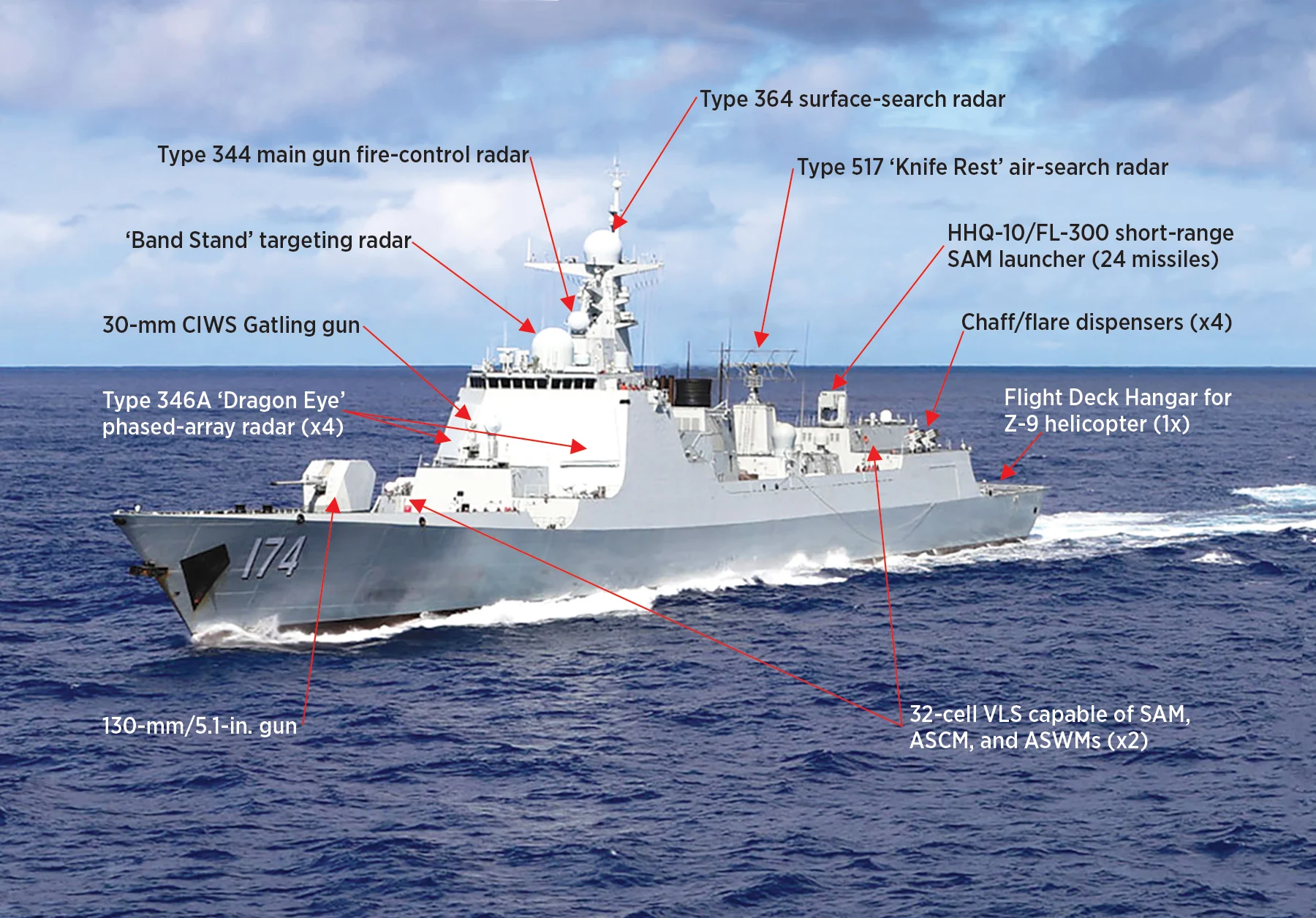
According to reports from Defence Security Asia, the Joint Staff Office tracked a formation of four vessels, including the Chinese Navy's Type 055 "Anshan," Type 052D "Kaifeng," Type 903A supply ship "Kekexili Lake," and the Russian Navy's Steregushchiy-class "Rezkiy." The firing was reportedly conducted by the "Kaifeng." The Type 052D is a multi-role destroyer equipped with a 64-cell VLS, a 130mm main gun, and a 30mm close-in weapon system, and it is highly likely that the weapon used this time was a secondary machine gun system rather than missiles.
This is not a coincidence. If missiles were launched, the political threshold would rise sharply. Even firing the main gun carries strong symbolism. With a 30mm caliber firing, the fleet can adhere to procedures while leaving only the intention of not recognizing jurisdiction over the area. From the Japan Maritime Self-Defense Force's practical perspective, this is more of an operational experiment utilizing the gaps in navigation rules and maritime law rather than a display of firepower.
The Legal Controversy over Okinotorishima Became an Operational Area
China has long positioned Okinotorishima as a "rock" under Article 121(3) of the United Nations Convention on the Law of the Sea, taking a stance that does not recognize Japan's EEZ designation. It has been reported that Japan did not categorically declare the firing itself as a clear violation of international law, but protested it as a safety threat to surrounding vessels. This restrained expression is not a sign of weakness. Bringing the status of Okinotorishima directly to the international court is not necessarily a favorable gamble for Japan.
The issue is that the legal ambiguity has spilled over from diplomatic documents. China has gradually differentiated its use of reefs, artificial islands, coast guard vessels, fishing boats, and the navy in the South China Sea. The recent firing around Okinotorishima is considered to have brought the same concept into the open ocean of the Western Pacific.
Chinese-Russian Formation and Outside the First Island Chain
Notably, the presence of the Russian ship is significant. The Chinese and Russian navies have continued cruising in the Pacific after joint exercises, and the formation accompanied by a supply ship is based on the premise of prolonged operations in the open ocean rather than a short-term demonstration. While it is dangerous to simply overlay the Soviet Pacific Fleet of the Cold War with the current Chinese Navy, it cannot be ignored that multiple continental naval forces are beginning to share the same operational map around Japan.
On July 7, there were reports of incidents around the Senkaku Islands where Chinese coast guard vessels and Japan claimed mutual withdrawal. In the East China Sea, there are coast guard operations, in the Philippine Sea, there are naval operations, and behind it all is the cooperation between China and Russia. This is not a one-off friction; it indicates that the layers of pressure covering maritime traffic routes and SLOCs are thickening.
What Japan's Response Lacks
- There is a need to shift continuous monitoring around Okinotorishima from an aircraft-centric approach to a combination of unmanned aerial vehicles and satellites.
- Information sharing between the Japan Coast Guard and the Maritime Self-Defense Force should be expanded not only to short-range responses like those in the Senkaku Islands but also to open ocean EEZ incidents.
- In joint responses with the U.S. military, the speed of shooting reports, merchant vessel warnings, and tracking announcements should be included in training items from peacetime.
In the author's view, what Japan should be most wary of is not the 30mm rounds from the Kaifeng. The danger lies in China's technique of accumulating actions that "may not be illegal," thereby limiting Japan's protests to mere safety notices for navigation. The defense of the southwestern islands is often discussed in terms of protecting the islands, but the actual weakness lies in the waters far from the islands, particularly in defining what constitutes normal navigation.
This firing was a small shot. However, the smaller the shot, the more quietly it can change what is considered "normal" in the same maritime area next time.
The Chinese Navy's 052D destroyer Kaifeng conducted a live-fire exercise 180 km southwest of Okinotorishima in 2026, within Japan's EEZ in the Philippine Sea. The exercise involved the use of a 30mm close-in weapon system, rather than missiles, to assert operational control in the area. This event occurred alongside a Russian naval vessel, highlighting joint operations between China and Russia. Japan has raised safety concerns regarding the exercise.
- The Chinese Navy's 052D destroyer Kaifeng conducted live-fire exercises 180 km southwest of Okinotorishima.
- The exercise took place within Japan's exclusive economic zone (EEZ) in the Philippine Sea.
- The Kaifeng is equipped with a 30mm close-in weapon system, used in this exercise instead of missiles.
- The presence of a Russian naval vessel indicates a joint operational context between China and Russia.
- Japan has protested the exercise, citing safety concerns for surrounding vessels.