
What Dangerous Trends Does Japan's New White Paper Expose?
[Global Times Special Correspondent Chen Yang, Global Times Reporter Ma Jun] Editor's Note: The 2026 version of Japan's "Defense White Paper," released on August 4, has sparked widespread opposition from neighboring countries. This "Defense White Paper," which can be considered the longest in Japan's history, devotes a significant amount of space to portraying the so-called "severe security environment" Japan faces, thereby creating an excuse for Japan to expand its military capabilities. Chinese experts interviewed by the Global Times stated that a careful analysis of the content of this white paper reveals Japan's ambitious direction for military expansion.
Attempting to Focus on Developing Seven Capabilities
According to a summary of the new version of the "Defense White Paper" downloaded from the official website of Japan's Ministry of Defense, Japanese Defense Minister Kōizumi Shinjirō proclaimed at the beginning, "Japan's external security environment is currently in the most severe and complex period since the end of World War II, and the possibility of severe situations occurring in East Asia that could shake the foundation of the post-war stable international order cannot be ruled out." Under this overall tone, Japan heavily emphasizes China's external posture and military trends as "unprecedentedly the greatest strategic challenge," seeking excuses for Japan to develop offensive capabilities and strengthen its defense industry.
The white paper also clearly states that in order to fundamentally enhance defense capabilities, Japan "needs to focus on seven functions and capabilities," including "out-of-area defense capabilities," "joint air defense and missile defense capabilities," "unmanned equipment defense capabilities," "cross-domain operational capabilities," "command control and intelligence functions," "mobility deployment and national protection capabilities," and "sustainability and resilience," explicitly stating that "the key is to fully utilize the counterattack capabilities of out-of-area defense capabilities."
Chinese military expert Zhang Xuefeng, in an interview with the Global Times, stated that the white paper's emphasis on developing the so-called "counterattack capabilities" is precisely the offensive capabilities that the outside world has been highly vigilant about. Despite the constraints of the "peace constitution," Japan began to semi-publicly discuss the development of preemptive "enemy base attack capabilities" in the 2004 and 2010 "Defense Program Guidelines." In December 2022, the Japanese government's official terminology replaced the controversial "enemy base attack capabilities" with "counterattack capabilities," explicitly writing it into the new version of the "Three Security Documents" (the "National Security Strategy," "National Defense Strategy," and "Defense Force Build-up Plan"). However, this verbal game does not change Japan's core intention to seek the development of offensive capabilities.
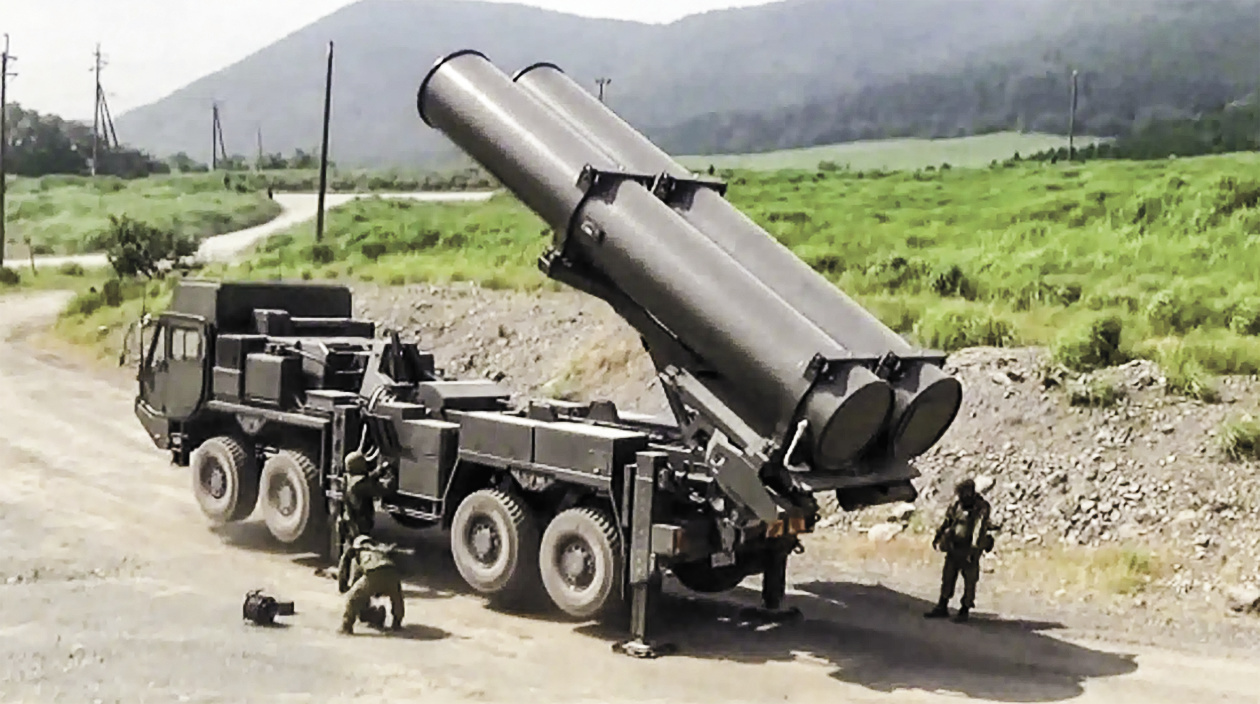
The new version of the "Defense White Paper" clearly states that to enhance out-of-area defense capabilities, it is necessary not only to actually equip the Type 25 ship-to-ship missile, Type 25 high-speed glide bomb, and hypersonic missiles but also to advance measures such as target intelligence collection. Experts explain that the Type 25 ship-to-ship missile is the improved version of the previously much-discussed Type 12 ship-based anti-ship missile, which is essentially a newly developed stealth subsonic cruise missile with a range of about 1,000 kilometers; the Type 25 high-speed glide bomb is Japan's Ground Self-Defense Force's first hypersonic missile, with the current early version having a range of 500-900 kilometers and a speed exceeding Mach 5. The improved version planned for deployment in the fiscal year 2027 will have a range increased to 2,000 kilometers and a speed exceeding Mach 12. They are all part of Japan's focus on developing a new generation of offensive weapons, breaking free from the Self-Defense Forces' reliance on U.S.-made long-range offensive weapons.
Seeking to Seize Space and Cyber Positions
As Japan's advanced long-range strike missiles only entered service in March this year, significantly increasing their operational radius beyond the traditional strike range of the Self-Defense Forces, the Ministry of Defense proposed developing supporting target intelligence collection capabilities. The new version of the "Defense White Paper" claims that enhancing cross-domain operational capabilities means that the Self-Defense Forces will utilize space to enhance intelligence collection capabilities and space domain awareness (SDA) capabilities. Since the space domain is not only an object of surveillance activities but also a domain for conducting military operations, the Air Self-Defense Force was officially restructured into the "Aerospace Self-Defense Force" on June 26.
An unnamed Chinese expert told the Global Times that Japan's version of the "Starlink" satellite constellation, which was announced to be in use in April, is specifically designed to serve the long-range strike capabilities of the Self-Defense Forces. According to Japanese officials, this satellite constellation is composed of a mix of synthetic aperture radar satellites and optical imaging satellites, where the radar satellites can penetrate cloud cover, and the optical satellites provide high-definition images, working together to achieve all-weather, high-frequency monitoring of targets. In addition, the Japanese Self-Defense Forces have also introduced U.S.-made "Global Hawk" and "Maritime Guardian" long-endurance reconnaissance drones, which can cooperate with the space-based satellite constellation to further enhance their battlefield intelligence collection capabilities.
Space reconnaissance capabilities are also one of the main contents listed separately in the "new type of operational methods" section of the new version of the "Defense White Paper." The white paper claims that the key to "new types of operational methods" lies in space, cyber, and electromagnetic domains as well as cutting-edge technologies: in the space domain, satellites are used to enhance command control, communication, as well as intelligence collection, alert monitoring, and reconnaissance, while threats to space equipment from anti-satellite weapons are increasingly growing; in the cyber domain, cyber attacks, including intrusions into critical infrastructure, pose security threats; in the electromagnetic domain, electronic warfare, including electronic attacks and electromagnetic wave management, is becoming increasingly important in modern warfare; supporting these areas are cutting-edge technologies such as artificial intelligence and quantum technology, which are not only rapidly advancing in technical development but can also pose more severe threats in information warfare through deep fakes and generative artificial intelligence to create videos, images, etc.
The aforementioned expert stated that it is worth noting that, in addition to the Self-Defense Forces continuously equipping offensive weapons in the real world, Japan is also taking the lead in developing offensive capabilities in cyberspace. The new version of the "Defense White Paper" openly mentions that starting from October 1, 2026, Japan will officially implement the so-called "proactive network defense." This new policy allows the Self-Defense Forces and other units to take "harmless" "communication protection measures" against "specific important electronic computers" that have suffered cyber attacks when "specific conditions are met." Behind this convoluted wording is the first time Japan's Self-Defense Forces are allowed to take offensive measures in cyberspace, such as intruding and paralyzing the opponent's servers "when necessary," marking a significant shift in Japan's post-war security policy in the cyber domain.
Claiming to Vigorously Develop Unmanned Equipment
The new version of the "Defense White Paper" also mentions a series of other measures to strengthen military power, including upgrading the Japan Ground Self-Defense Force's 15th Brigade stationed in Naha City, Okinawa Prefecture, to the 15th Division to strengthen military deployment in the southwest direction, with significant improvements in troop size and equipment performance; enhancing joint air defense and missile defense capabilities by further upgrading the Ground Self-Defense Force's Type 03 medium-range air defense missile; jointly developing the "Standard-3 Block 2A" interceptor missile with the United States and equipping it on Aegis destroyers; and constructing new generation Aegis system-equipped ships.
The Japanese Ministry of Defense has also repeatedly stated the need to vigorously develop unmanned equipment. The white paper states that in light of the ongoing population decline and the severe fiscal situation, "to obtain capabilities that can fully respond to cross-domain operations," the Self-Defense Forces will enhance unmanned equipment defense capabilities, aiming to establish a "multi-layered coastal defense system" (SHIELD) by 2027, acquiring a large number of inexpensive unmanned aerial vehicles (UAVs), unmanned surface vessels (USVs), and unmanned underwater vehicles (UUVs).
Zhang Xuefeng stated that Japan's vigorous development of unmanned equipment is clearly influenced by the Russia-Ukraine conflict and Middle Eastern wars. The new version of the "Defense White Paper" explicitly mentions that "various types of inexpensive unmanned equipment have been extensively deployed on the Ukrainian battlefield, which can be used to attack high-value weaponry and essential infrastructure, as well as to conduct large-scale composite attacks in conjunction with conventional artillery shells and missiles."
Zhang Xuefeng noted that Japan, in addition to cooperating with Ukraine to introduce combat-tested unmanned drone technology and innovative design concepts, is also developing other more advanced unmanned equipment.
The new version of the "Defense White Paper" specifically mentions that the Self-Defense Forces will begin developing multi-purpose unmanned surface vessels capable of surveillance, monitoring, and anti-ship missile launching, which can support manned vessels in combat. Additionally, Japan is also developing unmanned amphibious vehicles to operate autonomously in amphibious operations and to perform tasks such as transporting supplies from the sea to near troop locations. At the same time, Japan is also developing combat support drones (UAVs) to cooperate with the next generation of manned fighter jets. In June 2025, the Japanese Self-Defense Forces will conduct live-fire mine clearance tests using unmanned surface vessels launched from the "Mogami" class missile frigate for the first time.
Deliberately Building a Defense Industry Chain
The new version of the "Defense White Paper" summarizes the lessons learned from recent regional conflicts, such as "both sides in the Russia-Ukraine conflict recognize that stabilizing the procurement of equipment and ammunition is a major challenge. It is increasingly important to stockpile in peacetime and ensure sufficient sustained response capabilities." The conclusion drawn from this white paper is that "viewing the country's defense production and technological foundation as an indispensable element of national defense, taking measures to support domestic enterprises' participation and promote exports," while also advancing the export of defense equipment, as this "helps to strengthen the defense production and technological foundation and is beneficial for strengthening relations with importing countries."
The aforementioned unnamed expert stated that it is very concerning for the outside world that Japan has significantly increased its daily reserves of weapons and ammunition based on the experiences of the Russia-Ukraine conflict, indicating that Japan is seriously preparing for large-scale conflicts. The Japanese Ministry of Defense plans to add about 130 new ammunition depots on the basis of approximately 1,400 existing ones by around 2032 to enhance sustained combat capabilities. These new ammunition depots will mainly be distributed in Hokkaido, Kyoto Prefecture, Miyazaki Prefecture, Kagoshima Prefecture, and Okinawa Prefecture, primarily targeting the northern (Russian Far East) and southwestern (Taiwan Strait, etc.) strategic directions. At the same time, Japan is also increasing the quantity of weapons and ammunition procurement, with the budget for Japan's 2026 defense budget specifically allocated for the purchase of 155mm artillery ammunition, Type 23 ship-to-air missiles, and other projects amounting to 255.3 billion yen.
The white paper dedicates an entire chapter to "strengthening the defense production and technological foundation" to introduce Japan's efforts in building a complete military-industrial chain. It mentions that to absorb advanced civilian technologies and conduct efficient research and development, the Ministry of Defense's Acquisition, Technology & Logistics Agency actively engages in research cooperation and information technology exchange with research institutions. Additionally, the Ministry of Defense has implemented measures such as the Security Technology Research Promotion System (Ministry of Defense Fund) and advanced technology transfer research. In October 2024, the Acquisition, Technology & Logistics Agency will emulate the U.S. Defense Advanced Research Projects Agency (DARPA) by establishing a new Defense Innovation Science and Technology Research Institute, which will be primarily responsible for promoting breakthrough research.
This white paper proposes to attract Japanese private enterprises to join, while also attempting to expand overseas markets through weapon exports, share research and development costs, and take the opportunity to allow Japan to expand its weapon production capacity.
Chinese Ministry of Defense spokesperson Chen Xi stated in response to reporters' questions on the 4th that the new version of the "Defense White Paper" is filled with false narratives, exaggerating the "surrounding security crisis" and hyping the so-called "China threat," which is entirely a case of the thief crying "stop thief," seeking excuses to loosen its own military constraints.
There has been much criticism within Japan regarding the government's aforementioned policy direction. Many insightful individuals in Japan believe that the government's continuous expansion of military capabilities and breaking of restrictions not only does not contribute to regional peace and stability but instead makes Japan a creator of regional tensions.
According to a report by the Russian Satellite News Agency on the 4th, Secretary of the Russian Security Council Patrushev previously stated that Japan is accelerating militarization, deviating from the commitments made in its surrender document. Russian Foreign Ministry spokesperson Zakharova also stated that Japan's accelerated re-militarization actions undermine efforts for lasting peace, security, and development in the Asian region.
Japan is expanding its military capabilities as outlined in the 2026 Defense White Paper, which highlights the need for enhanced long-range strike capabilities and unmanned systems. The Japan Self-Defense Forces are focusing on developing new offensive weapons and improving their defense industry. Additionally, Japan is increasing its military readiness in response to perceived threats in the region, particularly from China.
- Japan's 2026 Defense White Paper emphasizes the need for enhanced military capabilities due to a perceived severe security environment.
- Japan plans to develop seven key military capabilities, including long-range strike and unmanned systems.
- The Self-Defense Forces are increasing their focus on space and cyber capabilities, including offensive measures in cyberspace.