
When networks are contested, paring down the data may mean better logistics at the edge
As supply lines and communications networks become priority targets for adversaries, building logistics capabilities that can move personnel and materiel safely and effectively will be critical to military efforts.
Doing so requires building a digital infrastructure that can enable technologies such as software-defined systems, smart warehousing and remote updates, allowing logisticians and troops in the field to work through contested environments to successfully carry out missions.
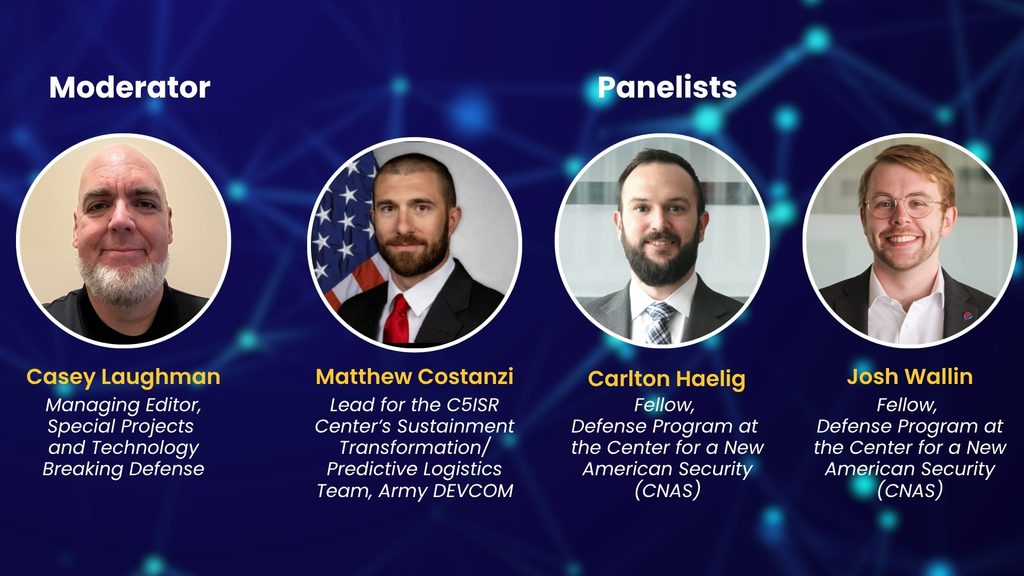
In a recent webinar, Breaking Defense examined these challenges with Matthew Constanzi, lead for the C5ISR Center’s Sustainment Transformation Predictive Logistics Team at Army DEVCOM; Josh Wallin and Carlton Haelig, fellows at the Defense Program for the Center for a New American Security; and Mike Zizza, sales and growth leader for Wind RiverX.
“The biggest challenge that I’ve seen from my position is the Army’s ability to execute what some will term precision logistics, and that’s just being able to provide the accurate amount of supplies that you need across the battlefield,” said Costanzi, “and doing that in dispersed and communication-denied and degraded environments.
“Within that challenge itself, it really boils down to the ability for the Army to be able to capture accurate and timely tactical-level logistics asset information from both assets and commodities on the battlefield.”
Building the communications and logistics backbones needed to meet that precision logistics challenge requires accurate and timely data, software-driven capabilities and dependable communications networks.
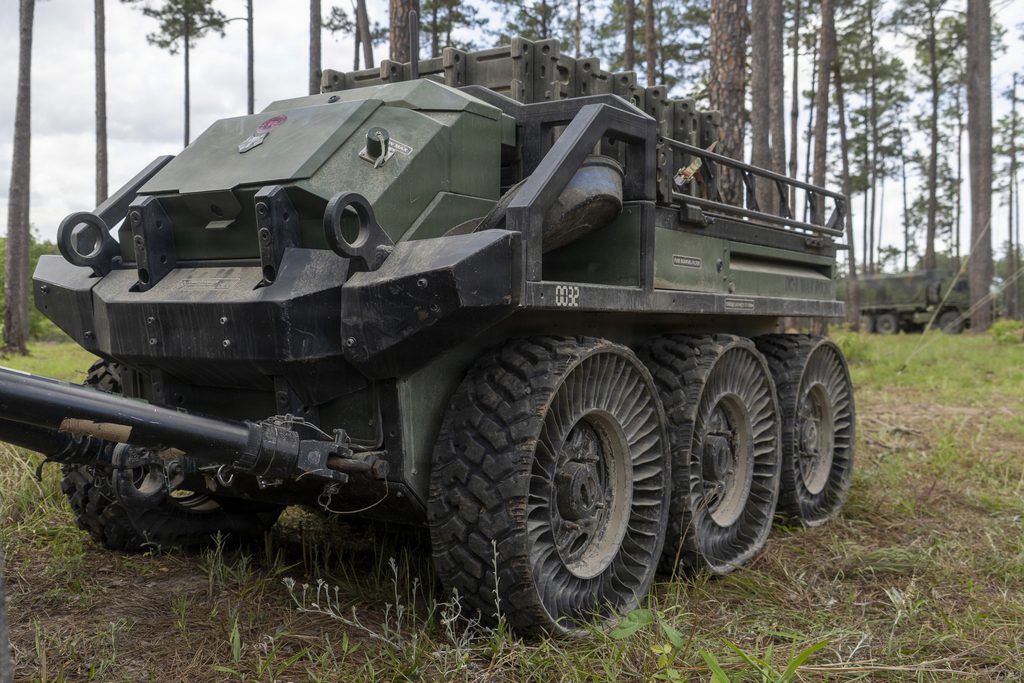 A Hunter Wolf unmanned ground vehicle assigned to Charlie Battery, 3rd Battalion, 320th Field Artillery Regiment, 3rd Mobile Brigade, 101st Airborne Division (Air Assault), transports cargo during a training exercise at the Joint Readiness Training Center, Fort Polk, Louisiana, April 13, 2026. The Hunter Wolf platform, selected for the U.S. Army’s Small Multipurpose Equipment Transport (S-MET) program, is designed to enhance Soldier mobility and mission endurance by automating logistics and providing tactical support in contested environments. (U.S. Army photo by Spc. Mariam Diallo)
Using data, not drowning in it
Logistics efforts in contested environments start with reliable, usable data. While sensor networks collect vast amounts of data, there is a difference between data and usable data. Without tools to sort through reams of data and make it digestible for those who need to use it, forces run the risk of drowning in information that they can’t effectively make sense of.
“There is a human capital aspect to it,” said Haelig. “By aggregating all of this data, you also present a challenge where folks might raise a question and say, ‘How do we make sense of this? How do we know that this data is accurate? How do we know that it’s the appropriate data for whatever it is we’re trying to get done?’
“And you have to sell it to the actual operators, whether they’re civilians or uniformed operators, that this is going to make their job easier, it is going to make these processes more effective; and you also have to give them the tools to do so.”
Software helps meet this challenge, and artificial intelligence (AI) is already offering ways to help manage data, with those capabilities only expected to grow as AI becomes more effective at sorting through massive datasets to provide usable data. Putting those tools into the hands of both rear-guard logisticians and frontline troops offers the ability to quickly and accurately identify key elements such as open logistics routes, potential areas that may be contested or denied and alternate wayfinding capabilities for both crewed and uncrewed delivery platforms.
Costanzi pointed out that the C5ISR Center is already working on these tools. The center has a proof of concept that it is testing to capture bulk information from fuelers and mobile fuel storage and distribution units, move that data autonomously into command and control (C2) nodes, then push it into the Army data fabric so it can be used by sustainment planners and other warfighting applications. The center is also working with the armaments and soldier Centers to track ammunition from its initial procurement to its consumption rates in the field.
“The big heavy hitters of the Army today are fuel and ammunition, so tracking those and knowing what is at each echelon so that you can provide resupply in a more precision manner definitely is key,” he said.
Quantity of data matters, but quality matters much more, and building tools to help take some of the cognitive burden off of operators will be critical to effective logistics, said Wallin.
“Being able to do things like automatic prediction, making recommendations – even things like filling out supply orders automatically – that’s where we see some potential benefit here,” he said. “Those are things that hopefully can avoid having human operators just being overwhelmed by the amount of information that’s coming in. It’s not just getting more information in, it’s having the tools in place so that operators are actually able to process it.”
Software-driven logistics
The fundamental question of logistics is how to get people and materiel from Point A to Point B safely and efficiently. The answers to that question will vary widely based on region – using highway networks in Europe is a far different logistical challenge than island-hopping in the Pacific – but when logistics are needed in contested environments, the key considerations include identifying usable alternate routes and protecting assets from confiscation or attacks. Being able to use software to help identify and mitigate those challenges speeds up the process and allows for rapid adaptation when necessary.
The Army’s Next-Generation Command and Control (NGC2) effort is driving implementation of software capabilities for logistics. Much of the Army’s logistics efforts still run on paper, but NGC2 aims to build a software structure that will modernize logistics through methods such as digitizing Preventive Maintenance Checks and Services (PCMS), AI-assisted technical manual navigation, troubleshooting, reporting and even capabilities such as medical evacuations.
“All that reporting was done in either spreadsheets or across a couple different enterprise systems, if there even was an enterprise system,” said Costanzi. “They’re trying to pull all that together into basically a sustainment planning tool, planning and execution tool under that NGC2 umbrella.”
Automating these processes not only takes some of the workload off of human operators, but also helps streamline data collection and evaluation. If a logistician has to manually track replacement parts, there is the potential for inaccurate counting, outdated information about stockpiles or data-entry duplication, raising the risk of old or wrong data giving a false picture of materiel on hand. And as assets move around, accurately tracking what assets are where – along with all of their necessary supplements such as replacement parts, fuel and ammunition – is critical to developing a true understanding of supplies on hand, resupply needs and readiness.
“All of that begins with these kinds of uncontested, peacetime software solutions, and from what I understand, these are being exercised in these types of operational environments, and these pitfalls and gaps are being raised as issues,” said Haelig. “But you can’t lose sight of the contested part of the contested logistics problem.”
Software and initiatives such as NGC2 will help solve – or are beginning to solve – some of these challenges, but as Zizza points out, NGC2 will also include legacy systems that are already in the field, and any software solution will have to be functional on the edge to be a truly effective logistics tool.
“The core of that is the idea of software being the real backbone of these systems, and systems of systems that are living code that can be modernized and updated,” said Zizza. “You could argue that contested logistics is ultimately a software resilience problem as much as a physical one, as much as one that’s challenged by weather and extreme distances like in places like the Pacific. When looking at software, being responsive equals survivability, and that equals readiness.”
The importance of reliable communications
Logistics networks run on dependable communications, and in contested environments existing networks may not be easy to access or may not be available at all. In many cases, US forces will be required to bring the network with them or adapt to communications infrastructure such as private 5G networks.
But as logistics tools become increasingly cloud-based, data connectivity increases in importance, and must be maintained to allow forces to communicate and effectively move assets where they need to be. The US and its allies will need to be able to implement communications capability at every level, so that even if they cannot connect to the upper echelon, frontline tactical units will still be able to share information and communicate with each other.
“You need to have really good resilience in your network, and it’s not just resilience in the sense of being able to keep all of your logistics nodes connected at all times, it’s being able to gracefully degrade,” said Wallin. “It’s accepting the fact that when you’re up against a very capable adversary, it is likely that you’re going to lose some nodes. That could be digitally, so it could be you lose communications; it could be physically, meaning you simply don’t have access to certain places because they’re being held under threat.
Costanzi echoed that concern, with the added note that forces in the field will not always have access to the same kinds of communications networks that vendors or planners have available to them as they are designing and testing logistics tools.
“All these vendors are working off of high-speed data connections, and I don’t know that we’re always going to see that in the field,” said Costanzi. “We need to make sure that we have ways to pare our data down smaller to be able to work in those degraded environments, or we’re going to end up fighting blind.”
Watch the webinar on demand
The U.S. Army is enhancing logistics capabilities to ensure safe and effective movement of personnel and materiel in contested environments, as demonstrated by the use of the Hunter Wolf unmanned ground vehicle during a training exercise at Fort Polk, Louisiana, on April 13, 2026. The Army's C5ISR Center is developing tools to capture and utilize logistics data autonomously, addressing challenges in precision logistics.
- The Army is focusing on precision logistics to provide accurate supplies across the battlefield.
- The C5ISR Center is developing tools to capture logistics data autonomously.
- The Hunter Wolf unmanned ground vehicle is being used to enhance logistics capabilities during training exercises.