
Why the Air Force tanker fleet is falling apart

Source: Task & Purpose
Loading...Strong SignalCredibility: 81%
Report Content
Aerial refueling tankers are the backbone of U.S. airpower, but the tanker fleet is falling apart. Most of the jets are KC-135s, which are over 60 years old, and the jet that’s supposed to replace them, the KC-46, is plagued by development issues and is already running low on spare parts.
With no let-up in operational tempo, it’s becoming more difficult for the Air Force to maintain its tanker fleet. That’s the main takeaway from a Government Accountability Office report published earlier this year. The report said the tankers’ full mission capability rate — that is, their ability to carry out all of their assigned missions — has “decreased substantially” from 2019 through 2025.
Tankers are critical for the U.S. military, which relies on airpower. Most of the U.S. fighter fleet needs tankers to cross an ocean, and tankers provide a high degree of flexibility for everything else, from bombers to transports and spy planes.
‘Franken-tanker’
Many of the issues stem from problems with the KC-46. The jet was modeled after the proven Boeing 767 airliner, but many of its components were either new designs or had not been integrated before.
“There’s a reason we call it the franken-tanker,” said Anne Phillips, a retired Air Force master sergeant who spent 14 years working on the KC-135 and was one of the first airmen to work with the KC-46. “It’s because we’re taking so many ideas and components from different aircraft and literally just slapping them on there to see if they stick.”
Top Stories This Week
The problems came in droves: the wing-mounted air refueling pods didn’t work; the fuel lines and fuel tanks leaked; the boom was too stiff and risked damaging the receiving aircraft; and the floor locks that hold cargo in place became unlocked in flight.
But the tanker’s most infamous problem is its remote vision system: a camera on the jet’s belly that replaces the window on earlier tankers where the aerial refueling boom operator would guide the boom to the receiving aircraft. Early operators reported the image from the camera distorting under certain weather and lighting conditions; blurry footage close to the receiving aircraft; and eye strain and headaches.
These problems delayed the aircraft by years when the tanker fleet was already wearing out.
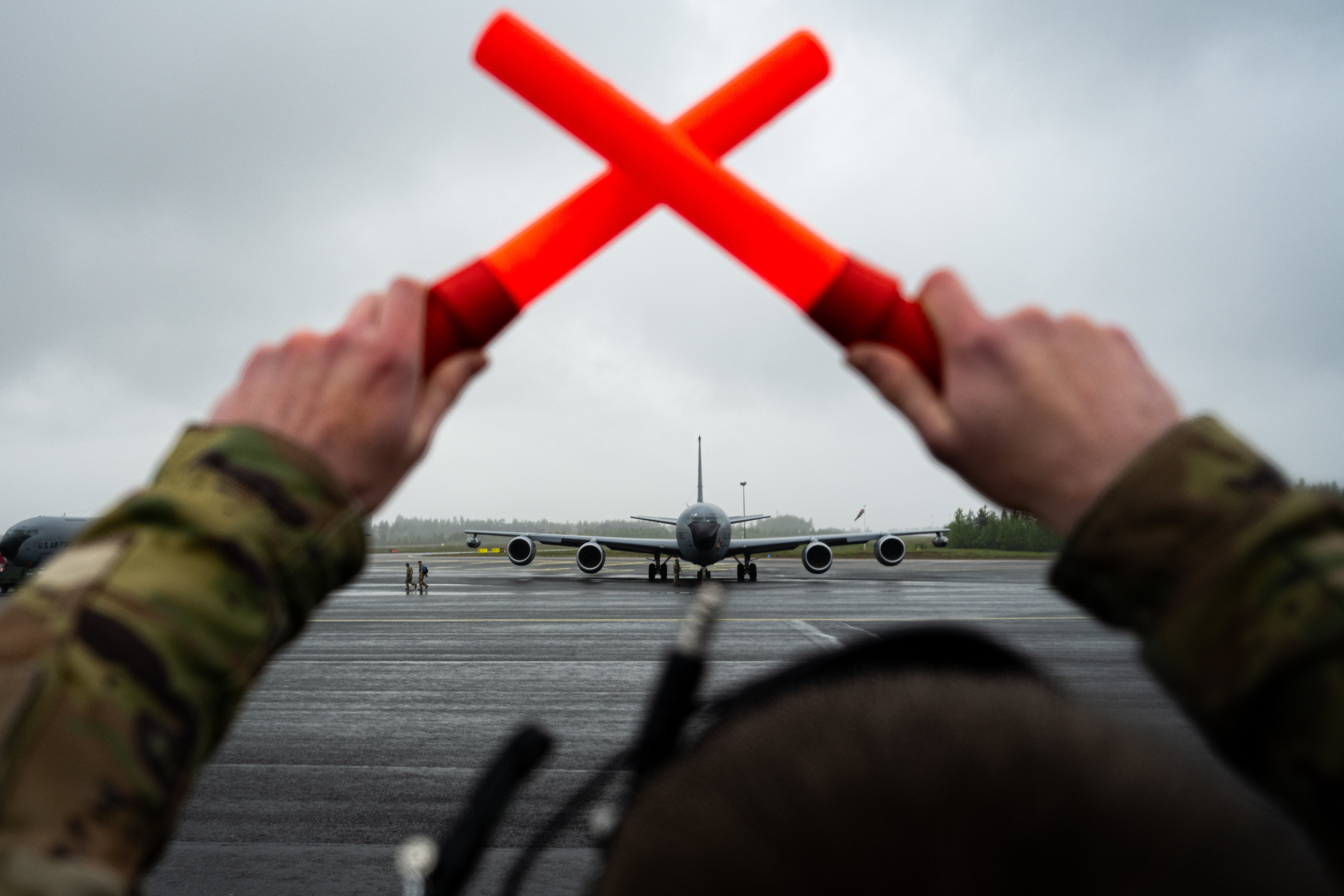 An airman prepares to marshal a KC-135 Stratotanker at Rovaniemi Air Base, Finland, June 17, 2025. Air Force photo by Senior Airman Christopher Campbell.
‘Not sustainable’
The delay left the Air Force dependent on the aging KC-135 and its dwindling supply of spare parts. The GAO found that airmen had to swap functional parts between KC-135s because there were not enough to go around, grounding some tails for months.
“Unit officials said this situation is not sustainable in the long-run and will have significant impacts on the health of the aerial refueling tanker fleet,” reads the report.
But after just seven years in service, the KC-46 is running into similar problems. The GAO said the Air Force based its demand for parts on that of the civilian 767, but military flying is much less predictable and can take a heavier toll on aircraft than civilian flying.
Another problem the GAO flagged is that Air Force maintainers can’t always access the data they need to fix the KC-46 due to restrictive technical data agreements with Boeing.
Airmen developed enough workarounds that the KC-46 is now refueling aircraft around the world, including in Operation Epic Fury. The Air Force now has 107 examples and it may buy 263 total. But that won’t be enough to fully replace about 370 KC-135s, and there is no clear plan to fill the gap.
Fail fast
Retired Gen. Mike Minihan, who led the Air Force’s tanker and airlift fleets from 2021 to 2024, told Task & Purpose the KC-46 is “the poster child for why we need to reform the acquisition process,” and the GAO seemed to agree.
In a separate report released in June, the office blamed an incentive structure where the services sprint to award billions of dollars on overly optimistic development contracts before another program scoops up the money. Often, those optimistic deadlines get delayed, costs balloon, and by the time a platform is delivered, it’s already out of date.
The GAO called for the Pentagon to adopt a model similar to something like the tech industry by making smaller bets on contracts, testing early and often, and pivoting quickly when something doesn’t work, rather than doubling down on it with more money.
Despite the GAO making this and similar recommendations over the years, so far the Pentagon has not implemented many of them.
We go deeper into the Air Force’s tanker fleet, the issues it’s facing, what’s been done to fix it — and what hasn’t — in our most recent YouTube video, which you can watch here.
The post Why the Air Force tanker fleet is falling apart appeared first on Task & Purpose.
Classification
Region
Europe
Analytical Domain
Operational
Primary Category / Secondary Categories
Weapons & Equipment / Logistics
SALUTE Report
Size
107 KC-46 tankers, 370 KC-135 tankers
Activity
The U.S. Air Force is facing significant challenges in maintaining its aerial refueling tanker fleet due to aging aircraft and development issues with the KC-46.
Location
Rovaniemi Air Base · Finland
Unit
U.S. Air Force
Time
2025
Equipment
KC-135 StratotankerKC-46 PegasusBoeing 767
Summary
The U.S. Air Force is struggling to maintain its aerial refueling tanker fleet, primarily the aging KC-135s and the problematic KC-46, which is facing development delays and spare parts shortages. This situation has led to a significant decrease in the fleet's operational capability, with airmen resorting to swapping parts between aircraft. The GAO has highlighted the unsustainable nature of this reliance on aging tankers and called for reforms in the military acquisition process.
Key Facts
- The KC-135 fleet is over 60 years old and is facing a decline in mission capability.
- The KC-46 is experiencing development issues and a shortage of spare parts.
- Airmen are swapping parts between KC-135s due to a lack of available components.
- The GAO has called for reforms in the acquisition process for military equipment.