
Will airmen trust AI? The Air Force’s future plans depend on it
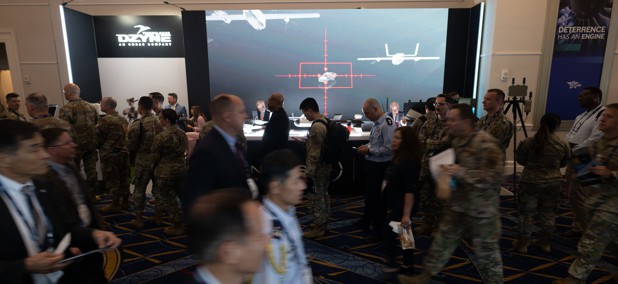
NATIONAL HARBOR, Md.—As Air Force leaders prepare to hand AI more decision-making power in the years ahead, they're also working to get airmen comfortable with that.
“A little bit scary, but we need to lean into it,” Air Force Secretary Troy Meink said at the Air and Space Association’s Air, Space & Cyber conference this week. “Autonomy is one of, if not the key technology enabling cost-effective combat power.”
Although Meink didn’t say so explicitly, “leaning in” will require new thinking on building trust between human airmen and the AI assistants, chatbots, and autonomous drones that will surround them. But other parts of the Air Force have spent a lot of time thinking about it, especially as the service works to field 500 highly-autonomous collaborative combat aircraft, or CCAs, by 2032.
“There’s a trust and autonomy question,” said Michael Gregg, director of aerospace systems at the Air Force Research Laboratory. “We have psychologists and behavioral scientists in our 711th Human Performance Wing that are actually studying this problem: How do you actually team machines with humans to make the human really really good at what they do and aid their decision-making? That is the future.”
And for some missions, like protecting air bases from drone attacks, the Air Force is exploring the possibility of not augmenting but replacing human decision-making. The waves of drones striking Ukrainian cities and ravaging U.S. bases in the Middle East have service leaders exploring the use of agents—AI tools that can take action—to work the process of obtaining approvals to launch counter-attacks.
That will require humans to define acceptable risk for allowing AI agents to make decisions.
“There is an increased push on how we use agents and agentic workflow into everything from fires to our back-office activities, and like you'll see a lot more of that coming this year,” said Ben Van Roo, the CEO of Legion Intelligence, a company that develops agentic AI agents for national-security purposes.
The question of AI directing “fires” is controversial, as the term suggests allowing a software program to launch a missile, fire a gun, or launch a deadly weapon. While there are some exceptions, military doctrine states a strong preference for meaningful human control over potentially lethal effects.
But cyber, directed energy, and other non-lethal technologies are giving the military more fires it might deploy without human oversight, said Mike Hiatt, the chief technology officer at Epirus, a company that makes microwave and other directed-energy counter-drone defenses.
“If you can have an option that has lower collateral effects and no collateral damage, you know, which is what the directed-energy weapons offer, you start to be able to change your risk calculation. You start to be able to make decisions where you say ‘OK, I'm a little more comfortable with putting this part of the system on a fully autonomous mode,” Hiatt said.
Van Roo said the decision processes to allow autonomous cyberattacks or nonlethal effects could eventually be accelerated with AI, or even automated completely.
“We're really still in the infancy right now of how we think about where we're going to use agents, what are we going to allow them to decide on? How do they work their way into our tactics, techniques, and procedures, into our doctrine?” he said.
Getting leaders and operators to be comfortable with AI agents will require new doctrine, training, and permissions, as well as a high degree of confidence that AI tools will perform in predictable ways.
“This is going to happen right now in front of us before AI and killer robots take over the world,” he said.
This year’s conference occurred amid a national debate over the dangers of AI, how it should be regulated, and who should decide.
The summer’s disclosures by Anthropic and OpenAI of surprising and dangerous model behavior were followed on Sept. 9 by the high-profile resignation of an Anthropic engineer who claimed a 10-percent probability that AI “could kill all humans.” The following day, representatives of those companies and Google intensified efforts to create an industry-safety body while signaling openness to Congressional action. But regulation is opposed by President Donald Trump, who posted this week, “The only control or ‘guardrail’ that AI needs is a STRONG AND SMART (High IQ!) PRESIDENT, and the U.S.A. has that, in spades!”
Pentagon leaders’ willingness to accept AI may stem from the fact that their current systems failed to keep key U.S. bases safe. But it may also reflect several years of Defense Department efforts to grapple with concerns about intent, alignment, and safe use that frontier AI labs are just now grappling with. Since 2019, the military has had a list of ethical principles to guide AI development, experimentation and use. It also reviews processes, experiments, and testing procedures for new technology, including software and, of course, the most dangerous weapons on Earth.
But the pace of AI advancement is quickly changing concepts of how to develop and test weapons. Ryan Tseng, president and co-founder of Shield AI, told the crowd at AFA that his company had worked with Ukrainians to improve the strike capability of one of the company’s drone weapons by 70 percent through “advanced autonomous behaviors.”
If autonomous drones are the signature feature of the war in Ukraine, many military officials expect the next conflict to be defined by rapid collaboration between agents, humans, and drones that will speed up strikes and counter-strikes. That will require continuous evolution on building trust between humans and AI entities as well.
“When we think about a future that's going to have very large-scale deployments of systems that need to interoperate with each other,” said Tseng. “It's a much larger decision space. A lot more things can happen.”
U.S. Air Force leaders are preparing to integrate AI into military decision-making, aiming to deploy 500 highly-autonomous collaborative combat aircraft by 2032. The focus is on building trust between airmen and AI systems, with discussions on the potential for AI agents to autonomously make decisions in military operations. This reflects a significant shift in military doctrine and operational strategy regarding the use of AI technologies.
- Air Force plans to field 500 highly-autonomous collaborative combat aircraft by 2032.
- AI will play a significant role in decision-making for military operations.
- There is a focus on building trust between human airmen and AI systems.
- The use of AI agents for military operations is being explored, including potential autonomous decision-making.
- The military is adapting its doctrine to incorporate AI technologies.