
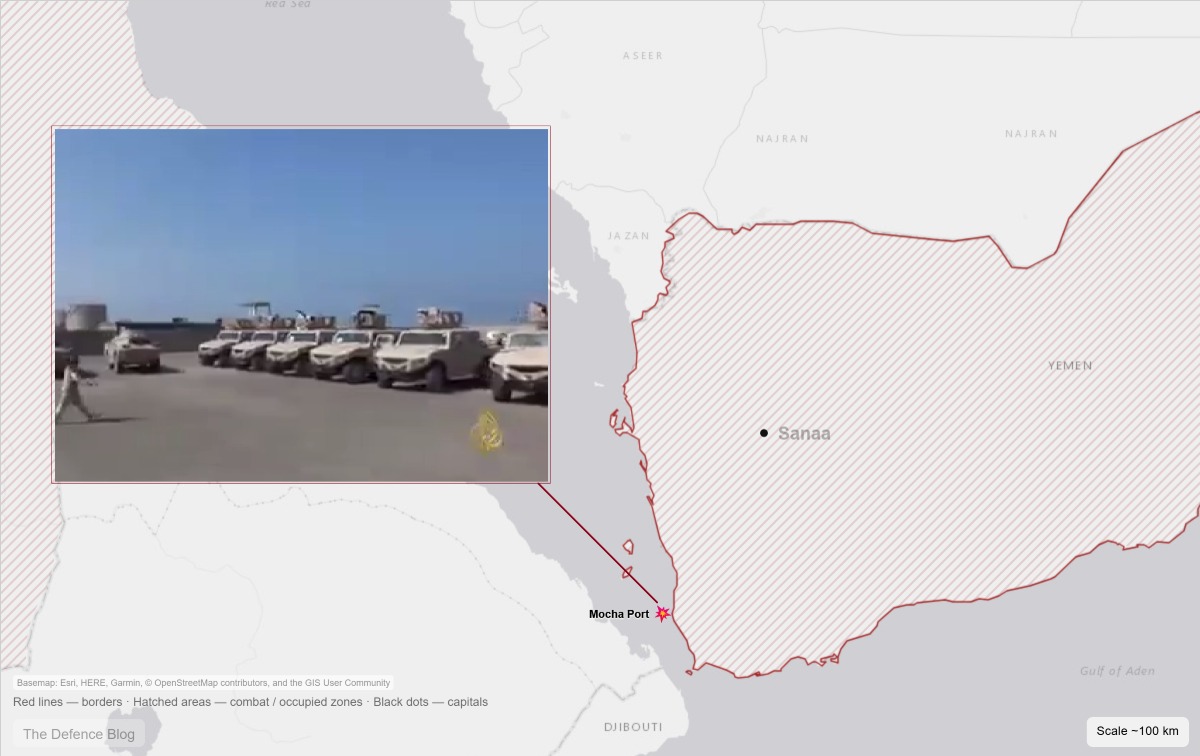
Yemen’s Houthi movement seized the Red Sea port city of Mocha on Thursday, forcing government-aligned forces to withdraw and pulling the Iran-backed group closer to full control of the Bab al-Mandeb strait.
Four Yemeni government military sources told Reuters that Houthi fighters took the city after hours of fighting, while a separate military official told Xinhua that government troops pulled back south toward Dhubab, a coastal area between Mocha and the strait.
Tareq Saleh, who commands the National Resistance Forces that had held Mocha, said he had moved his command center “to a safe location” to regroup, adding that his forces had paid a heavy price in recent days against a Houthi offensive he described as planned and backed by Iran. Yemen’s internationally recognized government had not issued its own public confirmation of the city’s loss as of Thursday evening, even as multiple anonymous military officials verified the takeover to international wire services.
Al Jazeera’s Yemen correspondent, Yousef Mawry, said Houthi forces also seized the nearby district of Hais and that government reinforcements failed to hold back what he called overwhelming military pressure from the group, also known as Ansar Allah. Government forces and their allies are now regrouping in Dhubab, directly across from Perim Island, a position Reuters’ sources described as key to controlling the strait.
Video footage from Mocha’s port aired by Al Jazeera showed dozens of armored vehicles and pickup-mounted technicals lined up near fuel storage tanks, an indication that a large amount of military hardware was left behind and fell into Houthi hands during the government withdrawal. Houthi-aligned media described the haul as an unprecedented depot of weapons and equipment, though that characterization comes from a party to the conflict and has not been independently verified.
The battle for Mocha capped roughly a week of fighting that Al Jazeera’s Yemeni affairs editor, Ahmed al-Shalafi, said began on September 3 with Houthi forces pressing from three directions at once: western Taiz, southern Hodeidah and Mocha itself. The National Resistance Forces’ withdrawal from the city’s outskirts at dawn Thursday opened the way for the final push, al-Shalafi and a second Al Jazeera correspondent reported. Witnesses told AFP that Houthi fighters marched into the area chanting slogans against the United States and Israel.
The fighting has displaced tens of thousands of people, with women and children fleeing toward the government-held provinces of Lahij and Aden and other residents moving south toward Dhubab, according to Al Jazeera and The New Arab. Al Jazeera reported that more than 20,000 people had been displaced across Taiz and al-Hodeidah provinces over the two weeks of clashes.
Bab al-Mandeb narrows to roughly 20 km (12 miles) at its tightest point, far narrower than the Strait of Hormuz’s roughly 50 km (30 miles), defense analyst Wolfgang Pusztai told Al Jazeera. Pusztai called the fall of Mocha “a very significant blow against the government” and said the strait’s width means the Houthis could threaten shipping there with artillery alone, without relying on the missiles and drones they have used elsewhere in the Red Sea.
Until this week, the Houthis controlled large parts of northern Yemen, including the capital Sanaa and the Red Sea port of Hodeidah, but held no territory directly overlooking Bab al-Mandeb. A Yemeni military source told AFP that Houthi forces were also advancing on the Red Sea islands of Hanish and had seized Zuqar Island using rocket fire and a boat-borne assault. Roughly 10 to 12 percent of global trade passes through Bab al-Mandeb, Mawry said.
Saudi Arabia formed a multinational maritime defense coalition in late July to protect Red Sea shipping after the Houthis imposed a blockade on Saudi commercial vessels and oil tankers transiting the strait. The Houthi-run Saba news agency said Saudi warplanes carried out about 40 airstrikes across Taiz, Hodeidah, al-Jawf and Marib provinces in the hours after Mocha fell; Saudi Arabia had not commented on the report as of Thursday evening.
The renewed fighting marks one of the sharpest escalations in Yemen’s civil war since a United Nations-brokered truce in 2022 largely halted major hostilities between the Houthis and the Saudi-backed government, a conflict that began when the Houthis seized Sanaa in 2014. It is unfolding alongside the wider Middle East war that began with U.S. and Israeli strikes on Iran in late February 2026, opening what several outlets described as a second front tied to that broader conflict.
Content preview only. Full article available at source. View Full Article
Houthi forces captured the Red Sea port city of Mocha on Thursday, forcing government-aligned troops to withdraw to Dhubab. The capture followed intense fighting and marked a significant advance for the Iran-backed group, which also seized the nearby district of Hais. The battle has displaced tens of thousands of people, with many fleeing toward government-held areas.
- Houthi forces captured Mocha and Hais after intense fighting.
- Government forces retreated to Dhubab, regrouping after heavy losses.
- Houthi forces seized a large amount of military hardware during the withdrawal.
- The battle for Mocha began on September 3, involving multiple fronts.
- Over 20,000 people have been displaced due to the fighting.