
Analysis & Reports
AI-assisted analysis of military-related information from public sources

US military bought commercial satellite images of alleged narco airstrips, Chinese naval fleet
The U.S. military purchased satellite images to identify Chinese aircraft carrier positions and Ecuadorian airstrips used for drug trafficking. The National Reconnaissance Office acquired commercial imagery to monitor naval assets and assist Ecuador in addressing narcotrafficking. Despite spending nearly $77 million on commercial space services, the Space Force faces challenges in fully utilizing these resources due to communication issues and perceived restrictions.
Navy renews Saildrone’s counter-drug mission in the Caribbean, Eastern Pacific
Saildrone continues its counter-drug operations in the Caribbean and Eastern Pacific under a new $16.3 million task order from the U.S. Navy, extending operations with 20 Voyager unmanned surface vessels until 2027. These USVs have been instrumental in detecting and monitoring narco-traffickers, including a significant cocaine seizure in October 2025. The initiative aligns with the Navy's strategy to enhance maritime security and adapt to dynamic threats.

China-linked spy site in Cuba is now fully operational
A signals intelligence facility in Bejucal, Cuba, has completed construction of a circularly disposed antenna array capable of intercepting U.S. military communications. The facility is linked to Chinese intelligence operations, although direct evidence of involvement is not confirmed. The array's strategic location allows monitoring of U.S. naval and air activities in the region, potentially impacting U.S.-Cuba diplomatic relations.
‘The threat is there’: Germany to pair P-8s with MQ-9 drones to keep an eye on Russian subs
Germany is deploying P-8A Poseidon aircraft and MQ-9B Sea Guardian drones to monitor Russian submarines in the North Atlantic. The first P-8A was sent to Scotland in April 2024 for joint patrols with the UK. Germany has ordered eight P-8As and eight MQ-9Bs, with the latter expected to enhance ISR capabilities by 2030.
Coast Guard, Saildrone team up in northern waters to boost border security, surveillance
The U.S. Coast Guard deployed 16 Saildrone Voyager unmanned surface vessels to the Great Lakes and North Atlantic in May 2023 to enhance maritime domain awareness and support border security operations. This initiative, stemming from a $15.5 million contract, aims to monitor suspicious activities and counter illegal fishing, with operations expected to continue through October 2023.

Yuyuantan Tian: Chinese Maritime Patrols in the Southeastern Waters of Taiwan Island, Two Suspected Japanese Aircraft Discovered
On June 8, the Chinese Maritime Law Enforcement fleet conducted patrols in the southeastern waters of Taiwan and discovered two suspected Japanese fixed-wing aircraft.
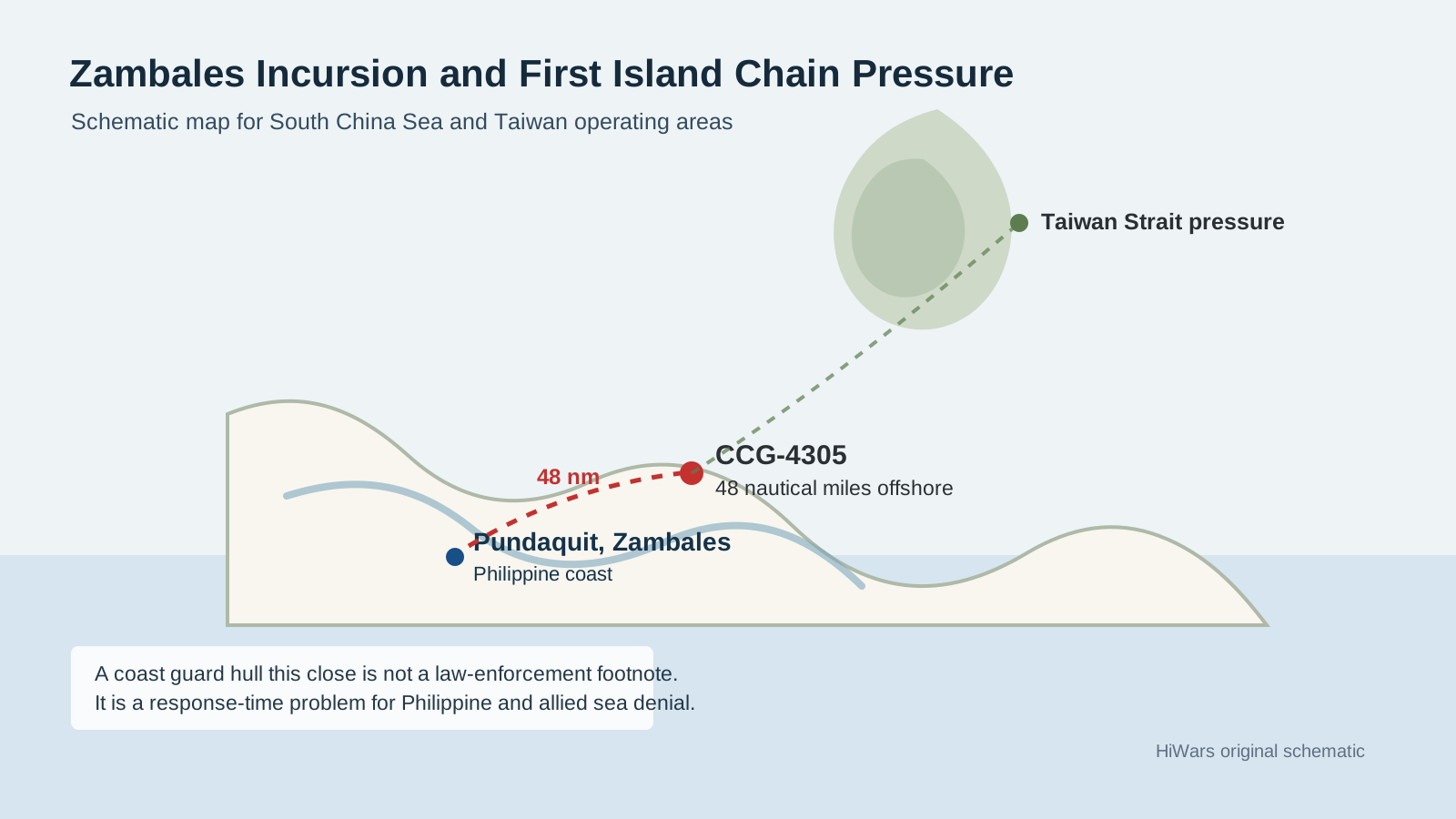
China’s 2026 CCG-4305 Patrol 48 Nautical Miles Off Zambales Tests Philippine Sea Denial
Chinese Coast Guard vessel CCG-4305 patrolled 48 nautical miles off Zambales on May 19, 2026, prompting a response from the Philippine Coast Guard. The incident is part of a broader pattern of Chinese maritime activity, including the presence of multiple vessels in Philippine waters. This situation raises concerns about sovereignty and the normalization of Chinese incursions into contested areas.
 Marcus ChenMon May 25 2026Loading...
US Navy uses MQ-4C drone for 12 hour surveillance mission near Cuba
A U.S. Navy MQ-4C Triton drone conducted a 12-hour reconnaissance flight off the coast of Cuba, focusing on Havana and Guantanamo Bay. The drone maintained an altitude of 49,000 feet and a ground speed of 290 knots, indicating sustained monitoring of the area. This mission aligns with U.S. military planning related to Cuba, providing critical surveillance data.

The SR-71 Blackbird Almost Flew Through Volcanic Ash. The Mach 3 Aircraft Would Have Been Destroyed
In 1980, an SR-71 Blackbird pilot avoided flying through a volcanic ash cloud while on a reconnaissance mission over Cuba. The ash cloud, resulting from three volcanic eruptions, posed a significant risk to the aircraft. The mission was part of U.S. efforts to monitor Soviet military activity in Cuba during a period of heightened tensions.
UK accuses Russia of covert submarine operation threatening undersea cables
The UK uncovered a covert Russian submarine operation in British waters involving an Akula-class submarine and two GUGI submarines, which lasted over a month and posed a threat to undersea cables. The Royal Navy and allies tracked the vessels using P-8 Poseidon aircraft and frigates, with no reported damage to infrastructure. UK officials warned of serious consequences for any attempts to sabotage subsea infrastructure.

Theseus tests GPS-denied navigation system over 550 km flight
Theseus successfully completed a 5-hour, 22-minute test flight of its Micro Visual Positioning System over central Florida in March, covering 564 kilometers. The system demonstrated a median horizontal position error of 51.95 meters and operated without mid-flight reinitializations. This test highlights advancements in GPS-denied navigation for drones, addressing vulnerabilities in current military operations.

British firm reveals ESA radars for Latin America expansion
Blighter is expanding its presence in the Latin American defense market by showcasing its ESA radar systems at FIDAE 2026 in Santiago, Chile, from April 7 to 11. The company aims to enhance military and security capabilities with its advanced radar technology, which is already deployed in over 40 countries. Blighter's systems are designed for persistent monitoring and counter-drone operations, utilizing low-power micro-Doppler technology.

What the Claude AI chatbot really does for CENTCOM
AI tools, including the Claude chatbot, are utilized by U.S. Central Command in military operations against Iran, particularly for intelligence gathering, target selection, and damage assessment. A recent Tomahawk missile strike resulted in civilian casualties, highlighting the risks associated with rapid target acquisition. The Maven Smart System, which integrates various AI capabilities, is central to this process, enabling faster decision-making in military operations.

The SR-71 Blackbird Was Shot At 4,000 Times. It Was Never Hit Once
The SR-71 Blackbird operated from January 1966 until its retirement in 1998, successfully conducting high-speed reconnaissance missions. It was designed to evade enemy missiles, achieving this feat by outrunning threats, as it was shot at 4,000 times without being hit. The aircraft's advanced design and capabilities made it a critical asset for the U.S. Air Force during the Cold War, gathering intelligence on various geopolitical hotspots.

U.S. Marines operate Vector drone during Puerto Rico operations
U.S. Marines employed the Vector unmanned aerial system during UAS operations at Camp Santiago, Puerto Rico, to support U.S. Southern Command missions. The Vector drone enhances real-time situational awareness and is capable of delivering high-resolution imagery for reconnaissance. This system allows for rapid deployment in confined areas and is designed to adapt to various mission requirements.
China Is Trying to Use Fancy Quantum Sensors To Unstealth U.S. Navy Nuclear Submarines
China has developed advanced quantum sensors and a Kelvin wake detection system to track U.S. nuclear submarines in the South China Sea. These technologies aim to enhance China's anti-submarine warfare capabilities, posing a potential challenge to U.S. naval stealth. The U.S. Navy continues to express confidence in its submarine fleet's effectiveness.
New York to London in 114 Minutes Flat: The SR-71 Blackbird Hit Mach 3.3 And Wiped Out All the Record Books
The SR-71 Blackbird, developed by Lockheed Martin's Skunk Works, conducted reconnaissance missions from the late 1960s until its retirement in 1999. It achieved remarkable speeds of 2,193 mph and altitudes of 85,069 feet, outpacing threats during its operational period. The aircraft was retired due to high costs and the advent of satellite technology, marking the end of an era in military aviation.

Mach 3.3 Record Breaker: The SR-71 Blackbird Was So Fast It Could Literally Outpace the Sun
The SR-71 Blackbird conducted reconnaissance missions from bases like Kadena Air Base during the late 1960s, observing activities in North Vietnam and Laos. It set numerous speed and altitude records, including a Mach 3.3 flight and an altitude of 85,068.997 feet. The program was terminated in 1989 due to rising costs and advancements in satellite technology, although NASA continued to operate the aircraft for research until 1999.
The first Airbus Pléiades Neo Next satellite will be launched early 2028
Airbus will launch its first Pléiades Neo Next satellite early 2028 from the European Spaceport in Kourou, French Guiana, using an Avio’s Vega C rocket. This satellite will enhance Earth observation capabilities with a native resolution of 20 cm, supporting sectors such as defense and intelligence. The program aims to improve the quality and reliability of geospatial technologies.

CIA-affiliated plane spotted at Caracas airport
A CIA-affiliated plane was spotted at Caracas airport, indicating potential intelligence, surveillance, and reconnaissance operations. The presence of the aircraft suggests ongoing activities related to U.S. intelligence operations in the region.


