
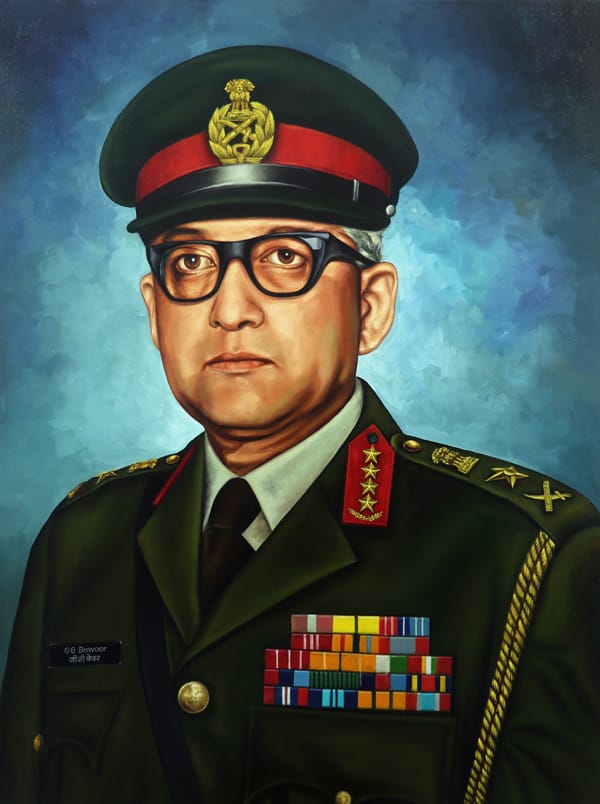
G.G. Bewoor
G.G. Bewoor was an Indian Army general whose long career connected the Second World War, post-partition military reorganization, and the command environment shaped by India's wars with Pakistan. His career illustrates how senior commanders inherit victory, institutionalize wartime lessons, and turn battlefield success into durable military posture. It offers insight into command not only at the moment of combat but in the strategic consolidation that follows it.
- Conflicts
- Indo-Pakistani War of 1971
- Tags
- Needs Review
Bewoor matters because his career spans the transition from colonial-era soldiering to leadership in an independent national army.
Bewoor represents a generation of officers who bridged multiple military eras. His service linked wartime experience under empire, the partition of the subcontinent, and the later consolidation of Indian command institutions.
His career arc holds more than biographical interest, reflecting the transformation of military institutions across eras.
His significance lies in how Indian commanders translated the 1971 war's success into institutional continuity and regional posture.
Bewoor is important because the 1971 war was not only a battlefield triumph for India. It also reset the strategic balance in South Asia and created the problem of how military leadership would carry that success forward.
Command after victory is still a form of strategic labor.
Bewoor helps explain that institutional follow-through after war can matter as much as the campaign itself.
The analytical value of Bewoor's page lies in continuity. Armies that win major wars still have to absorb lessons, stabilize doctrine, and convert prestige into credible readiness.
His career is useful because it opens that usually quieter but still consequential phase of military history.
He remains relevant because he illustrates how command authority is shaped by the task of maintaining and interpreting victory.
Bewoor's biography enables comparison of officers distinguished less by a single dramatic battlefield moment than by steering institutions through the aftermath of major war. His career broadens the understanding of military leadership by highlighting its organizational dimensions alongside operational ones.
Such comparative analysis provides valuable analytical depth.
Bewoor should be framed through command continuity and postwar military adaptation rather than through rank chronology alone.
Bewoor’s significance extends beyond a chronological list of ranks. His career demonstrates how military institutions process strategic success, maintain institutional credibility, and convert wartime achievements into lasting strategic posture.
Analyzing his tenure through the lens of command continuity and postwar adaptation provides deeper insight into this process.
No analysis & reports about G.G. Bewoor
No discussions about G.G. Bewoor yet
Start the first discussion