
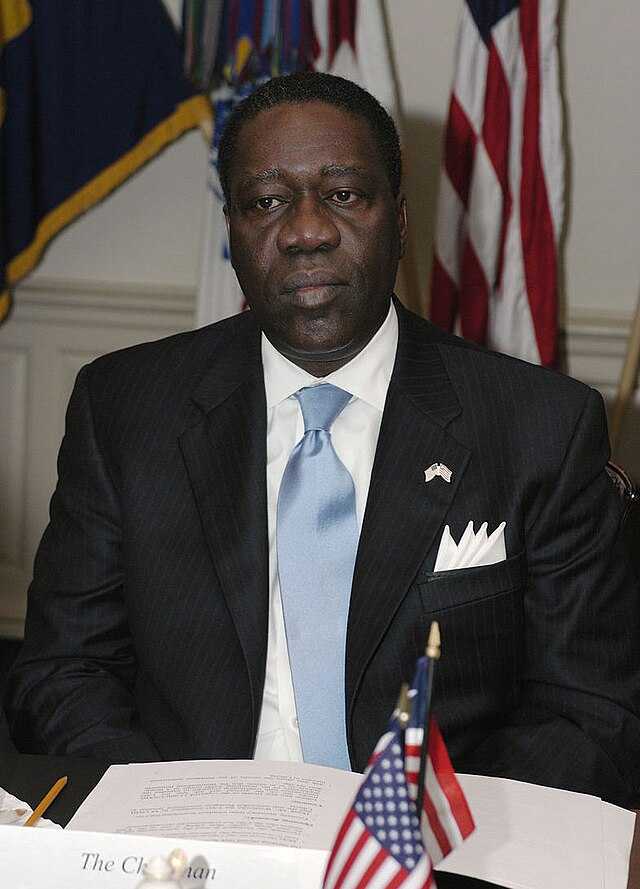
Gyude Bryant
Gyude Bryant was the head of Liberia's National Transitional Government after Charles Taylor's departure in 2003. His role illustrates how states emerge from civil war through interim authority, outside security guarantees, and efforts to convert battlefield exhaustion into political order. As a transitional leader, he represented a different kind of conflict figure: not a rebel commander or warlord, but a leader tasked with stabilizing a shattered country while armed groups still retained influence.
- Conflicts
- Second Liberian Civil War
- Tags
- Needs Review
Bryant's significance lies in leading an interim state during the fragile passage from war toward institutional recovery.
Bryant matters because he occupied a role that military histories often neglect: the postwar caretaker who must govern while violence has formally receded but coercive power has not fully disappeared. In Liberia, this meant presiding over a transitional order backed by international peacekeepers and burdened by the wreckage of civil war.
His role is important because he led during the stage when war ends on paper but security order still has to be assembled in practice.
After years of devastating conflict, Liberia required more than a ceasefire. It needed a functioning interim authority capable of holding the political center while disarmament, elections, and external stabilization advanced. Bryant's government belonged to that difficult phase of conflict termination.
Bryant's role was part of the architecture of peace implementation, not merely that of a stopgap politician.
Bryant's tenure highlights how transitional leaders often depend on outside force while attempting to rebuild domestic legitimacy.
Bryant's period in office highlights a core post-conflict problem: a transitional government must exercise authority before fully sovereign institutions have been rebuilt. In Liberia, this process unfolded with heavy UN involvement, lingering factional influence, and widespread demands for reconstruction and accountability.
Bryant's rule reflects the broader challenges of war termination, as his administration grappled with the interplay of external intervention and internal factionalism.
He remains important because durable peace often depends on transitional governance as much as on battlefield outcomes.
Bryant's legacy is not one of dramatic battlefield command, but of political bridging. His importance lies in helping Liberia move from warlord-centered violence toward an electoral and reconstruction process that could carry the country forward.
Bryant's case illustrates that conflict history includes the difficult management of aftermath, not only combat itself.
Bryant should be judged in the context of postwar constraints and corruption-prone reconstruction rather than through transitional office alone.
Bryant's leadership cannot be accurately assessed by either idealizing him as a peacemaker or focusing solely on later corruption allegations.
He must be situated within the structural difficulty of leading a transitional government in a traumatized, militarized society.
No analysis & reports about Gyude Bryant
No discussions about Gyude Bryant yet
Start the first discussion