
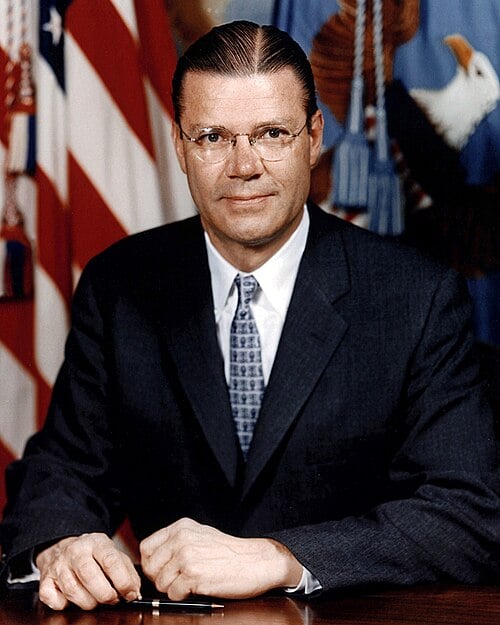
Robert McNamara
Robert McNamara was U.S. secretary of defense under John F. Kennedy and Lyndon B. Johnson and one of the most influential civilian managers of the Vietnam War. His work involved Pentagon modernization, systems analysis, nuclear strategy, Vietnam escalation, body-count metrics, bureaucratic decision-making, and later public reflection on strategic failure. He demonstrated both the power and the danger of technocratic control in war. His career linked institutional reform, crisis decision-making, and the limits of quantitative control.
- Nationality
- USA
- Born:
- June 9, 1916
- Died:
- July 6, 2009
- Conflicts
- Vietnam WarBay of Pigs InvasionKorean DMZ Conflict
- Tags
- Needs Review
McNamara brought corporate management and systems analysis into the Pentagon during a period of nuclear danger and limited-war escalation.
Robert McNamara came to the Pentagon from business management and became secretary of defense in 1961. He tried to impose analytical discipline, cost control, and centralized civilian management on a vast military bureaucracy.
His methods were influential because they promised rational control over complex defense choices. They also created blind spots when measurable indicators were mistaken for strategic understanding.
McNamara played a central role in the U.S. escalation of Vietnam under Kennedy and Johnson.
McNamara became one of the most important civilian advocates and managers of U.S. military escalation in Vietnam. He was deeply involved in assessments, troop recommendations, bombing policy, and the logic of demonstrating American resolve.
The Gulf of Tonkin episode and later escalation decisions turned Vietnam into a major U.S. combat commitment. McNamara's role illustrates how bureaucracy, intelligence, metrics, and presidential pressure can reinforce one another.
His later doubts make the record especially important for understanding how officials reassess war after the fact.
McNamara's management style emphasized measurement, but Vietnam exposed the limits of quantitative control over political war.
McNamara's Pentagon relied heavily on systems analysis, planning-programming-budgeting, and quantitative indicators. In many procurement and planning areas, this changed how defense decisions were made.
In Vietnam, however, metrics such as body counts, sortie rates, and enemy losses could not solve the political problem of legitimacy and control. The war exposed a gap between managerial confidence and strategic reality.
A high-value profile should explain why McNamara became a symbol of both modern defense management and technocratic failure.
McNamara's later admissions and reflections made him central to debates about accountability for Vietnam.
After leaving the Pentagon, McNamara served as president of the World Bank and later became publicly associated with reflection on the mistakes of Vietnam. His later writings and interviews made him a focal point for debates over regret, responsibility, and learning from failed wars.
For military history, McNamara is important because his career links decision-making at the highest level to later attempts at explanation. He did not merely witness escalation; he helped manage it.
That makes his biography analytically valuable rather than only biographical.
McNamara changed how the Pentagon thought about planning, budgeting, and civilian control.
McNamara's tenure mattered beyond Vietnam because it helped normalize a more analytical, centralized style of defense management. Planning-programming-budgeting systems, cost discipline, and tighter civilian oversight all became part of the Pentagon's institutional language.
That influence makes him relevant even where his policies were later criticized.
McNamara was also central to the U.S. debate over nuclear forces, strategy, and deterrence stability.
McNamara's defense tenure coincided with major debates over nuclear strategy, force posture, and the logic of deterrence. His influence there matters because it shaped how civilian leaders and military planners thought about escalation and credibility.
His importance extended beyond the Vietnam War.
McNamara's approach connected strategic theory, bureaucratic control, and the real-world pressure of crisis management.
McNamara sat between the White House and the Pentagon, helping turn presidential preference into executable war policy.
McNamara's significance also lies in his position inside civilian control. He translated presidential direction into planning, budget choices, and war management, which gave him unusual influence over how policy became action.
That role is analytically important because it shows the limits of technocratic power. A secretary of defense can organize decisions, but he cannot guarantee that metrics, briefings, and management systems will capture the political reality of war.
McNamara analysis should separate his management innovations from the strategic and moral failures associated with Vietnam.
McNamara's record is unusually sensitive because many sources are shaped by hindsight. Contemporary documents show confidence and escalation logic; later reflections emphasize error and tragedy.
McNamara should not be reduced to a villain or a repentant technocrat. The key issue is how a talented manager helped build a system that could measure activity but struggled to understand political war.
No discussions about Robert McNamara yet
Start the first discussion