AH-64 Apache

🇺🇸United States
Hughes Aircraft, McDonnell Douglas, Boeing
1984 – Present
Spotlight

Forty years on, the Longbow-equipped Apache is being rebuilt for the drone era.

2026 British Army Air Corps Display: AH-64E Apache (Boeing)

Watch on YouTube
Overview
AH-64 Apache - Image 1
AH-64 Apache - Image 2
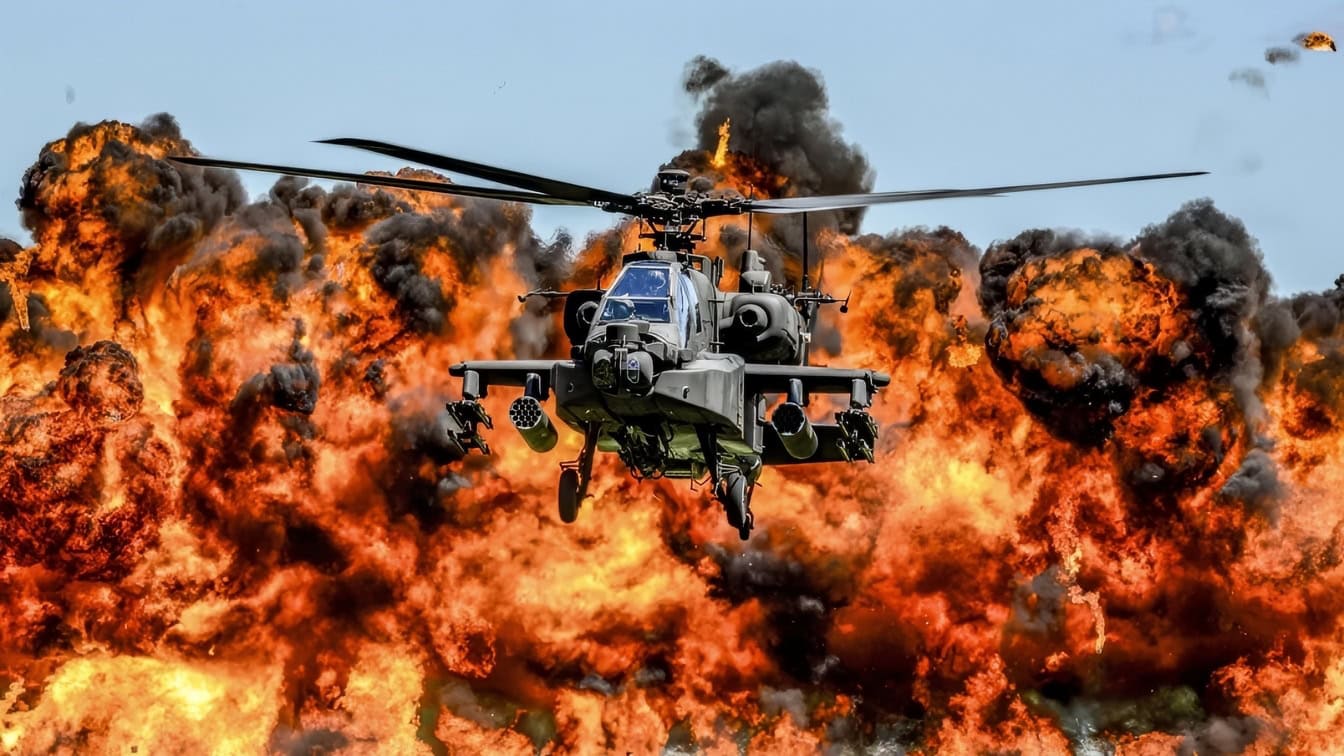
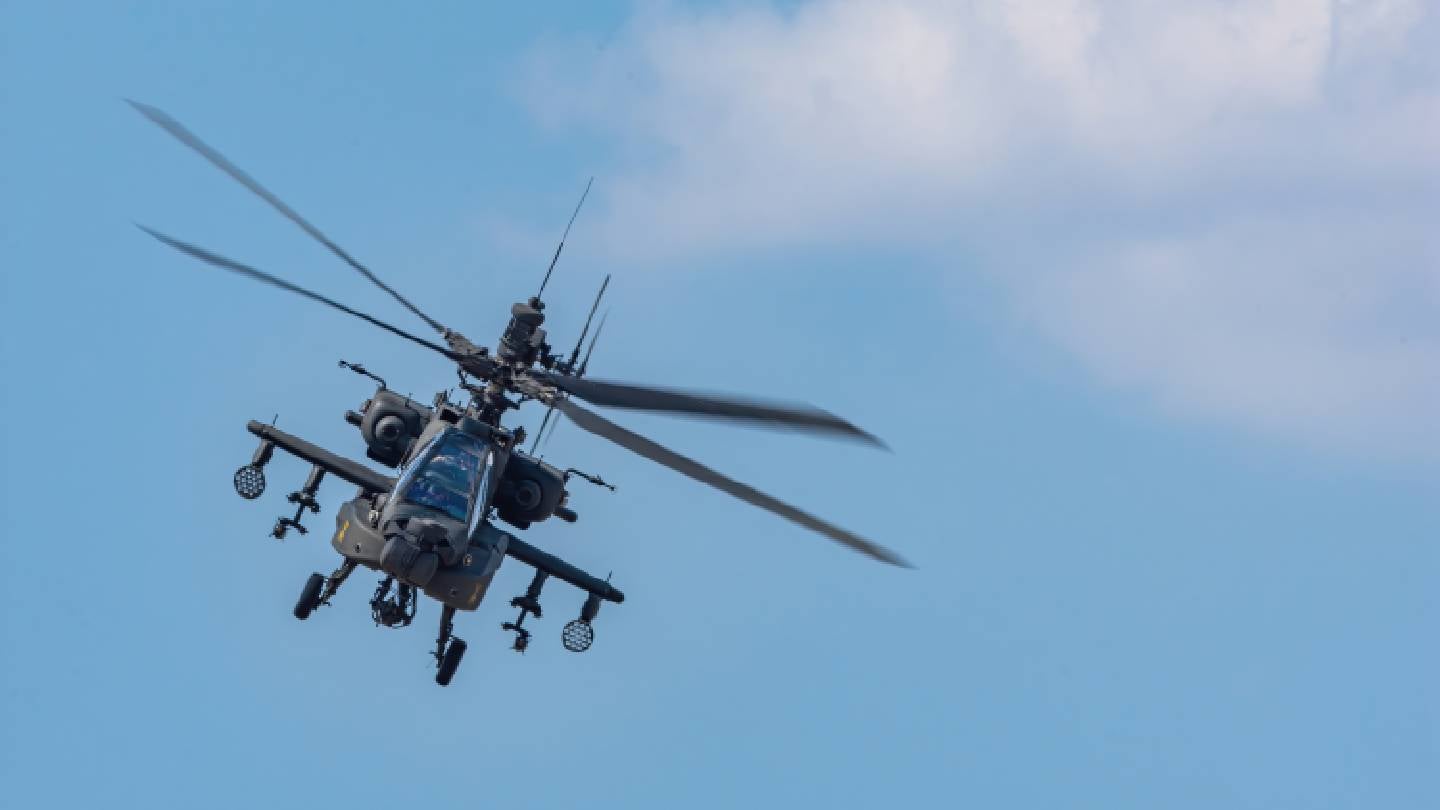
The AH-64 Apache is a four-blade, twin-engine attack helicopter developed for the United States Army to replace the AH-1 Cobra.
Specifications

General

Crew2
Engines2
Range Km476 km
Weight Max Kg10,433 kg
Cruise Speed Kmh233 km/h
Service Ceiling M6,096 (20,000 ft, Boeing figure)
Main Rotor Diameter M14.63 m

Other

RadarAN/APG-78 Longbow mast-mounted fire-control radar with AN/APR-48B radar frequency interferometer (Longbow-equipped aircraft)
ArmamentM230 30 mm chain gun (1,200 rounds, 600–650 rds/min); up to 16 AGM-114 Hellfire / AGM-179 JAGM or 76 × 70 mm rockets
Height M4.7 (Boeing figure)
Length M14.7 (fuselage, Boeing figure)
Powerplant2 × General Electric T700-GE-701D turboshafts, ~1,994 shp (1,487 kW) each on AH-64E
Max Level Speed Kmh279+ (150+ kt, Boeing figure)
Rate Of Climb M Min853+ (2,800+ ft/min, Boeing figure)
Latest Developments
Sep 10, 2026strong signal
U.S. Army awards NG $4.8B for helicopter missile defense

Entity 'AH-64 Apache' mentioned in report

Sep 8, 2026strong signal
U.S. and Indonesia test rocket systems in joint drill

Entity 'AH-64 Apache attack helicopters' mentioned in report

Aug 28, 2026strong signal
China’s Military Was Stunned by Desert Storm. It Has Spent 35 Years Learning to Do It.

Entity 'AH-64 Apache' mentioned in report

Aug 18, 2026strong signal
Body cam footage shows Marine after ejecting from F-18: ‘Hey buddy, I just crashed’

an AH-64 Apache helicopter crash in Texas last week that killed two soldiers.

Featured Coverage
Research Notes

Attack helicopter family built for armed reconnaissance and anti-armor warfare

high

The Apache became the U.S. Army's primary attack helicopter family and evolved from AH-64A through Longbow and AH-64E variants.

The AH-64 Apache is the central attack helicopter family of the U.S. Army and many partner forces. Boeing describes the Apache as progressing from the AH-64A in 1984 to the AH-64E, while the U.S. Army notes that earlier AH-64A aircraft were remanufactured into AH-64D Longbow models.

The aircraft's original logic was heavily tied to anti-armor warfare, armed reconnaissance, and close cooperation with ground forces. Over time, its mission set expanded through better sensors, digital connectivity, precision weapons, and unmanned-aircraft teaming.

For HiWars, the Apache parent page should explain the family rather than only one model. AH-64A, AH-64D Longbow, AH-64E, and national variants differ in sensors, datalinks, weapons integration, engines, and modernization status.

Sensors, precision weapons, and networked attack

high

Apache capability comes from combining crew coordination, targeting sensors, Hellfire-class missiles, rockets, cannon, and networked awareness.

The Apache is a two-crew attack helicopter designed around target detection, precision engagement, and survivability in demanding low-altitude environments. Boeing emphasizes integrated sensors, networking, real-time data sharing, and unmanned aircraft control in the AH-64E.

Its weapons fit commonly includes a 30 mm chain gun, rockets, and anti-armor missiles, but the larger capability is the sensor-to-shooter loop. The aircraft can find, classify, prioritize, and engage targets while coordinating with ground units and other aircraft.

This makes the Apache more than a flying weapons rack. It is a battlefield information and attack node whose effectiveness depends on training, terrain, air defense threat, weather, electronic warfare, and integration with ground maneuver.

AH-64E, launched effects, and future survivability

high

Apache modernization focuses on keeping a proven helicopter relevant in a battlefield shaped by drones, networks, and stronger air defenses.

Boeing states that AH-64E production continues and that future Apache evolution uses an open systems approach to integrate new capabilities, including launched effects and autonomous teaming. That is a response to a battlefield where helicopters face more sensors, missiles, drones, and electronic warfare.

The Apache's future value depends on whether it can extend reach, share information, and reduce exposure while still delivering precision attack. Modernization is therefore not only about engines or weapons, but about networking, autonomy, software, survivability, and sustainment.

HiWars should connect Apache records to operator variants, modernization versions, combat use, losses, and doctrine. An AH-64E Version 6.5 and an older AH-64A-era configuration belong to the same family but should not be treated as equivalent.

Key parameters at a glance

high

Figures are Boeing/US Army published values unless marked otherwise.

Role
Twin-engine, two-seat armed reconnaissance and attack helicopter
Current variant
AH-64E Apache Guardian, Version 6 software; Version 6.5 in test
Manufacturer
Boeing (Mesa, Arizona); originally Hughes, then McDonnell Douglas
Total built
2,875+aircraft, all models
AH-64E delivered
891+as of Nov 2025
Primary sensors
AN/APG-78 Longbow FCR, AN/APR-48B RFI, M-TADS/PNVS 'Arrowhead'
Gun
M230 30 mm chain gun1,200 rounds
Primary missiles
AGM-114 Hellfire family; AGM-179 JAGM; Spike NLOS on selected US units
Crewed-uncrewed teaming
MUM-T Level 4 — control of UAS sensor and flight path from the cockpit
Export customers
15 nations besides the US Army, incl. UK, Netherlands, Israel, Japan, India, Egypt, Saudi Arabia, South Korea, Australia

Program milestones

high

Publicly reported milestones from prototype to the current counter-drone role.

1975-09YAH-64 prototype first flight

Hughes flew the YAH-64 for the US Army's Advanced Attack Helicopter competition; it was selected over Bell's YAH-63 in December 1976.

1984-01AH-64A enters production

First production Apache delivered; the type replaced the AH-1 Cobra as the Army's heavy anti-armour helicopter, initially armed with laser-guided Hellfire and the M230 gun.

1991-01Desert Storm opening strike

Task Force Normandy Apaches destroyed Iraqi early-warning radar sites in the opening minutes of the air campaign, opening a corridor for coalition strike aircraft.

1997-03AH-64D Longbow delivered

The mast-mounted AN/APG-78 millimetre-wave fire-control radar and RF Hellfire gave the Apache fire-and-forget engagement of multiple targets with minimal exposure.

2003-03Karbala deep attack

A regimental deep-strike mission in Iraq met massed small-arms and AAA fire; nearly all aircraft were damaged and one was lost, prompting US Army revision of deep-attack doctrine.

2011-11First AH-64E delivered

The Guardian (formerly Block III) introduced T700-GE-701D engines, composite rotor blades, improved drive train, open systems architecture and Level 4 manned-unmanned teaming.

2024Version 6.5 flight testing (reported)

Boeing began testing the AH-64E V6.5 configuration, aimed at a common fleet-wide software baseline and at hosting launched effects, improved networking and future sensors.

2025-11Counter-UAS trials

In Operation Flyswatter at MCAS New River, AH-64Es scored 13 kills in 14 engagements against drones using APKWS guided rockets and 30 mm gunfire, cued by the Longbow radar.

Strategic significance

high

The Apache's enduring value rests less on the airframe than on the sensor-and-network package bolted to it. The AH-64D's mast-mounted Longbow radar allowed a hovering helicopter to classify and prioritise dozens of vehicles from behind terrain masking, and the AH-64E extended that logic into the network: open systems architecture, Link 16 and Level 4 manned-unmanned teaming let a crew task a drone's sensor and flight path from the cockpit. That combination is why the type has been bought by roughly fifteen countries besides the US Army — the UK, Netherlands, Israel, Japan, India, Egypt, Saudi Arabia, South Korea and most recently Australia — and why Boeing reports more than 891 E-models delivered as of late 2025.

Combat experience has been more ambiguous than the export record suggests. Task Force Normandy's opening strike in 1991 validated the deep-attack concept, but the March 2003 Karbala mission showed how quickly massed small-arms and light AAA fire can defeat a regiment-sized low-altitude penetration, and the US Army subsequently pushed the Apache back towards armed reconnaissance and close support in company-sized packets. Two decades over Iraq and Afghanistan then optimised the fleet for permissive-air, precision-fires work, a posture that Ukraine has called into question: dense man-portable air defences and loitering munitions make the low-altitude attack-helicopter profile expensive.

Boeing's answer, and the US Army's, is to treat the Apache as a launch and control platform rather than a shooter that must close the range. Version 6.5 pursues a single fleet-wide software baseline and the ability to host launched effects; longer-term concepts move the radar off the mast to conformal arrays, add the T901 engine if it is funded, and target a modernised aircraft around 2032-2035 with service into the 2060s. The near-term evidence is the counter-drone mission, where Longbow cueing plus cheap APKWS rockets and proximity-fuzed 30 mm ammunition has proved effective in trials. Whether that is a genuine second act or a bridge to an uncrewed successor remains the open question — the Army has already cancelled its FARA scout programme, leaving the Apache with no designated replacement.

Videos

British Army's AH-64E Apache: Can it survive the drone age? (BFBS Forces News)

Watch on YouTube

First AH-64E Apaches arrive in Australia (Defence Australia)

Watch on YouTube

After 40 years in service, is the Apache still the strongest attack helicopter? AH-64 explained (Chris Military Base)

Watch on Bilibili
Sources & References
Related Discussions

No discussions about AH-64 Apache yet

Start the first discussion