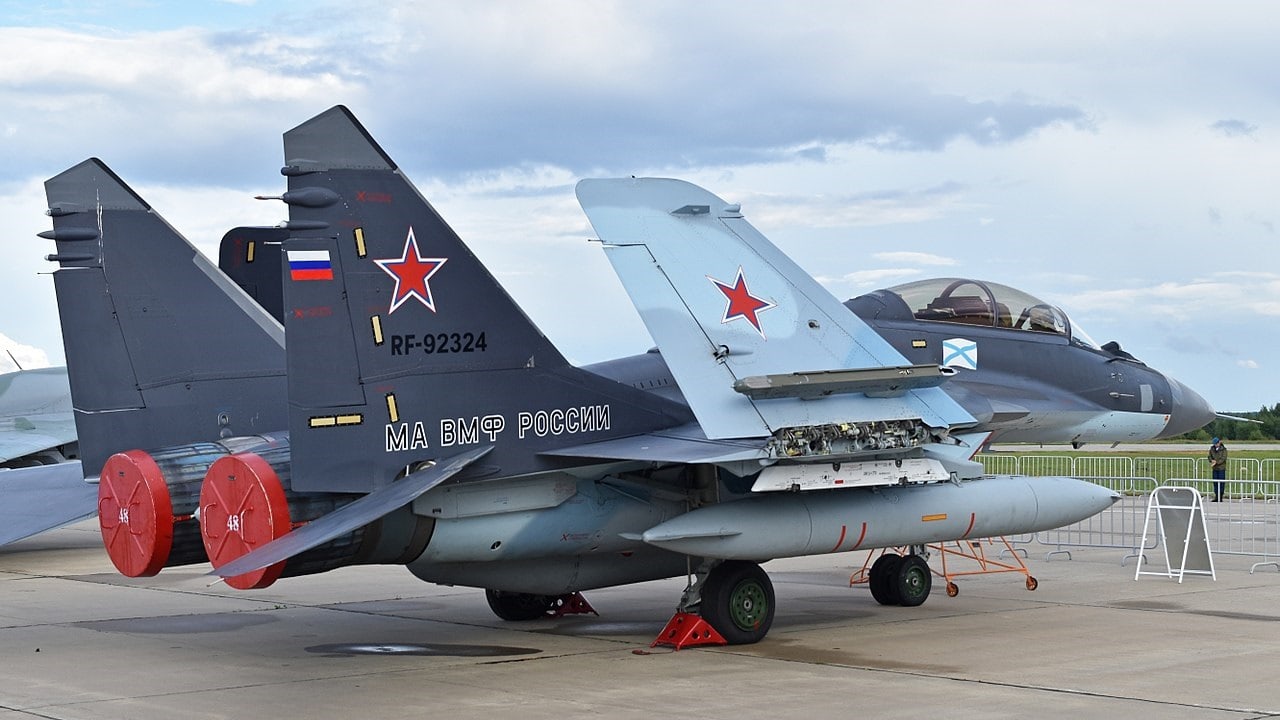
Kh-29

🇷🇺Russian Federation
1980 – Present
Spotlight

Soviet short-range strike missile with a 320 kg warhead built to crack hardened targets

Kh-29TE Air-to-Surface Missile — Export Presentation (Rosoboronexport)

Watch on YouTube
Overview
Kh-29
The AS-14 Kedge (Kh-29) is a Soviet-developed air-to-surface missile, modernized by Russia, designed to target ground and naval assets like bunkers and ships. It features a solid-fuel rocket motor, a range of 10 to 30 kilometers, and various guidance systems, including laser and television guidance, but its large size limits payload capacity and complicates mission execution.
Specifications

General

Length M3.87 m
Range Km30 km
Wingspan M~1.1 (est.)
Warhead TypePenetrating high-explosive/fragmentation with selectable fuze delay
Launch PlatformSu-22, Su-25, Su-27, Su-30, Su-35, MiG-29K, MiG-35, Su-24, Su-34, Su-57
Cep M~5-7 (Kh-29L, reported)
Guidancesemi-active laser (Kh-29L), TV (Kh-29T/TE), imaging IR (Kh-29TD), passive anti-radiation (Kh-29MP)
Speed Mach0.8 Mach
Warhead Kg317 kg
Launch Weight Kg657-690 (variant dependent)

Other

DesignerVympel NPO (USSR); series production by Tactical Missiles Corporation (KTRV)
VariantsKh-29L, Kh-29T, Kh-29TE, Kh-29TD, Kh-29ML/TM, Kh-29MP
Diameter M0.38
PropulsionSingle-stage solid-propellant rocket motor
Latest Developments
Featured Coverage
Research Notes

Heavy Soviet/Russian tactical air-to-surface missile

The Kh-29, NATO reporting name AS-14 Kedge, is a heavy short-range air-to-surface missile for attacking hardened ground targets, infrastructure, and some naval targets. It sits between light precision weapons and larger stand-off missiles, emphasizing warhead effect over long range.

Large warhead with laser or electro-optical guidance

Kh-29 variants use guidance such as laser homing or television/electro-optical control to deliver a heavy warhead against point targets. The missile can be effective against bunkers, bridges, runways, ships, and reinforced positions, but its limited range requires the launch aircraft to approach closer than with modern long-range stand-off weapons.

Powerful but exposure-prone strike option

Kh-29's combat tradeoff is straightforward: it offers strong terminal effect but exposes the aircraft to air defenses because of its range and guidance requirements. It is more suitable when air defenses are suppressed, target coordinates are well understood, and the launch aircraft can safely designate or maintain the needed attack geometry.

Key parameters at a glance

medium

Headline figures are open-source estimates unless stated; Russian and Ukrainian sources differ slightly on range and warhead mass.

Role
Short-range precision air-to-surface missile for hardened point targets
Designer / producer
Vympel NPO (USSR); Tactical Missiles Corporation (KTRV)
Service entry
1980(Soviet Air Force)
Warhead
317-320kg penetrating HE/fragmentation
Launch weight
657-690kg (variant dependent)
Guidance families
Semi-active laser (L/ML), television (T/TE/TD), passive radar (MP)
Launch range, laser variant
2-10km (reported)
Launch range, TV variants
3-13 km (T); up to 30 km (TE/TD)(reported)
Accuracy
~5-7m CEP (reported)
Design target set
Reinforced shelters, bridges, runways, ships up to 10,000 t

Program milestones

medium

Publicly reported milestones from Soviet fielding to current use on both sides of the war in Ukraine.

1976Development at Vympel NPO

Work on a heavy laser- and TV-guided tactical missile matures at Vympel NPO, reusing airframe and solid-motor solutions derived from Soviet air-to-air missile practice.

1980Kh-29L and Kh-29T enter Soviet service

The semi-active laser Kh-29L and TV-guided Kh-29T are accepted for service, initially cleared on Su-17M-series, Su-24M and MiG-27 strike aircraft.

1980sExport deliveries begin

The missile is exported alongside Su-22 and Su-24 packages to Warsaw Pact and Middle Eastern customers, establishing a wide legacy user base.

1990sKh-29TE offered for export

An extended-range TV-guided variant with roughly 690 kg launch weight and reported reach up to 30 km is marketed with Su-30MK-family aircraft.

2015Reported combat use in Syria

Russian state media show Kh-29L employment by Su-24M and Su-34 aircraft against fixed targets in Syria (reported, not independently confirmed).

2019-07Ukraine revives Kh-29 firings

Ukraine's State Research Institute for Testing and Certification of Weapons conducts Kh-29L/Kh-29T launches from Su-24M of the 7th Tactical Aviation Brigade — the first such firings in some 23 years.

2020-05Kh-29T integrated on the MiG-29MU2

Flight-design trials of the upgraded MiG-29MU2 include Kh-29T launches at the Povursk range, adding a heavy guided air-to-ground round to Ukraine's fighter fleet.

2022-2024Limited Russian use in the full-scale war

Western analysis notes Kh-25M and Kh-29 rounds have scarcely been seen in Russian use over Ukraine, with tactical aviation favouring the newer Kh-38M and glide-bomb kits that permit longer standoff.

Strategic significance

medium

The Kh-29 occupies a narrow niche: it trades standoff distance for destructive effect. Its 317-320 kg penetrating warhead is more than twice that of a heavyweight AGM-65 Maverick, letting one round defeat reinforced shelters, bridge spans and hardened command posts that lighter precision weapons cannot break. The price is exposure — the laser and baseline TV versions must be released inside roughly 8-13 km, well within the engagement envelopes of modern short-range air defences, and TV guidance degrades in poor visibility because the pilot must lock the target before launch.

That trade-off has shaped its record in the war in Ukraine. Both air forces inherited Soviet stocks, but Western analysis indicates Russian tactical aviation has employed the Kh-29 only sparingly, favouring the longer-ranged Kh-38M and, from 2023, glide-bomb kits that keep aircraft farther from Ukrainian SAM belts. Ukraine, working with a smaller and far less replaceable inventory, went the other way: state test-institute programmes revived Kh-29L/T firings from the Su-24M in 2019 and cleared the Kh-29T on the upgraded MiG-29MU2 in 2020, extending the useful life of legacy rounds on the airframes actually available.

Export relevance now rests mainly on the extended-range Kh-29TE, marketed with Su-30MK-family aircraft to operators reported to include India, Algeria, Malaysia, Indonesia and Vietnam. Even in that market the missile reads as a legacy item: air forces buying survivable strike capability increasingly prefer satellite- and inertially-guided glide munitions or longer-range standoff missiles. The Kh-29's continued value is therefore narrow but real — a comparatively cheap way to put a very heavy penetrating warhead precisely onto a target that lighter weapons would only scratch.

Videos

Ukrainian MiG-29MU2 Test-Launches Kh-29T Missiles (Immersion Zone)

Watch on YouTube

Indonesian Air Force Su-30MK2 Fires Kh-29TE for the First Time (Chingis Dambiev)

Watch on YouTube

Su-34 Carrying FAB-250 Bombs and Kh-29TE Missiles (Bilibili)

Watch on Bilibili
Sources & References
Related Discussions

No discussions about Kh-29 yet

Start the first discussion