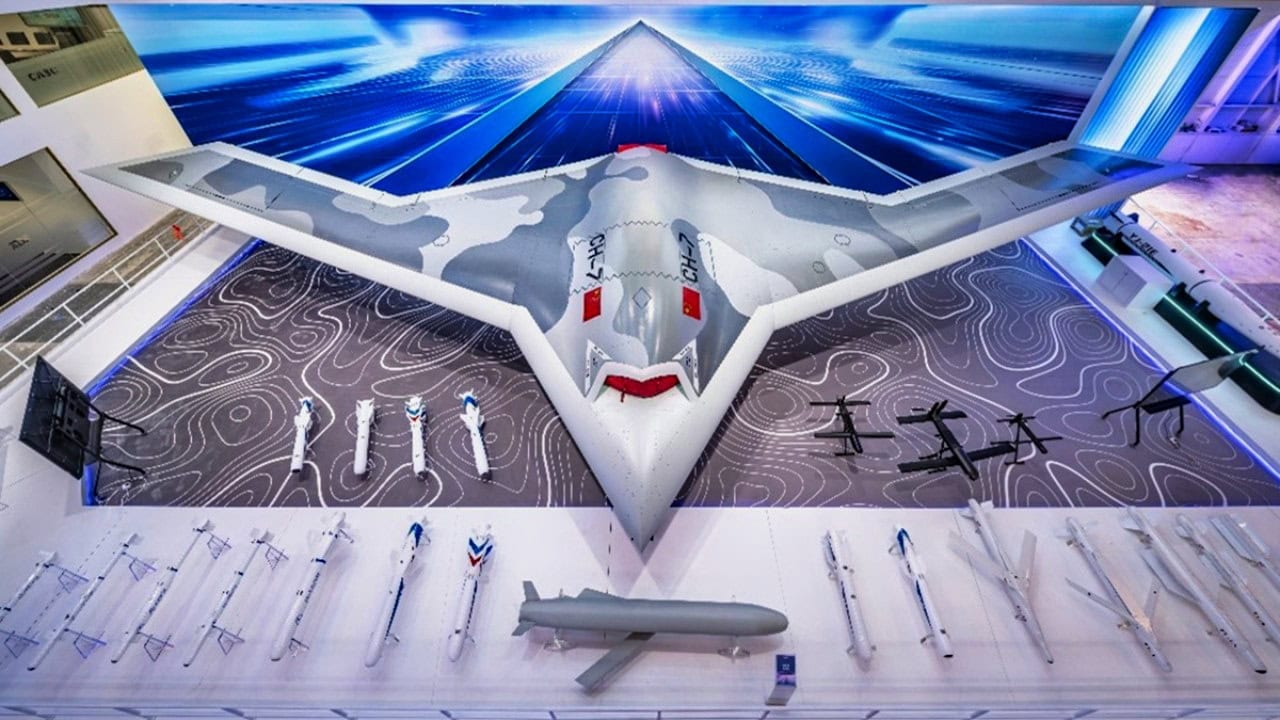
WZ-7 Soaring Dragon

🇨🇳China
Guizhou Aircraft Industry Corporation
2018 – Present
Spotlight

China's joined-wing HALE drone: a 60,000-foot sensor for the anti-ship kill chain

China's WZ-7 Reconnaissance UAV Put into Drill to Improve Real Combat Capabilities (CCTV Video News Agency)

Watch on YouTube
Overview
WZ-7 Soaring Dragon
The WZ-7 Soaring Dragon is a high-altitude, long-endurance unmanned aerial vehicle designed for reconnaissance and surveillance missions. It features a unique joined-wing design and is capable of providing targeting data for missiles.
Specifications

General

ArmedNo
Range Km7,000 km
Payload Kg650 kg
Wingspan M24.86 m
Max Speed Kmh750 km/h
Endurance Hours10 hours
Service Ceiling M20,000 m

Other

Height M~5.4 m (est.)
Length M~14.3 m (est.)
OperatorsPLA Air Force and PLA Naval Air Force (PLANAF)
Powerplant1 × turbofan on production aircraft; WP-13-class turbojet on early prototypes (reported)
Sensor FitVentral fairing for SAR and EO/IR; dorsal SATCOM and datalink domes; ELINT/ESM antennas reported on naval aircraft
Combat Radius Km~2,000 km (est.)
First Flight Year2009 (reported)
Wing ConfigurationJoined (diamond) wing — swept main wing meeting a forward-swept aft wing at the tail
Latest Developments
Sep 29, 2026strong signal
China's WZ-7 Drone Raises the Cost of Holding Scarborough Shoal in 2026

The objective is not to match the WZ-7 aircraft platform for platform.

May 21, 2026strong signal
China Can Spot An American Aircraft Carrier 60,000 Feet Up with A Rocket-Powered Drone — And Feed The Coordinates to A Missile

The WZ-7 Soaring Dragon feeds targeting data to the DF-21D and DF-26 anti-ship missiles.

Featured Coverage
Research Notes

Chinese HALE reconnaissance UAV

medium

The WZ-7 Soaring Dragon was developed as a high-altitude long-endurance UAV for strategic reconnaissance and maritime surveillance missions.

The WZ-7 Soaring Dragon, also known as Xianglong, reflects China's move into large high-altitude long-endurance unmanned aircraft. The design was developed for broad-area reconnaissance rather than tactical battlefield support, giving the PLA a platform suited to watching maritime approaches, tracking naval activity, and supporting long-range targeting networks. Its public appearances and regional flight reporting made it one of the more visible Chinese strategic UAVs of the 2010s and 2020s.

Distinctive joined-wing sensor platform

medium

The WZ-7 is notable for its joined-wing configuration, jet propulsion, long endurance, and payload capacity for surveillance sensors and communications equipment.

Technically, the WZ-7 is built around persistence and sensor carriage. Its distinctive joined-wing planform, high-altitude flight profile, and jet-powered endurance are intended to support long surveillance or patrol sorties. Open-source descriptions associate the aircraft with electro-optical, radar, signals, or communications payloads, although exact mission fits are not always publicly confirmed. The design is best understood as part of China's airborne C4ISR architecture rather than as a strike UAV.

Maritime and regional surveillance role

medium

Reported WZ-7 activity near Japan, Taiwan, and surrounding seas points to a role in maritime domain awareness and long-range reconnaissance.

Operationally, WZ-7 flights have been reported in sensitive regional air and maritime spaces, including areas around Japan and the western Pacific. The aircraft can support peacetime monitoring, crisis surveillance, and targeting-chain development by collecting data over long distances. Its relevance grows alongside Chinese anti-ship missile, naval aviation, and command-network modernization, because persistent unmanned surveillance helps connect sensors to shooters across maritime theaters.

Key parameters at a glance

medium

China has published no official performance data for the WZ-7. Figures below are open-source analyst estimates unless stated otherwise.

Role
High-altitude long-endurance (HALE) reconnaissance and surveillance UAV
Manufacturer
Guizhou Aircraft Industry Corporation (AVIC)
Configuration
Joined 'diamond' wing, V-tail, dorsal intake with rear-mounted engine
Length
~14.3m (est.)
Height
~5.4m (est.)
Powerplant
1 × turbofan on production aircraft (reported)
Combat radius
~2,000km (est.)
Primary sensors
Ventral SAR / EO-IR fairing, SATCOM and datalink domes, ELINT/ESM on naval fit (reported)
Operators
PLA Air Force and PLA Naval Air Force
Fleet size
~20 airframes built (est., open-source counts)

Program milestones

medium

Publicly reported milestones. Early development dates rest on airshow displays and analyst reconstruction rather than official announcements.

2006-11Xianglong concept shown at Zhuhai

A scale model of a joined-wing high-altitude UAV named 'Xianglong' (Soaring Dragon) appeared at Airshow China, the first public sign of the programme.

2009First flight reported

Analysts date the maiden flight of the prototype to 2009. The early airframe used a single vertical tail and a turbojet engine, and the type was subsequently offered for export as the EA-03.

2015Production-standard airframe emerges

A revised configuration with V-tails, a reshaped fuselage and a turbofan engine entered low-rate production, replacing the turbojet prototype standard.

2018Entry into PLA service

The type is assessed to have reached operational service with PLA units around 2018, initially with naval aviation and subsequently with the air force.

2021-09Public debut in PLAAF markings

The WZ-7 was displayed at Airshow China 2021 in air force markings, the first official acknowledgement of the aircraft under its military designation.

2023-01First Japanese intercept

Japan's Ministry of Defense reported a WZ-7 transiting the Miyako Strait into the Philippine Sea and back. JASDF fighters from the Southwestern Air Force were scrambled — the first publicly confirmed intercept of the type.

2023-03Naval configuration revealed

Imagery showed a PLANAF WZ-7 with radome panels on the nose, wing roots and upper fuselage, indicating additional SATCOM and electronic support measures antennas for maritime surveillance.

2024-03First known Sea of Japan flight

A WZ-7 circled over the Sea of Japan on 26 March and returned westward, a routing that implies transit of Russian or North Korean airspace. Japan's Central Air Defence Force scrambled fighters.

Strategic significance

medium

The WZ-7's value lies less in the airframe than in what it plugs into. A jet-powered platform loitering around 18,000-20,000 m with a synthetic aperture radar, electro-optical sensors and a satellite datalink can hold a wide maritime box under near-continuous watch and pass a track picture back to shore-based commanders. That is the missing middle of China's anti-access architecture: over-the-horizon radars and reconnaissance satellites can cue a search, but a persistent airborne sensor is what narrows a contact into a firing solution for weapons such as the DF-21D or DF-26. The joined-wing layout — a swept main wing meeting a forward-swept aft wing — buys structural stiffness and a high lift-to-drag ratio at low structural weight, the same design problem the RQ-4 solved with a conventional high-aspect-ratio wing.

Operationally the type has spread outward from Chinese coastal waters in a way that is easy to track through foreign intercept reporting. Japan's first confirmed intercept came at the start of 2023, when JASDF fighters responded to a WZ-7 running the Miyako Strait into the Philippine Sea; by March 2024 the type was circling the Sea of Japan, a routing that required transit of Russian or North Korean airspace. In April 2024 one appeared over the West Philippine Sea as tensions around Scarborough Shoal rose and the US Army deployed its Typhon launcher to Luzon. Reporting has also placed WZ-7 units at high-altitude airfields in Tibet facing India and in the Taiwan Strait approaches, though those deployments are less firmly documented than the Japanese intercepts.

The limits are the familiar ones for large HALE aircraft. The WZ-7 is unarmed, non-stealthy and predictable in flight profile; it is straightforward to detect and, in a shooting war, straightforward to engage with long-range surface-to-air missiles or fighters carrying very-long-range air-to-air weapons. Its practical worth is therefore concentrated in peacetime and grey-zone surveillance, and in the opening phase of a conflict before air defences are fully committed. Comparisons to the RQ-4 Global Hawk and MQ-4C Triton are reasonable in role and altitude band, but the WZ-7 is a smaller aircraft with shorter reported endurance, which suggests a regional rather than global reach — consistent with a force designed to see out to the second island chain rather than across oceans.

Videos

Japan's Jets Intercept China's WZ-7 Drone For The First Time (CRUX)

Watch on YouTube

Rare first release of in-flight footage of the WZ-7 high-altitude UAV (CCTV News)

Watch on Bilibili

How capable are the WZ-7 and WZ-8? A look at China's high-altitude reconnaissance pair (NewSay)

Watch on Bilibili
Sources & References
Related Discussions

No discussions about WZ-7 Soaring Dragon yet

Start the first discussion