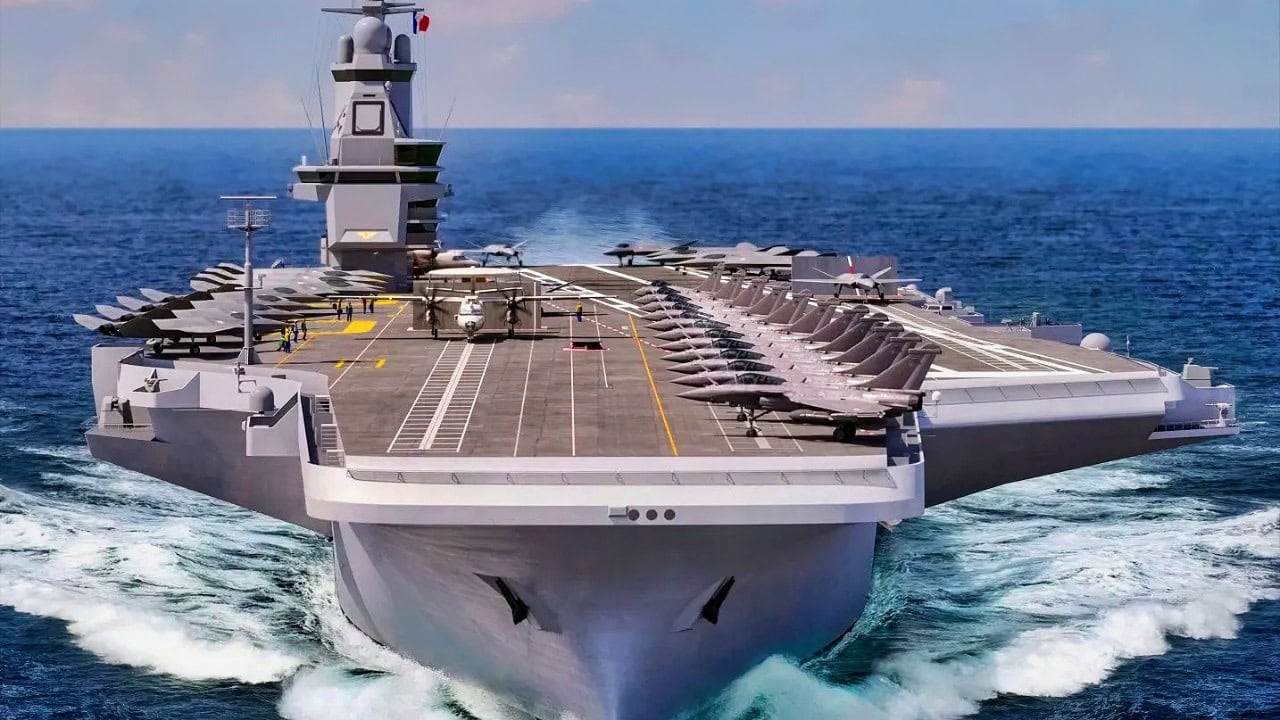
Charles de Gaulle occupies a category of one. She is the only nuclear-powered carrier in service outside the US Navy and, with two C13-3 steam catapults and arrestor gear, the only non-US ship able to operate conventional fixed-wing aircraft with catapult-assisted launch — including fixed-wing airborne early warning in the form of the E-2C Hawkeye. That combination gives France an organic air picture and a strike radius that STOVL carriers such as the Queen Elizabeth class or Italy's Cavour cannot match. The trade-off is size: at roughly 42,500 tonnes she is less than half the displacement of a Nimitz, which constrains air wing size, sortie generation and magazine depth.
The 2017-2018 mid-life refit is what keeps the ship relevant. Reactor refuelling, a new SMART-S Mk2 radar, replaced combat and telecommunications systems and conversion of the air wing to an all-Rafale M standard were intended to underwrite roughly two more decades of service. The Clemenceau 25 Indo-Pacific deployment in late 2024 to April 2025 tested that investment at range: 150 days, about 40,000 nautical miles, around 2,500 catapult launches, and multinational exercises with Indian, Japanese, US, Australian and Southeast Asian forces. It also exposed the structural limitation of a single-carrier navy — with the ship east of Suez, France had no carrier available for the Mediterranean or Atlantic.
That gap is the main argument for the successor. The Porte-Avions Nouvelle Generation is planned at roughly 75,000-80,000 tonnes with three EMALS catapults, K22 reactors and an air wing built around the Next Generation Fighter, E-2D Hawkeyes and carrier UAVs, with construction contracts and an entry into service targeted around 2038. Until then Charles de Gaulle remains France's sole means of embarked fixed-wing power projection, and an 18-month reactor-refuelling refit planned from 2027 will again remove that capability from the fleet for well over a year.