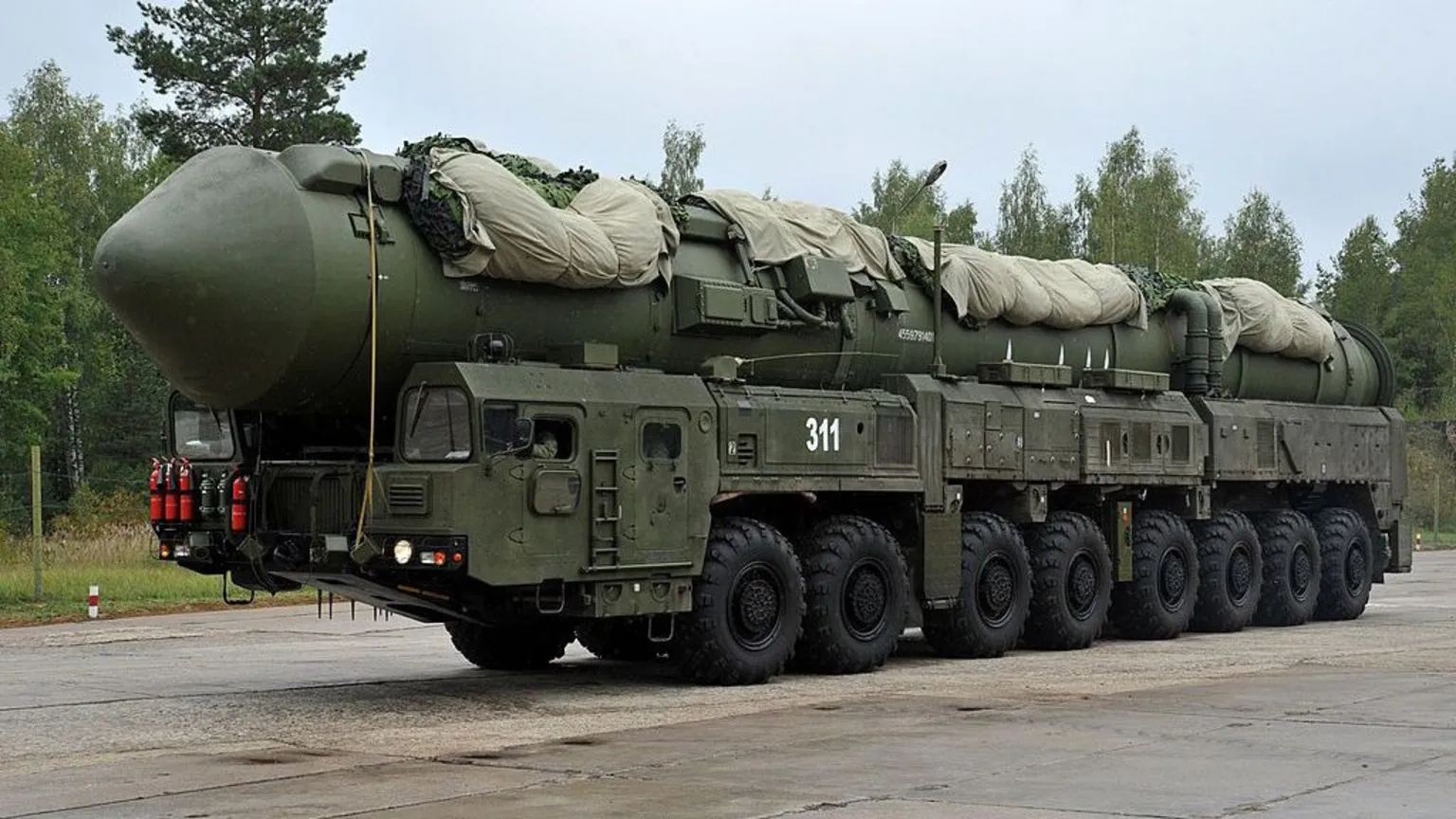
Russian Oreshnik missile

🇷🇺Russian Federation
2024 – Present
Spotlight

Russia's RS-26-derived IRBM: multi-warhead strikes used as strategic signalling

How does Russia's new 'Oreshnik' missile work? (Reuters)

Watch on YouTube
Overview
Russian Oreshnik missile
The Oreshnik is an intermediate-range hypersonic ballistic missile developed by Russia. It is notable for its multiple independently targetable reentry vehicle (MIRV) capability, allowing it to release multiple warheads that can strike different targets simultaneously. The missile is based on the RS-26 Rubezh intercontinental ballistic missile model and can carry conventional or nuclear warheads. It has a speed exceeding Mach 11 and a range between 3,000 and 5,500 km, making it capable of reaching most of Europe from Russian territory. The missile was first used in combat during the Russian invasion of Ukraine in 2024.
Specifications

General

MobileYes
Guidanceinertial navigation, microsatellite positioning (e.g., GLONASS), advanced terminal guidance
Length M16.75 m
Range Km5,000 km
Propulsionsolid-fueled
Warhead Typesnuclear, conventional, MIRVs

Other

ClassRoad-mobile intermediate-range ballistic missile (IRBM)
Stages2 (assessed; RS-26 Rubezh with one booster stage removed)
Max SpeedMach 10+ (claimed)
Unit CostTens of millions of USD per round (est.)
Launch PlatformMulti-axle transporter-erector-launcher (TEL), MZKT-family chassis (assessed)
First Combat Use21 November 2024 - PA Pivdenmash plant, Dnipro, Ukraine
Reentry Vehicles6 MIRV-type RVs, each dispensing ~6 submunitions (assessed)
Assessed Range Km3,000-5,500 km (assessed); Belarus cites 5,000 km (claimed)
Latest Developments
May 27, 2026strong signal
Russia's Oreshnik Strike Exposes NATO's 2026 Air Defense Gap

Ukraine confirmed that the strike included an Oreshnik intermediate-range ballistic missile against the Bila Tserkva district in Kyiv Oblast.

Jan 12, 2026strong signal
Ukraine reveals outdated components in Russia’s Oreshnik missile

Ukraine reveals outdated components in Russia’s Oreshnik missile.

Jan 12, 2026strong signal
Russian media claims that the "Hazel" missile's power makes Europe "think twice"

“榛树”导弹威力令欧洲“三思而行”

Featured Coverage
Research Notes

Development History

medium

Oreshnik is a recently revealed Russian IRBM associated with the RS-26/Rubezh lineage.

Oreshnik became public after Russia used a new intermediate-range ballistic missile against Dnipro, Ukraine, in November 2024. CSIS and other open sources describe it as connected to the RS-26 Rubezh lineage, though exact design details remain opaque. The missile appeared after the collapse of the INF Treaty framework, making it politically significant as well as technically significant. Its development and public messaging show Russia's renewed emphasis on intermediate-range strike options against Europe and Ukraine.

Technical Profile

medium

Open sources describe an IRBM-class weapon with multiple reentry vehicles and conventional or nuclear payload potential.

Technically, Oreshnik is publicly described as an intermediate-range ballistic missile rather than an ICBM. U.S. and Western officials have associated it with multiple warheads or multiple reentry vehicles, and Russian statements describe very high terminal speeds. Public details on guidance, payload, basing, and production scale remain uncertain. The missile's most important features for database readers are range class, multiple-warhead presentation, and nuclear-capable potential. Because the system is new and politically messaged, claims should be treated cautiously.

Operational Use

medium

Oreshnik has been used as a combat strike and strategic signal during the Russia-Ukraine war.

Operationally, Oreshnik is significant because Russia used it in combat and framed the launch as a warning to Ukraine's Western backers. AP and other reports describe the first use as a strike on Dnipro, while CSIS tracks the missile as a distinct system. Its role is partly military and partly coercive signaling: it demonstrates a capability to strike at intermediate ranges with a weapon that can be conventional or nuclear-capable. The system also marks a post-INF era where Europe again faces land-based intermediate-range missile threats.

Key parameters at a glance

medium

The Oreshnik is a new and poorly documented system. Figures below are Russian claims marked "(claimed)" or Western/open-source estimates marked "(assessed)"; no official specification has been released.

Role
Road-mobile intermediate-range ballistic missile used for strategic signalling and deep strike
Design origin
Derived from the shelved RS-26 Rubezh ICBM programme (assessed)
Range
3,000-5,500km (assessed)
Propulsion
Two-stage solid-propellant (assessed)
Terminal speed
Mach 10+ (claimed)
Payload
6 reentry vehicles, each dispensing about 6 submunitions (assessed)
Warhead options
Nuclear or conventional (claimed); the Dnipro strike is assessed to have used inert or minimally explosive submunitions
Launcher
Multi-axle transporter-erector-launcher, dispersed off-road (assessed)
First combat use
21 November 2024 against the PA Pivdenmash plant in Dnipro, launched from Kapustin Yar (reported)
Forward basing
Belarus, Krichev-6 airfield; Russia declared combat duty in December 2025 (claimed)

Program milestones

medium

Publicly reported milestones. Russian statements are treated as claims until independently corroborated.

2018RS-26 Rubezh programme shelved

Russia suspended the RS-26 Rubezh ICBM, a system Western analysts had long regarded as an INF-range weapon in an ICBM wrapper. Analysts assess the Oreshnik reuses that airframe with one booster stage removed.

2024-07Moscow signals resumption of INF-range work

After Washington and Berlin announced US long-range missile deployments to Germany from 2026, Putin said Russia would complete development of intermediate- and shorter-range systems. Analysts named the RS-26 as the likely basis.

2024-11First combat use against Dnipro

On 21 November a single missile released multiple reentry vehicles over the PA Pivdenmash plant. Putin named the system Oreshnik; the Pentagon called it experimental and said Russia likely held only a handful of rounds.

2024-12Serial production announced

Putin stated the system had entered serial production and would be fielded with the Strategic Missile Forces, and threatened strikes on Kyiv "decision-making centres" (claimed).

2025-08Belarus basing work observed

Commercial satellite imagery showed preparation of a launch and support site in Belarus, reported to be roughly 60 km from Minsk, ahead of any deployment announcement.

2025-12Deployment to Belarus declared

Lukashenko said ten Oreshnik systems would be stationed in Belarus; Russian MoD footage showed vehicles at Krichev-6 airfield near the Russian border, and Moscow declared combat duty on 30 December (claimed).

2026-01Second combat use, against Lviv

A strike on the Lviv State Aviation Repair Plant marked the first Oreshnik employment in western Ukraine, close to the NATO border, and drew condemnation at the UN Security Council.

2026-05Third combat use, Kyiv region

Two rounds were reported during a mass strike on 24 May involving hundreds of drones and other missiles. European officials described the employment as nuclear brinkmanship; accuracy and reliability of the type were publicly questioned afterwards.

Strategic significance

medium

The Oreshnik's value to Moscow appears to lie more in signalling than in destruction. A missile that disperses roughly three dozen small submunitions from six reentry vehicles delivers far less concentrated blast than a comparably sized unitary warhead, and the Dnipro strike is widely assessed to have used inert or near-inert payloads. What the launch communicated was different: that Russia can hold European capitals at risk with a system fielded outside the lapsed INF framework, and that it will do so in response to Western long-range weapons decisions. Each subsequent employment - Lviv in January 2026, the Kyiv region in May 2026 - has been timed to political moments rather than to targets that obviously required an IRBM.

Technically the system is best read as recombination rather than innovation. Independent analysts describe it as established Soviet-era and RS-26 components arranged in a new configuration; the hypersonic terminal speed Moscow emphasises is a normal property of any ballistic reentry vehicle, not a distinguishing capability. The harder question is accuracy. A MIRV bus was designed to disperse nuclear warheads, where circular error is tolerable; using one for conventional effect demands a precision standard that has not been publicly demonstrated, and reporting through 2026 has raised both guidance defects and reliability failures. Interception is nonetheless difficult for Ukraine, whose Patriot batteries are few, are optimised against shorter-range threats, and would face multiple separating objects on a steep terminal trajectory.

The Belarus deployment is the development with the widest implications. Basing at Krichev-6, a few kilometres from the Russian border, adds little range that Russian territory does not already provide, so its function is largely political - binding Minsk further into Russian nuclear signalling and compressing warning time against NATO's eastern flank in perception if not in fact. For European planners the practical consequence is a renewed case for theatre ballistic missile defence and for counterforce options against road-mobile launchers, which is precisely the escalation dynamic the INF Treaty was written to prevent. Numbers remain the key uncertainty: a handful of rounds is a messaging tool, while a sustained production run would be a genuine change in the European missile balance.

Videos

In-depth analysis of Russia's Oreshnik hypersonic missile attack on Ukraine (BFBS Forces News)

Watch on YouTube

How is Ukraine defending itself against ballistic missiles like the Oreshnik? (DW News)

Watch on YouTube

Russia confirms Oreshnik use in large-scale strike on Ukraine (Huanqiu / Global Times Online)

Watch on Bilibili
Sources & References
Related Discussions

No discussions about Russian Oreshnik missile yet

Start the first discussion