F-35C

🇺🇸United States
Lockheed Martin
2019 – Present
Spotlight

The US Navy's first stealth fighter built from the ground up for carrier operations

Stealth Jet at Sea – Real F-35C Operations Aboard US Navy Carriers (USA Military Channel)

Watch on YouTube
Overview
F-35C - Image 1
F-35C - Image 2
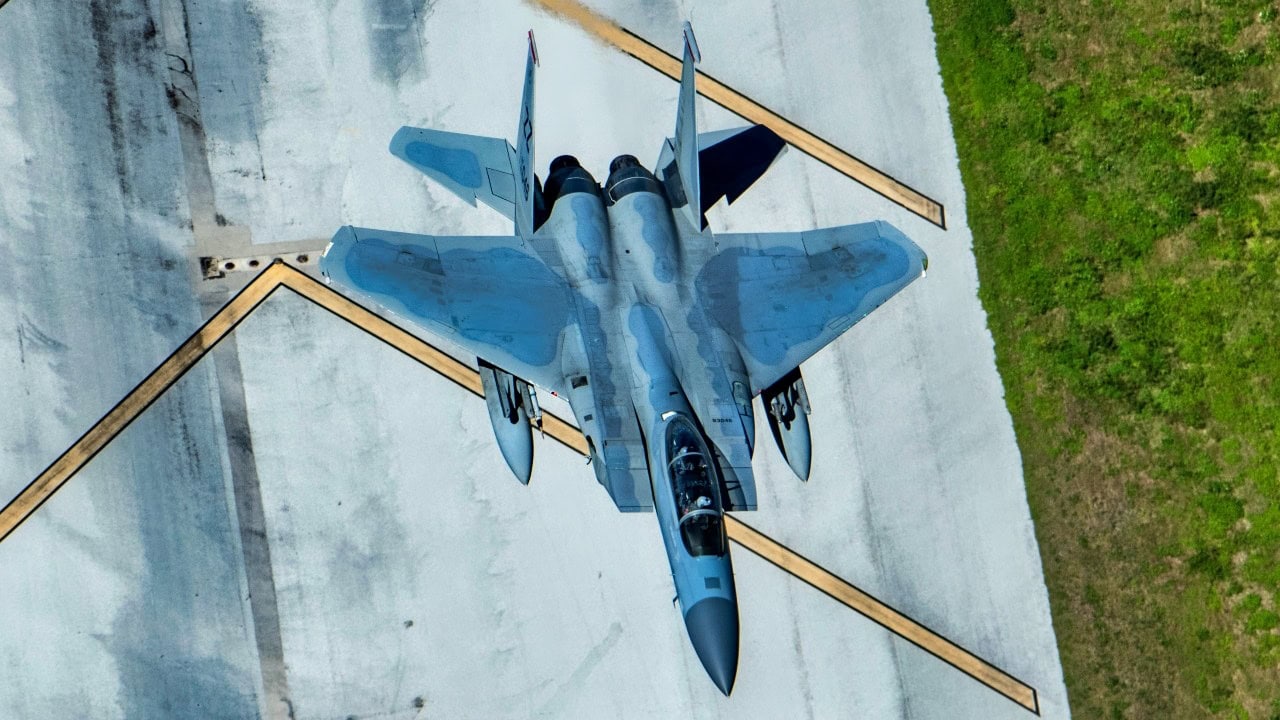
The F-35C is the U.S. Navy’s first low-observable carrier-based aviation platform. It is a 5th Generation stealth multirole strike fighter designed for Navy carrier operations. The F-35C features radar-evading stealth, advanced sensors, supersonic speed, and superior range. It can carry more than 5,000 lbs of internal weapons, or more than 18,000 lbs of combined internal and external weapons. The F-35C is the first and world’s only long-range stealth strike fighter designed and built explicitly for Navy carrier operations.
Specifications

General

Crew1
RadarAN/APG-81 AESA
Armament25 mm GAU-22/A; 2x AIM-120C air-to-air missiles; 2x GBU-31 JDAM
Length M15.7 m
Weight Kg15,800 kg
Payload Kg8,160 kg
Wingspan M13.1 m
Max Speed Kmh1,931 km/h
Combat Radius Km1,100 km
Service Ceiling M15,000 m (50,000 ft)

Other

Range Km>2,200 km (>1,200 nmi) on internal fuel
Powerplant1x Pratt & Whitney F135-PW-100 afterburning turbofan, ~191 kN (43,000 lbf) class
Wing Area M262.1 m² (668 sq ft), ~45% larger than F-35A/B
Approach Speed~145 kn (reported)
Internal Fuel Kg8,960 kg (19,750 lb)
Max Takeoff Weight Kg~31,800 kg (70,000 lb class)
Latest Developments
Oct 24, 2026strong signal
Second batch of Finnish F-35s arrives in Rovaniemi

bringing the number of Finnish F-35s in the country to four.

Oct 24, 2026strong signal
Canada gets its first two CF-35A stealth fighters

Canada plans to base its first eight F-35s there during 2026 and 2027 to train Canadian pilots.

Oct 23, 2026strong signal
Denmark to buy cheap U.S. cruise missile built in Germany

Entity 'F-35' mentioned in report

Oct 22, 2026strong signal
‘Ability to strike back’: Denmark commits to long-range missile orders

The purchases of F-35 Joint Strike Missiles, produced by Norway’s Kongsberg, and ground-launched Anthem cruise missiles, manufactured by US firm Covenant, are a significant step towards making Denmark better able to defend itself.

Oct 22, 2026strong signal
Pentagon, Lockheed agree to 10-year deal for 850 F-35 jets

the framework averages 85 U.S. aircraft per year

Oct 22, 2026strong signal
Pentagon, Lockheed agree to decade-long F-35 framework deal for hundreds of jets

The framework covers at least 850 US aircraft over 10 production lots with initial spares and includes 10 years of sustainment and modification kits.

Oct 21, 2026strong signal
Air Force needs 1,509 combat-ready jets by 2035, service tells Congress

The Air Force included funds for an identical number of F-35s in its base budget.

Oct 21, 2026strong signal
Australia marks missile, cyber ‘firsts’ in exercise with Indonesia

A detachment of its Lockheed Martin F-35 Lighting II fifth-generation fighters are currently deployed to Singapore as part of a contingent taking part in the Five Power Defence Arrangements exercise called Bersama Lima.

Featured Coverage
Research Notes

Carrier variant for catapult launch and arrested recovery

high

The F-35C adapts the F-35 mission-system concept to U.S. Navy aircraft carriers with larger wings, stronger landing gear, and carrier-specific structures.

The F-35C is the carrier variant of the F-35 family. It is designed for catapult launch and arrested recovery, which requires structural and aerodynamic changes not needed on the land-based F-35A or the STOVL F-35B.

The U.S. Navy describes the F-35C as the first and only long-range stealth strike fighter built and designed for Navy carrier operations. Lockheed Martin highlights the larger wing and carrier-suitable design features that support slower approach speeds and deck operations.

For HiWars, this page should focus on what makes the C model different: carrier basing, naval logistics, deck handling, arrested landings, air wing integration, and the role of stealth aircraft in a carrier strike group.

Extending carrier air wing reach and survivability

high

F-35C capability matters because it brings stealth, sensors, and networking to the carrier air wing.

Carrier aviation depends on reach, survivability, and the ability to operate as part of a larger naval force. The F-35C adds low observability, sensor fusion, and networked information sharing to the carrier air wing, complementing Super Hornets, Growlers, Hawkeyes, and other embarked aircraft.

Its larger wing and internal fuel help support carrier-relevant range, while carrier-specific landing gear and tailhook structures let it survive deck operations. These features make the C variant heavier and structurally different from the F-35A.

The key reading point is that F-35C is a naval aircraft first. Its value is measured not only by fighter specifications, but by how it changes carrier strike-group awareness, first-day strike options, and survivability in contested areas.

Carrier integration and fleet-level dependencies

high

F-35C effectiveness depends on carrier maintenance, deck cycles, mission data, logistics, and integration with the rest of the air wing.

A carrier aircraft is part of a shipboard system. F-35C operations depend on catapults, arresting gear, deck handling, aircraft elevators, maintenance spaces, weapons movement, spare parts, software support, and carrier air wing planning.

This makes fleet integration central to the page. The aircraft's advertised stealth and sensor advantages matter most when they are connected to the wider carrier strike group, including electronic attack, airborne warning, surface escorts, submarines, and logistics.

HiWars should connect F-35C records to squadrons, carrier deployments, air wing composition, software block, weapons integration, and operational milestones. The page becomes much more useful when it explains naval employment rather than repeating F-35 program language.

Key parameters at a glance

high

Figures reflect published Lockheed Martin and U.S. Navy data for the carrier variant.

Role
Carrier-based (CATOBAR) 5th-generation stealth strike fighter
Wing area
62.1m² (~45% larger than F-35A/B)
Wingspan
13.1m (folding wingtips for deck parking)
Internal fuel
8,960kg — the largest of the three F-35 variants
Powerplant
1x P&W F135-PW-100, ~191 kN (43,000 lbf) class
Combat radius
>1,100km on internal fuel
Carrier features
Tailhook, reinforced twin-wheel nose gear, larger control surfaces for slower approach
Operators
U.S. Navy VFA squadrons and U.S. Marine Corps VMFA squadrons
Combat debut
November 2024, strikes on Houthi targets from USS Abraham Lincoln

Program milestones

high

Publicly documented milestones of the carrier variant.

2010-06First flight

F-35C test aircraft CF-1 made the carrier variant's maiden flight at Fort Worth, Texas.

2014-11First arrested landing

Test aircraft CF-03 completed the type's first arrested landing aboard USS Nimitz (CVN 68) off San Diego, opening at-sea developmental testing.

2018-12Fleet squadron carrier-qualified

VFA-147 'Argonauts', the first operational Navy F-35C squadron, completed carrier qualifications aboard USS Carl Vinson.

2019-02Initial operational capability

The U.S. Navy declared IOC for the F-35C with VFA-147, making it the last of the three variants to reach the milestone.

2021-08First operational deployment

VFA-147 deployed aboard USS Carl Vinson with Carrier Air Wing 2 — the first carrier deployment of a stealth fighter.

2022-01South China Sea landing mishap

An F-35C suffered a landing mishap aboard USS Carl Vinson and went into the South China Sea; the wreck was recovered from the seabed in March 2022.

2024-11Combat debut

Marine squadron VMFA-314, embarked in USS Abraham Lincoln, flew the F-35C's first combat strikes against Houthi weapons storage sites in Yemen.

Strategic significance

medium

The F-35C gives U.S. carrier air wings their first low-observable strike aircraft, changing what a carrier can credibly threaten inside a defended airspace. Compared with the F/A-18E/F it flies alongside, the C-model combines stealth shaping, an internal weapons bay and a sensor-fusion cockpit with roughly twice the unrefueled combat radius of the legacy Hornet it was designed to replace, allowing the carrier itself to stand farther from shore-based anti-ship threats.

The variant's carrier-specific design choices carry real trade-offs. The enlarged, folding wing, tailhook and reinforced landing gear that make catapult launches and arrested recoveries possible add weight and drag, capping the F-35C at Mach 1.6 and 7.5 g — below the F-35A's limits — while giving it the largest internal fuel load and longest range in the family. Integration has also been gradual: only carriers modified with F-35-specific support facilities can embark the type, and the 2022 Carl Vinson ramp strike showed the demands carrier operations place on a new airframe.

Its November 2024 combat debut against Houthi targets in Yemen, flown by Marine squadron VMFA-314 from USS Abraham Lincoln, was operationally modest but institutionally significant: it validated the stealth fighter within a full carrier strike group's cycle of operations. In a potential Western Pacific contingency, F-35Cs would be central to the reach and survivability of U.S. naval airpower — a capability China is visibly answering with its own carrier-based J-35, making the two aircraft likely reference points for one another over the coming decade.

Videos

Navy F-35C Update from Lockheed Martin (U.S. Naval Institute)

Watch on YouTube

F-35C: Carrier-Variant Navy & Marine Stealth Jets Refuel Mid-Air (USA Military Channel)

Watch on YouTube

F-35C set for trials aboard USS Gerald R. Ford as China announces Fujian carrier tests (Bilibili)

Watch on Bilibili
Sources & References
Related Discussions

No discussions about F-35C yet

Start the first discussion