

The USS Ford Spent 326 Days At Sea. The Navy Says It’ll Be Fixed In Six Months – The math on the USS Gerald R. Ford doesn’t add up. At least not on paper. The Navy’s newest and most expensive aircraft carrier returned to Norfolk on May 16 after a 326-day deployment, the longest by a U.S. carrier since the Vietnam War.
The USS Gerald R. Ford Has a Math Problem
It beat the previous post-Vietnam mark of 295 days, set by the USS Abraham Lincoln in 2020, by more than a month. Along the way, the Ford fought a serious shipboard fire, became a punchline over its plumbing, and flew combat operations across three combatant commands.
Yet according to Rear Adm. Kavon Hakimzadeh, commander of Norfolk Naval Shipyard, the Ford will return to the fleet after just six months in the yard. That’s a bold promise. However, there’s more behind it than a shipyard admiral’s confidence.
A Seven-Month Cruise That Wouldn’t End
The Ford left Norfolk on June 24, 2025, on what was supposed to be a standard deployment. “We thought it would be a seven-month deployment,” Chief of Naval Operations Adm. Daryl Caudle said at the homecoming. “These were missed events from weddings to births.”
Instead, the ship crossed the Atlantic four times. It supported the counter-drug mission in the Caribbean, took part in the January operation that captured Venezuelan President Nicolás Maduro, and then launched strikes against Iran beginning February 28 as part of Operation Epic Fury. By the time it came home, the air wing had logged more than 11,800 launches.
The human cost was real. Rear Adm. Gavin Duff, commander of Carrier Strike Group 12, put it plainly on the pier: “This morning, 80 newborn children were held by their fathers, most for the very first time.”
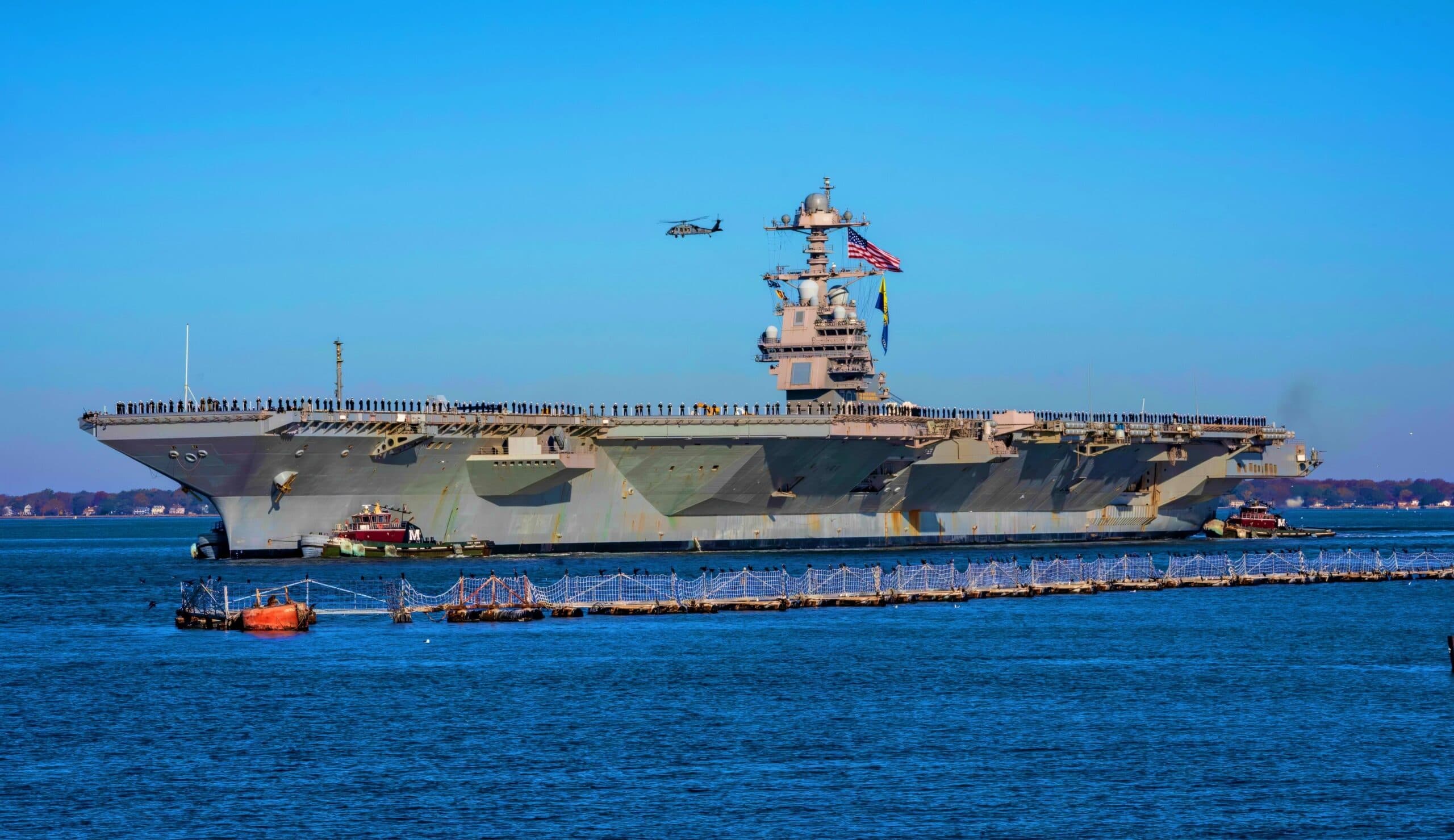
NORFOLK (Nov. 26, 2022) The USS Gerald R. Ford (CVN 78) returns to Naval Station Norfolk after completing their inaugural deployment to the Atlantic Ocean with the Gerald R. Ford Carrier Strike Group (GRFCSG), Nov. 26. The GRFCSG, returned to Naval Station Norfolk following a scheduled deployment with Allies and partners in an effort to build strategic relationships and contribute to a stable and conflict-free Atlantic region, while also showcasing the U.S. Navy’s most advanced class of aircraft carrier. (U.S. Navy Photo/Video by Mass Communication Specialist First Class Nathan T. Beard)
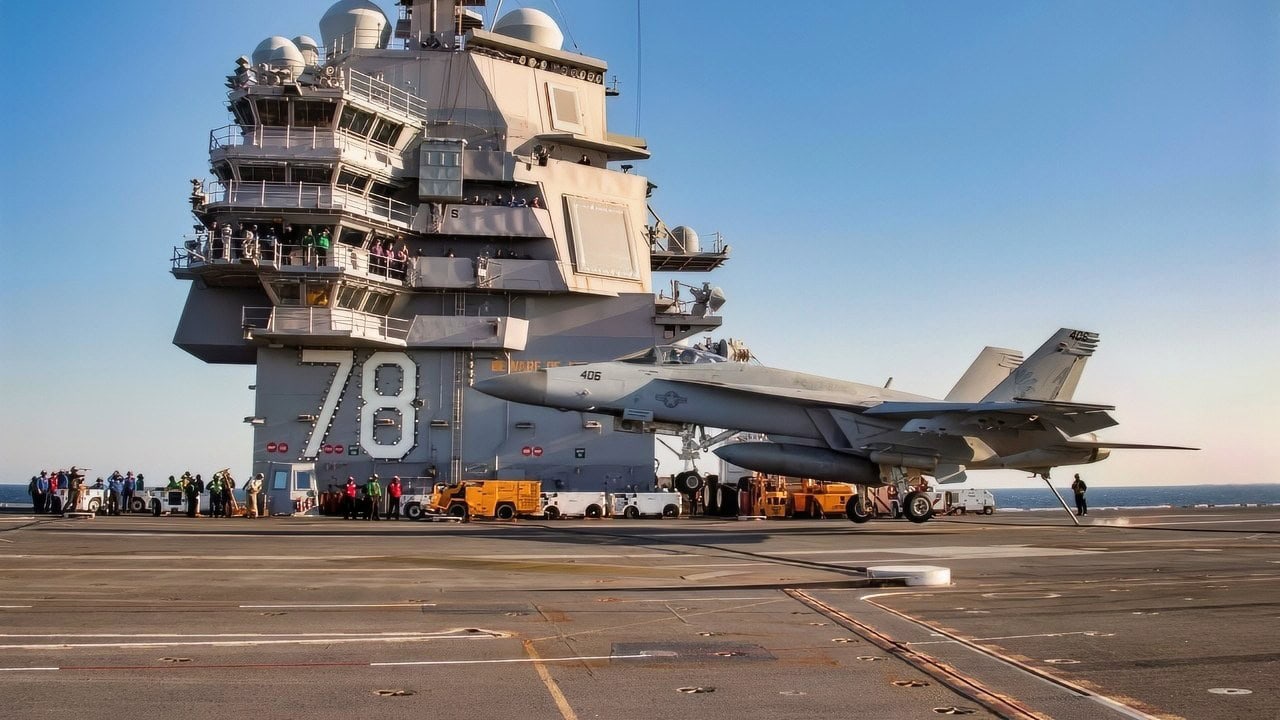
USS Gerald R. Ford Supercarrier Flight Deck. Image Credit: Creative Commons.
USS Gerald R. Ford Aircraft Carrier or Supercarrier
The Laundry Fire Was The Wild Card
On March 12, a fire broke out in the ship’s aft laundry. It took roughly 30 hours to fully extinguish and secure the affected compartments. More than 200 sailors were treated for smoke inhalation. The fire destroyed more than 100 racks, displacing roughly 600 sailors from their bunks for the rest of the cruise.
CNN reported that the fire suppression system “did not operate as intended.” Six months later, investigators are still looking into the cause.
The Ford left combat operations and pulled into Greece on March 23 for preliminary repairs.
The Ford’s Plumbing Issues Were Well-Documented
Then there are the toilets. The USS Ford uses a Vacuum Collection, Holding and Transfer (VCHT) system that relies on suction through narrow pipes to move waste, modeled in part after commercial and cruise industry designs.
The carrier’s roughly 650-head vacuum wastewater system has generated 42 requests for outside assistance since 2023, 32 of them in 2025 alone.
A 2020 GAO report found that the system’s sewage pipes are undersized for a crew of over 4,000 personnel, leaving the network vulnerable to total zone failures if a single valve or commode control component fails.
One four-day stretch saw 205 breakdowns. Caudle pushed back on that narrative. “If that system is operated in accordance with procedure, then it does not clog,” he said. (Insert sarcasm font here.) Either way, the shipyard plans to install the same fix used on the USS George H.W. Bush.
So How Do You Get Six Months Out Of That?
Acting Navy Secretary Hung Cao has offered a rule of thumb: every additional 30 days of deployment adds about 6 percent to a carrier’s maintenance workload. The Ford ran roughly five months past its planned return. That’s about 30 percent more work before you even count the fire. Early estimates put availability at a year.
Norfolk split the job in two. The Ford entered its Planned Incremental Availability, its first at a public shipyard since its 2017 commissioning, on July 7. The regional maintenance center and a commercial contractor carved the fire repairs into a separate availability.
“I’m still going to deliver that ship in six months, but we’ve set up a second availability,” Hakimzadeh said.
The shipyard also got a head start, working aboard the ship while it was still pierside at Naval Station Norfolk. “Capitalizing on these WOO periods is the single most important key to returning carriers to their strict maintenance timelines,” said project superintendent George “BJ” Baker.
Norfolk has a recent track record to point to. The USS Dwight D. Eisenhower finished its own availability ahead of schedule, though Hakimzadeh was candid that it was only “a few days early, but you always have problems near the end of availability.”
The Six-Month Clock Is Open To Interpretation
In splitting the work from the fire is smart management. It keeps the critical path clean and gets a carrier back to a fleet that badly needs one.
However, it’s also worth clarifying what the six-month clock actually measures. It measures the PIA. It doesn’t necessarily measure when the Ford is whole again, and Hakimzadeh himself acknowledged some of the final crew-level work may run past the window.
That’s not a knock on Norfolk. It’s the reality of a shipyard enterprise that’s being asked to do more with less. A new GAO report released last week notes that all four public shipyards are at least 100 years old, with dry docks averaging 107 years.
The Navy plans to spend more than $200 billion over 50 years to upgrade them, and some projects are already years behind.
The Ford’s deployment wasn’t an anomaly. It was a symptom of a carrier force stretched thin by back-to-back crises. Every month a carrier spends past its scheduled return is borrowed against the next deployment. The Navy is betting it can pay that debt back in six months.
On paper, the math still doesn’t add up. Norfolk is betting it can make it work in the yard.
We’ll have to see how close the work comes to its established timeline.
About the Author: Steve Balestrieri
Steve Balestrieri is a National Security Columnist. He served as a US Army Special Forces NCO and Warrant Officer. In addition to writing on defense, he covers the NFL for PatsFans.com and is a member of the Pro Football Writers of America (PFWA). His work was regularly featured in many military publications.