
$11 billion arms sale to Taiwan faces uncertainties with Trump; deterrence credibility in the Taiwan Strait is more crucial than 82 HIMARS systems.
 Li Minghui
$11 billion arms sale to Taiwan faces uncertainties with Trump; deterrence credibility in the Taiwan Strait is more critical than 82 HIMARS
After Trump's visit to China, he stated that he does not seek Taiwan's independence, a statement that is not new in itself. What is truly interesting is that, in the face of arms sales to Taiwan that have already been approved by Congress or recently announced, he added, "may do it, may not do it." This is not a technical issue, but a credibility issue.
Around May 15, the U.S. arms sale package to Taiwan was disclosed to exceed $10 billion, primarily including 82 HIMARS, 420 ATACMS, 60 self-propelled howitzers, and over $1 billion in drone systems. Marcus Chen has already detailed the delivery issues regarding HIMARS and ATACMS, so I will not repeat that delivery math here. What this article aims to examine is the political signals that have changed before this batch of weapons has fully transformed into combat power.
How much uncertainty can offset military sales signals
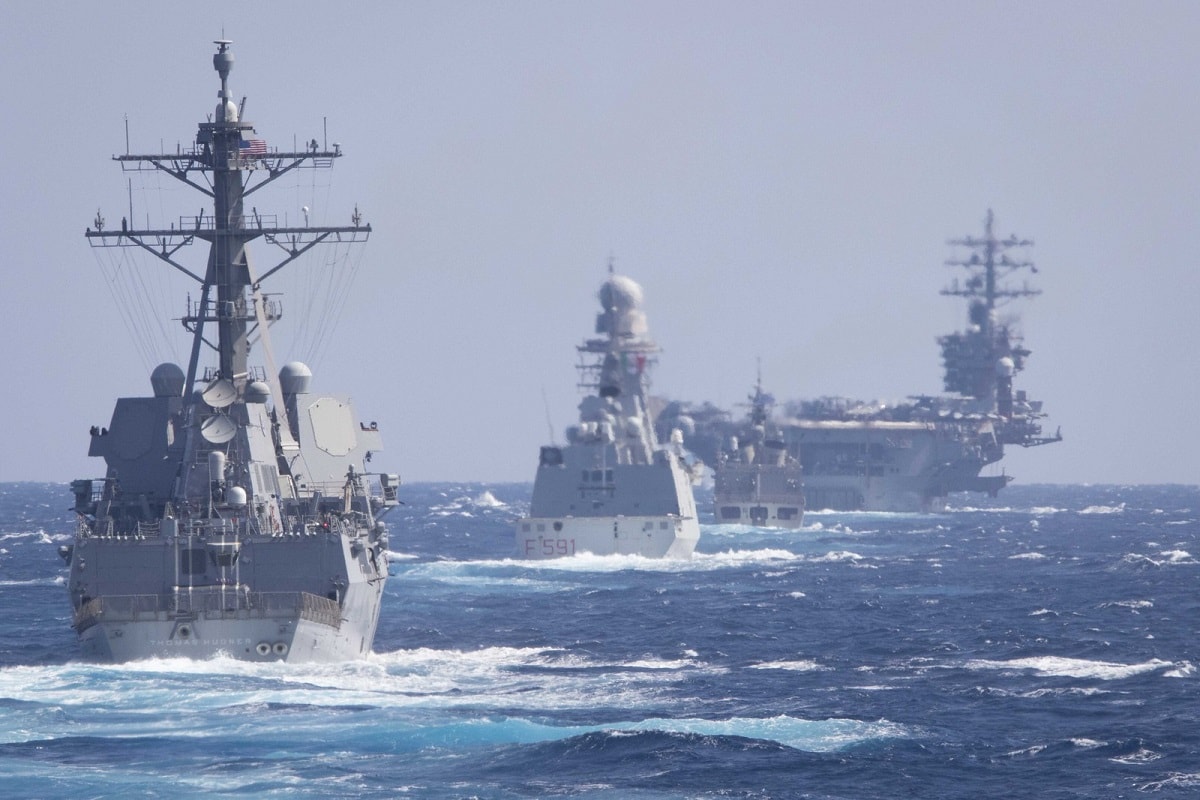
File photo: U.S. military vessels operating in the Indo-Pacific region, used to illustrate the context of U.S. military presence on the Taiwan Strait issue, not the site of this summit or arms sale.
Arms sales are originally a very hard signal. Congressional review, State Department notifications, DSCA announcements, and Taiwan's defense budget arrangements all combine to tell Beijing and Taipei: America's security commitment does not rely solely on a statement from the president. However, Trump's statement of "may do it, may not do it" pulls a institutionalized process back into a personal transaction style.
From Beijing's perspective, this statement can be interpreted as a gap: since the U.S. president is willing to describe arms sales as uncertain, China has the motivation to continue incorporating the Taiwan issue into summit meetings, trade negotiations, and crisis management. Beijing may not believe that Washington will actually halt arms sales, but it will test whether the U.S. is willing to lower the public intensity, slow down the notification pace, or package some projects more discreetly.
From Taipei's perspective, the issue is more practical. The Taiwan Ministry of Foreign Affairs responded that the Republic of China Taiwan is a sovereign independent country, maintaining the status quo in the Taiwan Strait, and continuing to deepen U.S.-Taiwan relations; arms sales are part of mutual deterrence. This statement is very stable, but what Taipei really needs to manage is risk: it cannot be seen as pushing for de jure independence, nor can it allow Beijing or Washington to mistakenly believe that Taiwan will accept its defense needs being bargained away.
Strategic ambiguity is turning into dual ambiguity
In the past, the core of U.S. policy toward Taiwan was strategic ambiguity: not clearly committing to whether to send troops, but continuously providing Taiwan with self-defense capabilities. The current problem is that ambiguity exists not only in "whether to fight," but also in "whether to sell, when to sell, and under what political conditions to sell." In simple terms, the first type of ambiguity creates uncertainty for Beijing, while the second type of ambiguity also imposes uncertainty on Taipei.
This is the most dangerous aspect of deterrence logic. Taiwan's purchase of HIMARS, ATACMS, self-propelled howitzers, and drones is not just for the sake of firepower on paper, but to make the PLA believe during the campaign planning stage that landing assembly, port loading, forward airfields, and command communication nodes will incur a higher cost. If Beijing believes that U.S. domestic politics or the president's personal negotiation habits may weaken subsequent supplies, it will factor this uncertainty into its risk model.
I believe that Trump's statement of not seeking Taiwan's independence is actually a rough version of traditional expressions for Washington; however, describing arms sales as "may do it, may not do it" is the detail that deserves more attention. The former is about managing political red lines, while the latter may touch on deterrence credibility. The nature of the two is different.
How will Beijing respond
Beijing's response is unlikely to stop at mere verbal protests. In the past, after arms sales to Taiwan, China's Ministry of Foreign Affairs and Ministry of Defense would typically accuse the U.S. of violating the one-China principle and may sanction military enterprises, increase East Theater Command exercises around Taiwan, and raise the frequency of maritime and aerial patrols. The difference this time is that Beijing will also observe whether Trump treats Taiwan as a bargaining chip. If an opportunity is observed, gray zone pressure will be more targeted.
- First, at the diplomatic level, it will emphasize that "the Taiwan issue is the first red line in U.S.-China relations," forcing the U.S. to repeatedly explain that its policy has not changed.
- Second, at the military level, it may strengthen joint combat readiness patrols around Taiwan, especially reconnaissance pressure targeting Taiwan's long-range firepower and drone systems.
- Third, at the public opinion level, it will juxtapose U.S. arms sales with the statement of "not supporting Taiwan independence," attempting to create distrust in Taipei towards Washington.
These actions do not necessarily mean that war is closer, but they will complicate Taiwan's risk management. Taipei must strive for weapons while also avoiding being forced to publicly respond to every change in U.S.-China rhetoric.
What Taipei should manage is not emotions but continuity
What Taiwan needs to do most now is not to amplify Trump's statement, nor to pretend it has no impact, but to pull the credibility of arms sales back from "presidential attitude" to "institutional continuity." Specifically, this means continuing to promote defense budgets, training absorption, ammunition reserves, dispersed deployments, and C4ISR integration, so that U.S. executive departments, Congress, and the military-industrial chain can see that Taiwan is a buyer capable of turning weapons into combat capabilities.
For Taiwan, mutual deterrence is not a unilateral insurance policy provided by the U.S., but a connection between political commitments, arms sales processes, training systems, and battlefield survivability from both sides. The 82 HIMARS are just one node in this. The real question is, when the next U.S.-China negotiation puts Taiwan back on the table, can Washington convince Beijing that arms sales are not negotiable chips that can be easily discounted.
On this point, there is still no answer. Perhaps this is precisely what should be observed in the Taiwan Strait over the next few months: what the U.S. is selling to Taiwan is ultimately weapons, or a still credible political commitment?
Sources
Al Jazeera, “Trump says he discussed Taiwan arms sale with China’s Xi Jinping,” 2026-05-15; Taipei Times, “Trump refuses to let Xi haggle over arms sales,” 2026-05-17; Taiwan Ministry of Foreign Affairs, statements on U.S. arms sales and Taiwan’s sovereign status; Breaking Defense and Newsweek reporting on the Taiwan arms package structure.
Trump indicated uncertainty about U.S. arms sales to Taiwan, stating he may or may not proceed with the $11 billion package that includes 82 HIMARS and 420 ATACMS. Taiwan's Ministry of Foreign Affairs emphasized its sovereignty and the importance of U.S. military support. Beijing is likely to respond with diplomatic pressure and increased military readiness in the region.
- Trump stated he may or may not proceed with arms sales to Taiwan.
- The arms package includes 82 HIMARS and 420 ATACMS.
- Taiwan's Ministry of Foreign Affairs reaffirmed its status as a sovereign nation.
- The U.S. arms sales are seen as part of a deterrent strategy against China.
- Beijing may respond with diplomatic and military pressure regarding Taiwan.