
2026 AIM-260 Super Hornet Test Shows the US Navy Still Has a Range Problem
 Marcus Chen
2026 AIM-260 Super Hornet Test Shows the US Navy Still Has a Range Problem
The useful number in the May 13 sighting at Eglin Air Force Base is not the AIM-260A's classified range. It is 12 feet.
That is roughly the length class of the AIM-120 AMRAAM family, and it explains why the photographed U.S. Navy F/A-18F Super Hornet matters. Army Recognition reported on May 16 that a Navy Super Hornet was seen carrying what appears to be the AIM-260A Joint Advanced Tactical Missile, the long-secret successor to AMRAAM. If that identification is correct, the Navy has moved the weapon from an opaque development file into visible carrier-air-wing integration.
That is good news. It is not a solution by itself.
The Missile Has to Fit the Air Wing
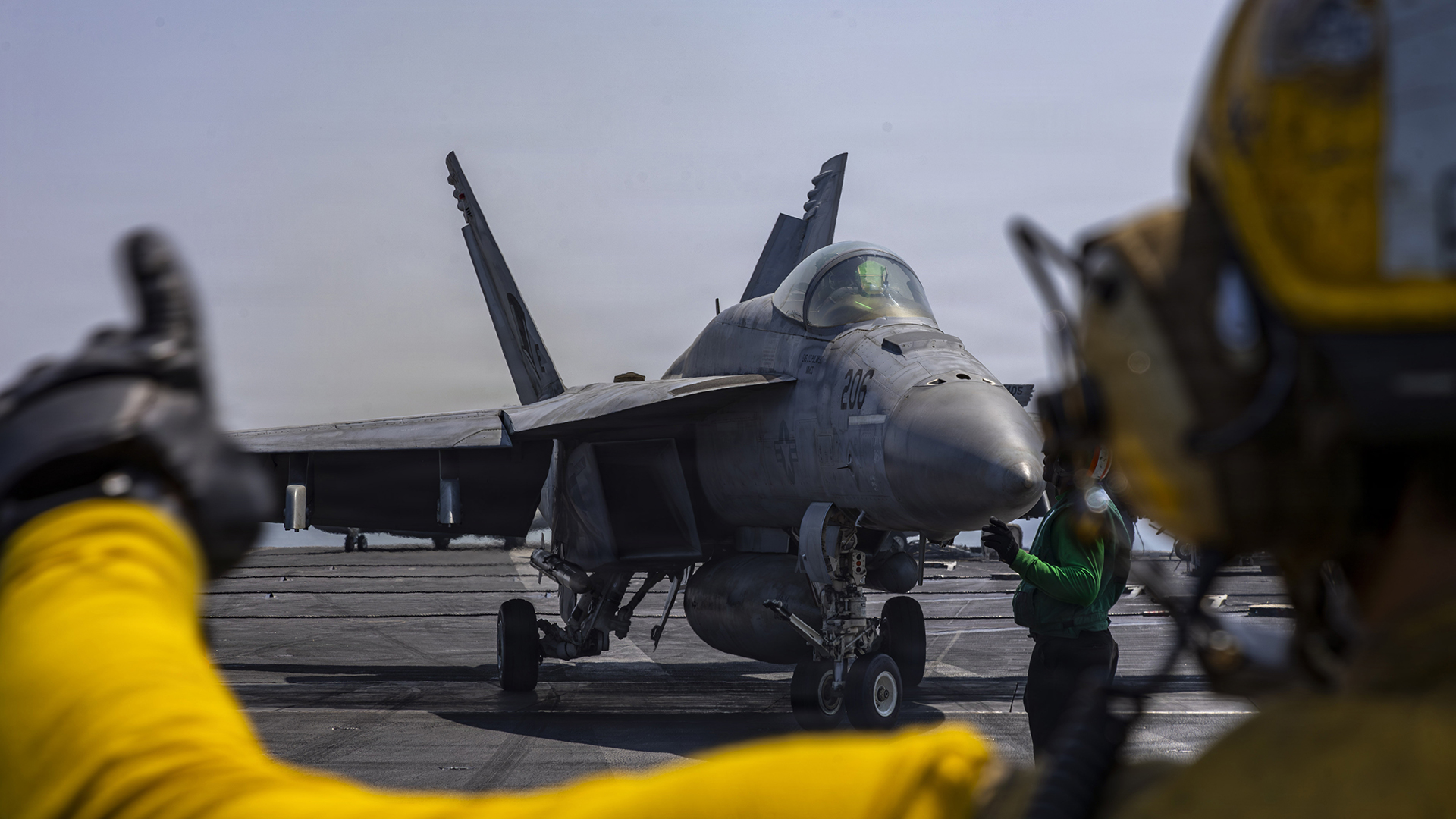
The AIM-260A is meant to outrange AMRAAM while fitting the same fighter stations and, for stealth aircraft, internal weapons bays. That design constraint is the story. A larger missile can buy range with more motor volume, but it also creates drag, integration cost, deck-handling problems and stealth penalties. A carrier air wing cannot afford a boutique missile that only works on one clean test jet.
The Air Force's public AIM-120 fact sheet lists AMRAAM at 143.9 inches long, seven inches in diameter and 335 pounds at launch, with active radar terminal guidance and inertial midcourse guidance. Those numbers are old, and the latest AIM-120D and D3 variants are more capable than the baseline data suggests. But the physical envelope still matters. If AIM-260A can give Navy fighters a longer no-escape zone without forcing a redesign of the Super Hornet's stations or the F-35C's internal carriage logic, that is a real operational gain.
The gain is especially important because the F/A-18E/F remains the workhorse of U.S. carrier aviation. The Navy can talk about F/A-XX, Collaborative Combat Aircraft and future unmanned shooters, but anyone who has served around a carrier strike group knows the actual near-term question is simpler: what can the current air wing launch tomorrow morning?
China Forced This Problem
The AIM-260A was publicly acknowledged in 2019 as a response to China's PL-15 and the wider problem of U.S. fighters losing their old firing-distance advantage. Public range figures for modern air-to-air missiles are imprecise and often misleading, because altitude, speed, target aspect, datalink quality and electronic warfare all change the real engagement. Still, the trend is clear. Chinese fighters and bombers do not have to defeat every U.S. aircraft in a dogfight if they can threaten tankers, E-2D Hawkeyes, P-8 patrol aircraft and carrier fighters before those aircraft can support the fight comfortably.
That is where the Eglin photo matters. A Super Hornet with a longer-range missile changes the outer air-defense geometry around a carrier. It can push some engagements farther from the ship. It can make Chinese aircraft work harder before releasing their own weapons. It can also let F-35Cs, E-2Ds and other sensors pass tracks to shooters that do not need to light up their own radars early.
But there is a hard limit. A missile does not create sortie generation. It does not create tankers. It does not fix the fact that a carrier operating east of Taiwan still has to manage fuel, deck cycles, aircraft fatigue, weapons upload time and the survivability of the logistics chain behind it.
The Carrier Math Is Still Unforgiving
Defense News reported this month that USS Gerald R. Ford is returning from more than 320 days at sea, the longest post-Vietnam deployment by a U.S. carrier, after a series of operations that stretched the Navy's force-generation model. Another Defense News report noted that senior Navy leaders are reconsidering the old 36-month carrier cycle because spare parts, maintenance reset and training time no longer match demand.
That matters for AIM-260A because a long-range missile is only useful if enough trained aircraft, pilots, maintainers and magazines are available when the crisis starts. The Indo-Pacific fight is not a single cinematic launch. It is repeated air-defense cycles over days, probably weeks, while the other side tries to kill tankers, jam networks, mine ports, strike runways and saturate the carrier's escorts.
Take a notional carrier air wing with four strike fighter squadrons. Even if 40 to 44 Super Hornets and F-35Cs are embarked, not all are mission-capable at once, not all are configured for counter-air, and not all can be launched in the first cycle. If a portion carry two or four long-range missiles, the opening inventory can disappear quickly in a serious raid environment. The first salvo looks impressive. The fifth day is where the math gets ugly.
That is the part Washington prefers not to say out loud. AIM-260A may restore some firing distance, but the Navy still needs enough missiles in the magazine, enough reload capacity at forward logistics nodes, and enough industrial output to replace weapons after combat use. The United States learned in Ukraine and the Red Sea that expensive interceptors get consumed faster than peacetime procurement models assume. Air-to-air missiles will not be exempt from that rule in a Taiwan or South China Sea crisis.
Range Helps, Networking Decides
The AIM-260A's best use is probably not a lone Super Hornet hunting at maximum range. It is a networked shot. An F-35C, E-2D, passive sensor or unmanned aircraft finds the target; another platform carries the missile; the network keeps the weapon fed with usable track data; the shooter survives long enough to leave and rearm.
That model is exactly why the missile's compatibility with F/A-18E/F, F-22, F-35 and future unmanned platforms matters. The United States does not need every aircraft to be exquisite. It needs enough sensors, shooters and weapons in the same kill chain to make Chinese planners doubt that their own long-range aviation can safely approach the first island chain.
The problem is that networks fail under pressure. Datalinks get jammed. Tankers are pushed farther back. Weather, maintenance and deck accidents ruin clean PowerPoint timelines. A longer missile expands the possible engagement zone, but it also increases dependence on accurate offboard targeting. If the track is stale, the missile is just an expensive tube of propellant flying into empty sky.
The Right Conclusion Is Uncomfortable
The May 13 sighting is a milestone for naval aviation. It suggests the AIM-260A is moving into the visible integration phase on the aircraft that will carry much of the Navy's counter-air burden until the next carrier fighter arrives. That is exactly where the program needs to be in 2026.
But the missile does not erase the basic Indo-Pacific problem. China's geography lets it mass aircraft, sensors and missiles close to the fight. The U.S. Navy has to bring its air wing, weapons, tankers, escorts and repair capacity across an ocean, then keep them there while the carrier force is already being stretched by global commitments.
AIM-260A gives the Super Hornet a better punch. It does not give the carrier air wing more arms. Until the Navy can pair longer-range missiles with deeper magazines, faster replenishment and a force-generation model that survives wartime tempo, the range problem is only partially solved.
The U.S. Navy integrated the AIM-260A missile into Super Hornet operations, as seen on May 13, 2026, at Eglin Air Force Base. This missile is intended to enhance the range capabilities of Navy fighters against threats, particularly from Chinese aircraft. However, challenges remain regarding missile availability and the operational readiness of carrier air wings amid ongoing global commitments.
- AIM-260A missile was seen on a U.S. Navy Super Hornet at Eglin Air Force Base.
- The AIM-260A is designed to outrange the AIM-120 AMRAAM.
- The U.S. Navy is facing challenges with carrier operations and missile availability.
- The integration of the AIM-260A is crucial for maintaining air superiority against Chinese forces.
- The U.S. Navy's operational model is being stretched due to global commitments.