
Two Israeli Bases in the Iraqi Desert Reveal the Sovereignty Gap in Gulf F-15 Fleets
 Ahmed Al-Rashid
Two Israeli Bases in the Iraqi Desert Reveal a Sovereignty Gap in Gulf F-15 Fleets
On May 18, 2026, the most important story in Al Jazeera's report on Iraq was not just the number of secret Israeli bases, but the location where these bases were established: the Iraqi western desert, near the Saudi border, in an area that is supposed to be marginal on the map but has turned into a logistical hub in a long-range war against Iran. According to Al Jazeera's reports citing The New York Times and Iraqi officials, there were reports of two temporary Israeli bases, with preparations for one of them starting as early as late 2024, while The Wall Street Journal previously mentioned that at least one site was used to house Israeli special forces and support air operations, with search and rescue capabilities for pilots if their planes were downed.
This is not a fog-free narrative. Baghdad has publicly denied allowing any unauthorized foreign presence, and U.S. officials stated that Washington did not participate in the operation, while other Iraqi sources spoke of an official protest submitted to the United States in March due to secret military activity. In my estimation, the field details should be treated with caution. But even if only half of the narrative proves true, its military significance is clear: Israel is no longer thinking of the long-range strike as just a flight distance, but as a complete system of air corridors, rescue points, intelligence, special forces, and control over weapon and aircraft software.
The Iraqi Site is Not Just a Stop Along the Way
Any military personnel who has served in the region knows that the Iraqi western desert is not a void. It is a sparsely populated area, difficult to monitor, and close enough to Saudi Arabia, Syria, Jordan, and Iran to become a junction between a sensitive political path and a dangerous operational path. The report indicates that Iraqi forces came close to discovering one of the sites in March and were subjected to air fire that resulted in the death of one fighter and the injury of two, according to the transmitted narrative. If this is true, we are not talking about a fleeting reconnaissance but about an operational position whose borders are protected by force.
The temporary base in this context does not need to resemble Al Udeid or Al Dhafra. A usable landing strip, limited fuel and ammunition storage, a communications team, a reception point for special forces, and a plan to extract a downed pilot are sufficient. Practically, this small structure could be more important than a whole squadron if it opens an unexpected attack angle for the adversary. Here lies the difference between those who own the aircraft as a platform and those who own the network to operate it.
F-15I is Not Just an Israeli Version of the F-15 Family
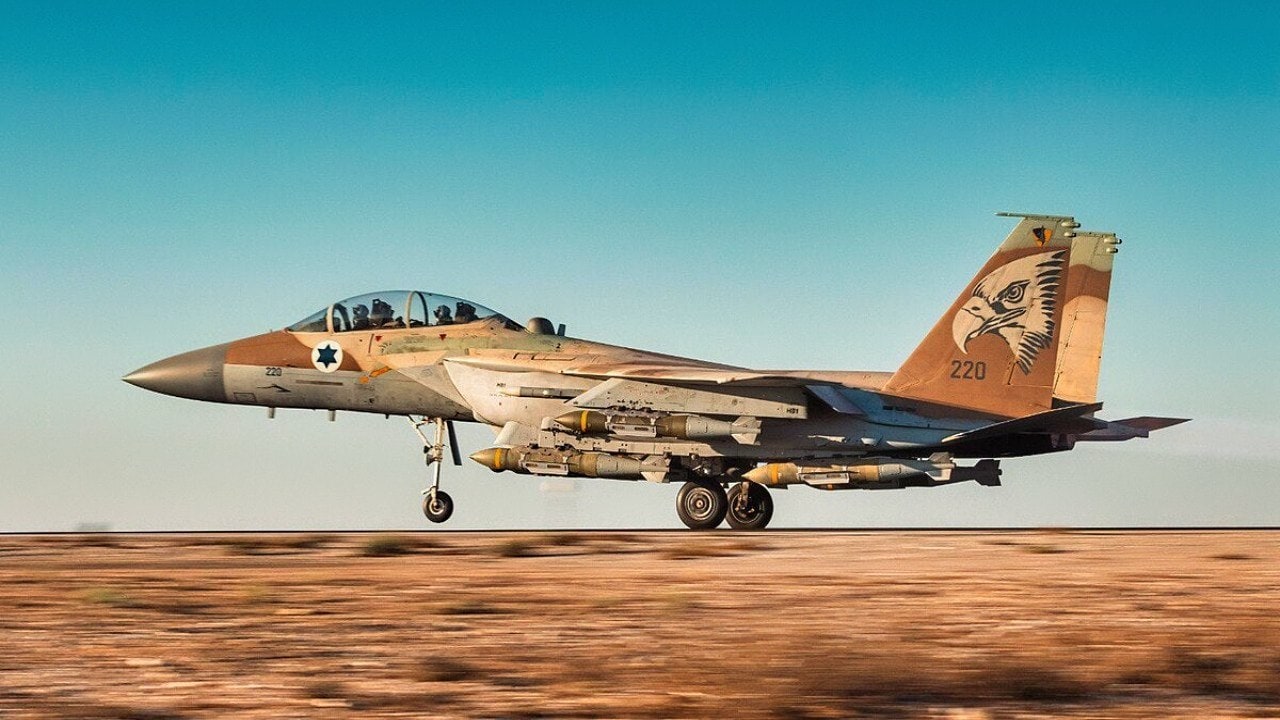
The public discussion about recent Israeli strikes has focused on the potential use of F-15I Ra’am fighters and air-launched ballistic missiles from the Sparrow family, especially in analyses that linked the strikes on Doha and Tehran to launch paths from outside the airspace of the targeted countries. I do not treat every published technical assessment as a definitive fact, but the essence of the matter does not change: the aircraft does not win on its own; it wins when integrated with long-range weapons, a mission data library, real-time intelligence, and software that allows the commander to modify the mission without waiting for external approval.
Here, the Gulf must hear the sentence it does not like to hear: buying F-15s does not mean possessing the logic of F-15s. Saudi Arabia has paid for decades to build one of the largest F-15 fleets outside the United States, and Washington agreed in February 2026 to a $3 billion support and sustainability package for Saudi F-15s, and prior to that, it approved $9 billion worth of Patriot PAC-3 MSE missiles for Saudi Arabia in January. Qatar has also introduced the F-15QA as a heavy and advanced platform. But the question is not how many aircraft are in the hangar, but who holds the keys to deep integration: the code, the threat library, the integration of non-standard weapons, and the electronic warfare package.
Three Billion for Sustainability Does Not Buy Sovereignty
The Saudi sustainability package is militarily significant. Without spare parts, training, software support, and ground equipment, the advanced aircraft becomes an expensive shell. But sustainability is one thing, and operational sovereignty is another. Sustainability means the aircraft can take off tomorrow. Sovereignty means that the state can determine how it takes off, with what weapon, against which target, and under what rules of engagement, without hitting a technical or political wall at a moment of crisis.
This point greatly disturbs many Gulf capitals because it reveals the limits of the rapid purchase model. You can buy the radar, the engine, the missile, and the training. The harder part is buying the political trust that allows the supplier to let you modify the internal structure of the aircraft as the operator desires, or allows you to introduce a national, Turkish, Korean, or European weapon into a sensitive American system. Historically, Israel has obtained a high level of access and adaptation because it is not just a customer, but an operational partner within a deeper American security structure. Arab countries, even when they pay more, often remain in the category of disciplined users.
Gulf Air Defense Faces a Narrower Equation
If the narrative about the Iraqi bases is true, it places Saudi Arabia specifically in front of a sensitive question. A site close to its borders is being used to support long-range strikes, while the kingdom possesses advanced air defense layers and massive budgets. The problem is not that Riyadh is unable to see everything in the desert; even major powers do not do that. The problem is that an adversary or ally may use the space surrounding the kingdom in a way that alters deterrence calculations without Riyadh being the central decision-maker.
The same applies to Qatar after the Doha strike in September 2025, which Al Jazeera's analysis referred to as evidence of a launch model from outside the airspace. The American base, modern aircraft, and advanced radars do not necessarily prevent a threat descending from a ballistic angle in mere seconds. Practically, Patriot and THAAD add an interception opportunity, but they do not eliminate the problem of engineering time when the weapon comes from a nearly vertical trajectory and at high speed. Defense here is not just about an anti-missile; it involves early warning, rapid political decision-making, clear rules of engagement, and regional connectivity that does not falter at the first diplomatic dispute.
Iraq Becomes a Mirror of Regional System Failure
Baghdad is the direct loser in this story. Iraq has tried for years to say it does not want to be a battleground for settling scores between Washington, Tehran, and Tel Aviv. But the existence of reports about Israeli sites, even with official denial, reveals that Iraqi sovereignty is still vulnerable from all sides. Iranian-backed militias weaken the state's decision, American pressure diminishes its margin, and if the Israeli secret operations are proven, they add a third layer of strategic humiliation.
As for the Gulf, the lesson is deeper than Iraq. Countries that spend tens of billions on fighters and air defense still rely on security arrangements that they do not fully control. In the old military adage, it is not enough to own the sword if someone else owns the sheath and the key. Israel has shown, or at least reports suggest it has shown, the ability to turn Arab geography into an extension of its operations. Arabs possess excellent platforms, but they have not yet built a decision-making and integration system that allows them to act with the same speed.
The conclusion is not that Saudi Arabia or Qatar should abandon the F-15 or Patriot. That is easy and impractical talk. The conclusion is that the next phase will not be measured by the number of aircraft or the value of contracts, but by the extent of control over software, munitions, early warning, and joint command centers. If sovereignty in the Gulf continues to mean merely purchasing weapons, while for others it means modifying and operating weapons from secret bases and unexpected corridors, then the power gap will remain even if the hangars are filled with new aircraft.
Two temporary Israeli bases were established in western Iraq on May 18, 2026, to support military operations against Iran. These bases enhance Israel's operational capabilities, integrating air support and special operations. Iraqi forces reportedly approached one site in March, resulting in airfire and casualties. The presence of these bases raises concerns about the military sovereignty of Gulf states despite their advanced military equipment.
- Two temporary Israeli bases established in western Iraq near the Saudi border.
- The bases support long-range operations against Iran.
- Iraqi forces reportedly approached one site in March, leading to airfire resulting in casualties.
- Israel's operational capabilities are enhanced through these bases, integrating air support and special operations.
- The report highlights the limitations of Gulf states' military sovereignty despite advanced equipment.