
2026 Autumn New Troop Transport: Joint Delivery, Reaching the Border in a Day
Editor's Note: The transportation of new recruits is a testing ground for the effectiveness of troop deployment and a window to observe our army's strategic delivery capabilities. From "days of detours" to "direct arrival in one day," from "chartered trains" to "regular ticket purchases," from "multiple transfers" to "one-stop direct service," and from "able to transport" to "able to travel well," the window of new recruits' "journey to the camp" reflects the resounding footsteps of national defense and military modernization transformation, as well as the leap-forward improvement of the joint delivery system.
The changes in new recruit transportation today are linked to victories on the battlefield tomorrow. The new recruit transportation work for the autumn of 2026 has concluded, and a reporter from the PLA has written a series of reports reflecting the delivery of new recruits, showcasing profound changes in joint operational concepts, military-civilian coordination mechanisms, intelligent scheduling methods, and logistics support models. Please pay attention.
Joint Delivery: Reaching the Border in One Day
——One of the News Observations on New Recruit Transportation in Autumn 2026
■ Jiang Zhen, PLA Reporter, Sun Xingwei
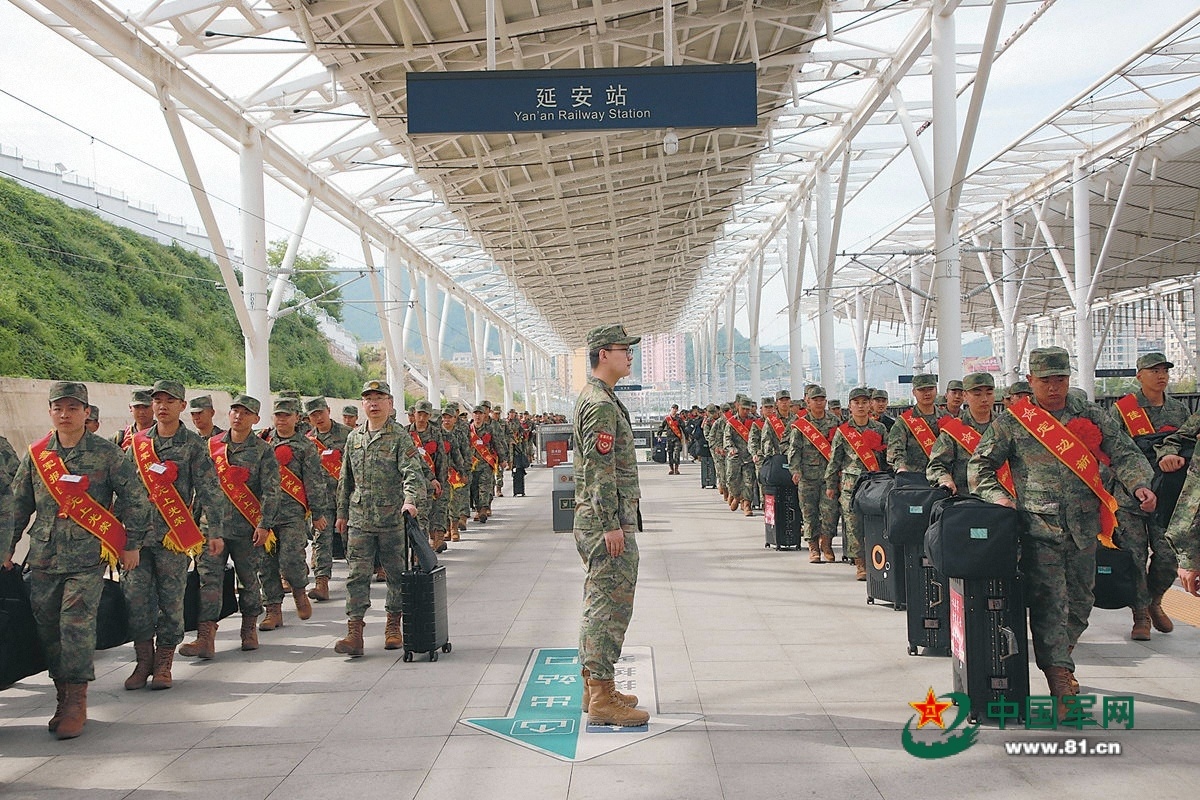
The military representative coordinates with the station to open a green channel, organizing new recruits to board the train in an orderly manner. Photo by Wu Pei
At 6 a.m., in the square in front of a high-speed railway station, new recruits dressed in the 21-style training uniform stand in neat rows. They wear red flowers on their chests, and passing travelers can't help but slow down and cast admiring glances.
A special high-speed train for transporting new recruits, named "Strong Army," has been waiting at the platform for some time. On the platform, military representatives check information with the station staff while holding a plan roster, and the train conductor confirms the boarding list at the train door. Once boarding is complete, the train departs. Hundreds of new recruits take this special train and arrive at a certain unit's camp thousands of kilometers away on the same day.
As they watch the special train leave, a military representative remarked, "For the same journey, new recruits used to take green trains, needing to transfer multiple times and taking several days to arrive."
From "days of detours" to "direct arrival in one day," it's not just the travel speed that has changed. In today's rapidly evolving technology and accelerating economic and social development, our army's strategic delivery system is undergoing a profound transformation: the road network is becoming denser, the system is becoming more interconnected, and the methods are becoming increasingly intelligent. Behind the "acceleration" of delivery is the resounding footprint of national defense and military modernization transformation.
From "chartered trains" to "regular ticket purchases," the transportation model has become more flexible and diverse. In recent years, as the national transportation network continues to improve, the methods of transporting new recruits have changed, with an increasing number of flight ticket purchases and high-speed rail transport. In aviation, previously, the focus of new recruit air transport support was on regions with inconvenient transportation such as Xinjiang, Tibet, Qinghai, and Yunnan, as well as new recruits in border defense and island troops; now, with the continuous improvement of airport construction in these regions, most areas have adopted flight ticket purchasing methods for organization and implementation, except for chartered flights mainly arranged for entering and exiting remote areas.
From "multiple transfers" to "one-stop direct service," the travel time has been effectively compressed. With the further improvement of the national high-speed rail network, new recruit transportation can basically reach the camp directly without transfers. Transportation departments at all levels prioritize direct trains when formulating new recruit railway transportation plans, reducing the number of transfers and travel time for new recruits. In 2024, a "one-stop" direct delivery model was implemented, with the proportion of railway direct plans accounting for 53% throughout the year. In the spring of 2026, 88% of the total new recruit transportation was completed within five days after departure, with nearly 90% of new recruits able to reach the camp within 24 hours.
From "able to transport" to "able to travel well," the experience of new recruits during transportation continues to improve. With the reduction in the number of transfers and the increase in the direct service ratio, the transportation chain from assembly to camp entry has become smoother. "Leaving home in the morning and arriving at the unit in the evening. The special train for new recruits has brought the distance between home and the barracks closer." This sentiment expressed by one new recruit resonates with everyone.
From "measured in days" to "measured in hours," from "multiple transfers" to "one-stop direct service," the concept of rapid arrival across the board is gradually transforming into a visible and tangible transportation support capability. A military representative who has participated in new recruit transportation support tasks for many years told reporters: "In the past, when making plans, the first thought was how to deploy troops; now, when making plans, the focus is on how to make troop deployment more efficient, safer, and more convenient. The new transportation concept has led to continuous improvements in delivery efficiency."
In the 1980s and 1990s, cross-regional troop deployment mainly relied on conventional railways and road motorized mobility. It was common for military trains to encounter capacity conflicts during transit, requiring temporary adjustments, with soldiers often "waiting for trains" and "waiting for orders" at stations. As many military representatives have said: "The slowness back then was due to a single capacity, temporary coordination, and outdated methods—high-speed rail had not yet formed a network, civil aviation capacity was limited, and long-distance transport was basically 'one railway all the way.'" "Planning relied on phone calls, faxes, and manual ledgers, vehicle allocation depended on experience, and in-transit monitoring relied on hierarchical reporting"...
With the continuous development of national transportation infrastructure, a comprehensive three-dimensional transportation network has been basically established, with high-speed rail as the backbone, conventional railways as the foundation, expressways as extensions, and trunk aviation as supplements. The transportation delivery system in the new era is gradually taking shape, transitioning military transportation from "segmented support" to "joint support"; the intelligent delivery mechanism is becoming increasingly refined, with information-based scheduling platforms replacing traditional phone books, planning tables, and manual ledgers, and the dynamic perception capability of new recruit transportation has been comprehensively enhanced.
The acceleration of new recruit delivery reflects the improvement of national transportation infrastructure construction levels and also reflects the leap-forward development of our army's transportation delivery capabilities. As a leader from a certain dispatch center said: "The improvement in new recruit transportation delivery efficiency tests the winning capability of the joint delivery system."
The People's Liberation Army (PLA) transported hundreds of new recruits across China using high-speed trains in Autumn 2026. This new logistics system has reduced travel time from several days to just one day, showcasing significant improvements in military transportation efficiency. The PLA's strategic transportation capabilities have been enhanced, allowing for direct routes and minimizing the need for multiple transfers.
- New recruits are transported efficiently by high-speed trains.
- Transportation time has been reduced from several days to one day.
- The PLA has improved its strategic transportation capabilities.
- Direct transportation routes have been established, minimizing transfers.
- The new transportation system reflects advancements in military logistics.