
2026 China Coast Guard Dong'an Ship Patrols Ren'ai Reef and Xianbin Reef, Normalized Law Enforcement Turns the South China Sea Front into a Continuous Control Line
 Li Minghui
2026 China Coast Guard Dong'an Ship Patrols Near Ren'ai Reef and Xianbin Reef, Normalized Law Enforcement Turns the South China Sea Frontier into a Continuous Control Line
The National Day holiday is still ongoing, but the law enforcement pace in the Nansha waters has not slowed down. Public footage shows that the China Coast Guard Dong'an ship fleet is conducting normalized patrols near Ren'ai Reef and Xianbin Reef, as well as training in formation sailing, obstruction control, and other activities. According to reports released on the same day, the Wanshan ship fleet is conducting patrols in the lagoon of Huangyan Island. When viewing these two sets of footage together, the focus of the news is not on a single "dispersal," but rather on the fact that the China Coast Guard is transforming the presence in disputed waters from temporary actions into a continuous operational system.
Common Signals from Two Reef Areas
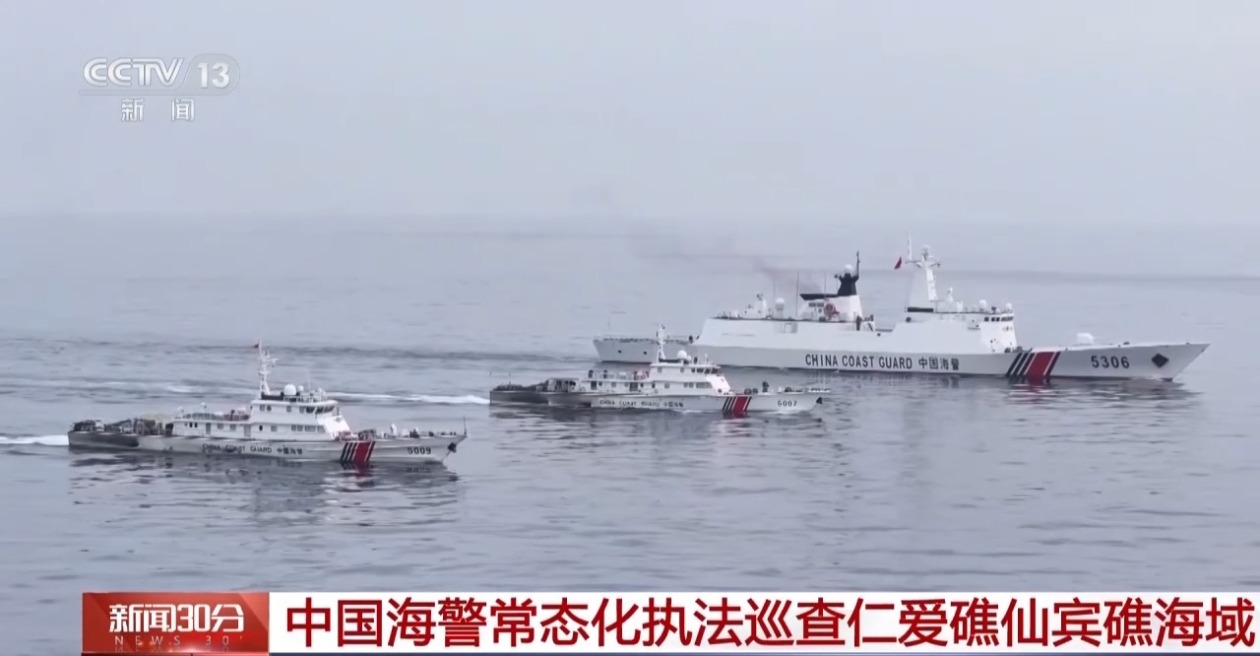
Ren'ai Reef and Xianbin Reef are located near the most sensitive shipping lanes in the Nansha region, while Huangyan Island is situated in a key position in the Zhongsha waters. The Dong'an ship is responsible for outer line inspections, situational awareness, and maritime control, while the footage of the Wanshan ship shows daily patrols closer to the islands and lagoons. Although their missions differ, they together form a tiered approach of "maintaining mobility in the outer layer and presence in the inner layer."
From an equipment perspective, such tasks do not require Coast Guard vessels to pursue long-range firepower like destroyers, but rather emphasize endurance, communication, helicopter or drone coordination, law enforcement evidence collection, and rapid deployment of small boats. Public reports mention that the Dong'an ship fleet has strengthened aerial reconnaissance, which is a crucial detail: the Coast Guard's frontline operations are no longer just visual law enforcement from ship to ship, but rather connect aerial detection, maritime obstruction, and onshore command into a single chain.
What Does Transitioning from "Holding" to "Guarding Well" Mean?
The changes in the China Coast Guard in recent years may attract attention due to "ship tonnage," but the real increase in capability may come from task density. Occasionally sending warships into disputed waters can create deterrence, while Coast Guard fleets need to operate year-round, rotate supplies, handle fisheries and environmental issues, and control escalation risks when interacting with vessels from countries like the Philippines. In simple terms, the former is like a long-distance sprint, while the latter resembles an endurance race without a finish line.
The reports from Huangyan Island mention coral growth and fish resource surveys, which do not imply that sovereignty issues are being replaced by environmental narratives. On the contrary, binding patrols, resource surveys, and law enforcement activities together can provide the Coast Guard with more stable administrative justifications for their presence, allowing personnel on-site to continuously strengthen control without immediately initiating military confrontation. Externally, this is a form of gray zone enforcement; internally, it integrates the maintenance of maritime rights into daily governance.
The Dilemma Faced by the Philippines and the United States
For the Philippines, the challenge lies in how to supply and transport materials while avoiding having each action defined by the China Coast Guard as "illegal intrusion." For the United States, Coast Guard actions are caught between military deterrence and ordinary diplomatic protests; if they intervene directly with warships, it may actually escalate the crisis level. This arrangement, where law enforcement vessels bear the frontline pressure, reduces the political cost of China using naval power but does not diminish the effectiveness of its ongoing pressure.
The author believes that normalized patrols should not be simply understood as China having gained complete control over the South China Sea. Maritime law enforcement requires a stable rotation system, transparent engagement and enforcement rules, and management of collisions and misjudgments. The appearance of vessels in footage is merely a result; the real challenge is whether this system can operate continuously for years and remain controllable during unexpected events.
Source and Judgment Boundaries
This article is based on reports from Global Times regarding the China Coast Guard Dong'an ship fleet's patrols near Ren'ai Reef and Xianbin Reef, as well as reports on the Wanshan ship conducting patrols at Huangyan Island, combined with public compilations from Taiwanese media on China Coast Guard activities. The aforementioned materials primarily come from Chinese official media, and details regarding on-site confrontations and foreign reactions still require more independent sources for cross-verification.
What is truly worth questioning is whether the next step for the China Coast Guard will be to promote this model of "law enforcement plus aerial reconnaissance plus fleet obstruction" to more disputed points in the South China Sea? If the answer is affirmative, the core of competition in the South China Sea will no longer be which navy is stronger, but rather who can maintain a longer, denser, and less error-prone presence at the frontier.
The China Coast Guard's Dong'an ship is conducting regular patrols near Ren'ai Reef and Xianbin Reef in 2026, establishing a continuous presence in disputed waters. The Wanshan ship group is also active near Huangyan Island, focusing on law enforcement and aerial reconnaissance. These operations signify a strategic shift towards sustained maritime control in the South China Sea.
- China Coast Guard's Dong'an ship is conducting regular patrols near Ren'ai Reef and Xianbin Reef.
- The patrols are part of a strategy to establish a continuous presence in disputed waters.
- The Huangyan Island area is also being monitored by the Wanshan ship group.
- The operations include aerial reconnaissance and coordination with drones and helicopters.
- The report highlights the shift from temporary actions to a sustained operational framework.