
2026 Fujian Ship Training Pipeline Expansion: PLA Aircraft Carrier's Long-Distance Capability Stalled by Talent Production Capacity
 Li Minghui
2026 Fujian Ship Training Pipeline Expansion: PLA Navy Aircraft Carrier's Long-Distance Capability Stalled by Talent Production
On July 13, the South China Morning Post cited a new report from the International Institute for Strategic Studies in London, stating that the PLA Navy is expanding its recruitment and training channels for carrier-based aviation personnel. This news may not be as eye-catching as the Fujian ship's catapult or the J-35's deployment, but in my view, it is closer to the next hard threshold in China's aircraft carrier program.
In the past, discussions about Chinese aircraft carriers have focused on three aspects: hull tonnage, electromagnetic catapults, and aircraft types. The problem is that an aircraft carrier is not just a large piece of equipment; it is a maritime airport that must operate daily. Whether an airport can operate at sea often depends not on the existence of a runway but on the ability to continuously assemble qualified pilots, deck controllers, maintenance crews, munitions, radar, and damage control teams.
From Temporary Assignments to Fixed Pipelines
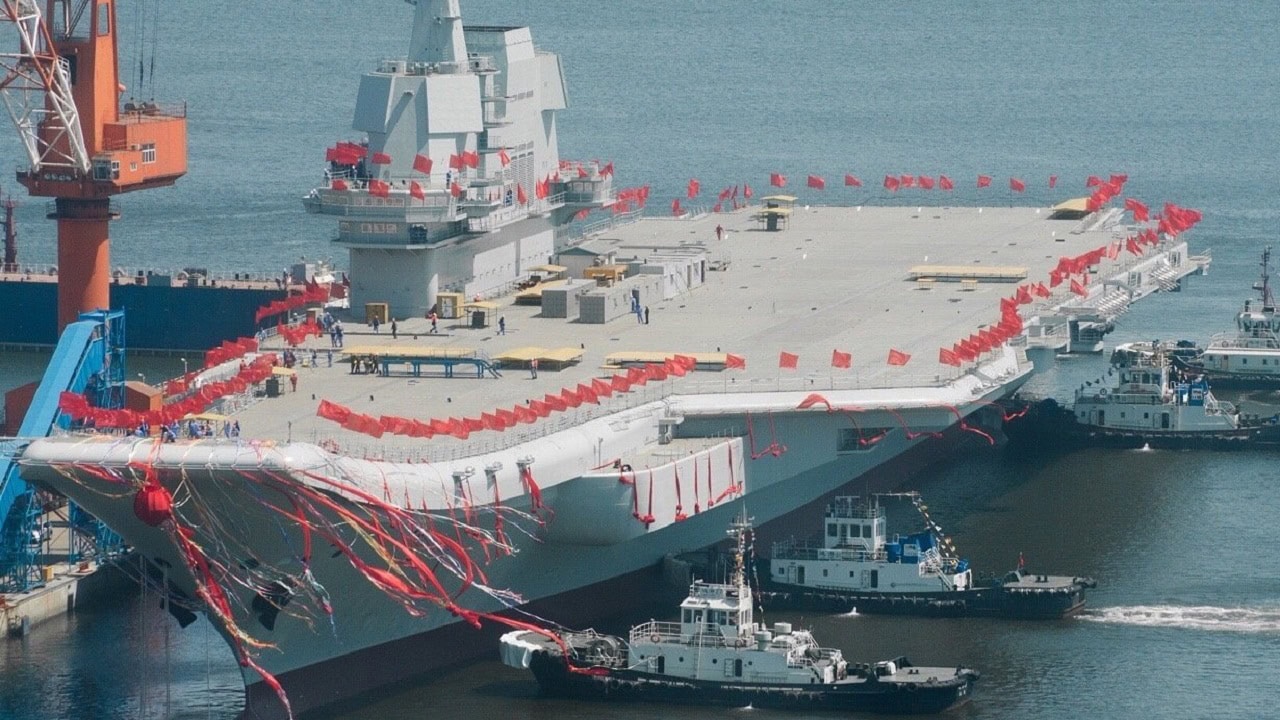
A key detail revealed by SCMP is that the Navy is no longer primarily relying on mature pilots drawn from active aviation units but is expanding its sources through local universities and specialized programs aimed at high school graduates. The implication of this change is straightforward: carrier-based aviation is shifting from a "project-based supplement" to "industrialized supply."
During the Liaoning and Shandong era, J-15 pilots were themselves a scarce resource, and the training focus was on mastering the takeoff and landing procedures. With the addition of the Fujian ship, the situation becomes much more complex. It is expected to carry the J-35 stealth fighter, the J-15T catapult-equipped heavy carrier-based aircraft, and the KJ-600 fixed-wing early warning aircraft. The flight envelopes, deck support, and task divisions of these three types of aircraft are completely different, which also raises different requirements for the instructor team and ground support system.
The Real Consumption of the Fujian Ship is Skilled Workers
According to publicly available information, the Fujian ship uses an electromagnetic catapult and an arrestor recovery system, which will increase the payload and takeoff weight of carrier-based aircraft but also complicate deck rhythm management. In simple terms, while the catapult allows aircraft to carry more fuel and munitions into the sky, it does not automatically make the deck operations smarter. Each launch and recovery must precisely coordinate fuel, munitions, towing, inspections, and takeoff/landing windows.
This is why expanding personnel recruitment is more significant than a single sea trial. The combat capability of an aircraft carrier is not about one or two ace pilots performing impressive maneuvers but about a flight group repeatedly operating under high-intensity conditions. A U.S. Navy nuclear-powered aircraft carrier typically supports thousands of crew members and aviation personnel. If the Chinese Navy wants to rotate three aircraft carriers, what is actually needed is several sets of interchangeable flight and support teams, not just a star lineup.
Long-Distance Operations Expose Shortcomings
Recent discussions about the Fujian ship potentially being equipped with a 324mm lightweight anti-torpedo launch system also highlight the same issue. Asia Times cited SCMP and related research stating that the Fujian ship's anti-torpedo "hard kill" capability may be aimed at countering the threat of heavy torpedoes from U.S. attack submarines. This judgment is reasonable, but I do not believe that a point defense system can fill the Chinese Navy's anti-submarine shortcomings.
Once the aircraft carrier is away from the protection of land-based aviation, the real test is the system: whether fixed-wing early warning aircraft can operate stably, whether escort destroyers can sustain anti-submarine operations, whether carrier-based helicopters and underwater sensors can share data, and whether damage control and maintenance can operate in a closed loop at sea. Each of these aspects requires personnel. Equipment can buy time, but training determines whether that time can be converted into combat capability.
Three Observation Points
- First, observe whether the KJ-600 enters high-frequency public training scenarios, as it determines whether the Fujian ship can form an independent air situation center.
- Second, watch whether the J-35 and J-15T begin mixed deck operations; individual aircraft appearances are of limited significance, while mixed scheduling is the real skill.
- Third, monitor whether the sources of carrier-based pilots continue to expand to local universities and early selection, as this relates to the talent redundancy for the future fourth aircraft carrier.
Interestingly, the PLA Navy stated in 2022 that the transition from "land-based forces" to "ship-based forces" was basically complete. However, from the perspective of training capacity, this statement seems more like a first-stage acceptance rather than a final answer. The ships can be built, and the aircraft can gradually be equipped, but the most challenging aspect to replicate quickly remains personnel.
What is truly worth questioning is not how many sea trials the Fujian ship can complete this year, but whether the Chinese Navy can produce a second and third batch of qualified carrier-based aviation personnel by around 2028. If not, the increase in the number of aircraft carriers will first become a training pressure rather than a long-distance advantage.
The People's Liberation Army Navy is expanding recruitment and training channels for naval aviation personnel as of July 13, 2026, to enhance its operational capabilities. This shift aims to transition from temporary personnel assignments to a more sustainable, industrialized approach. The Fujian aircraft carrier is set to operate advanced aircraft, necessitating a skilled workforce to ensure effective operations at sea.
- The PLA Navy is expanding recruitment and training for carrier aviation personnel.
- The shift is from temporary assignments to a more industrialized supply of personnel.
- The Fujian aircraft carrier will operate J-35 and J-15T aircraft, requiring a skilled workforce.
- The effectiveness of the carrier depends on the ability to maintain a qualified crew and support personnel.
- Concerns exist about the PLA Navy's anti-submarine capabilities and operational readiness.