
Supply Capability of Distributed Maritime Operations First Verified by Japan and the U.S. in Pacific Atlas 26-1
 Tanaka Takashi
Logistical Capabilities of Distributed Maritime Operations Verified by Japan and the U.S. in Pacific Atlas 26-1
During Pacific Atlas 26-1, held off the coast of Yokosuka from June 15 to 19, the focus was not on missiles or large ships, but rather on the verification of at-sea logistics by the U.S. Coast Guard's Legend-class cutter Midgett, the Japan Coast Guard patrol vessel Yumi-hari, and the Japan Maritime Self-Defense Force's 21st Air Wing anti-submarine patrol helicopters. According to a statement released by the U.S. Pacific Fleet on July 1, this exercise was the first logistical demonstration aimed at verifying communication, supply procedures, and the concept of sustained operations.
The Small Reality Indicated by VERTREP
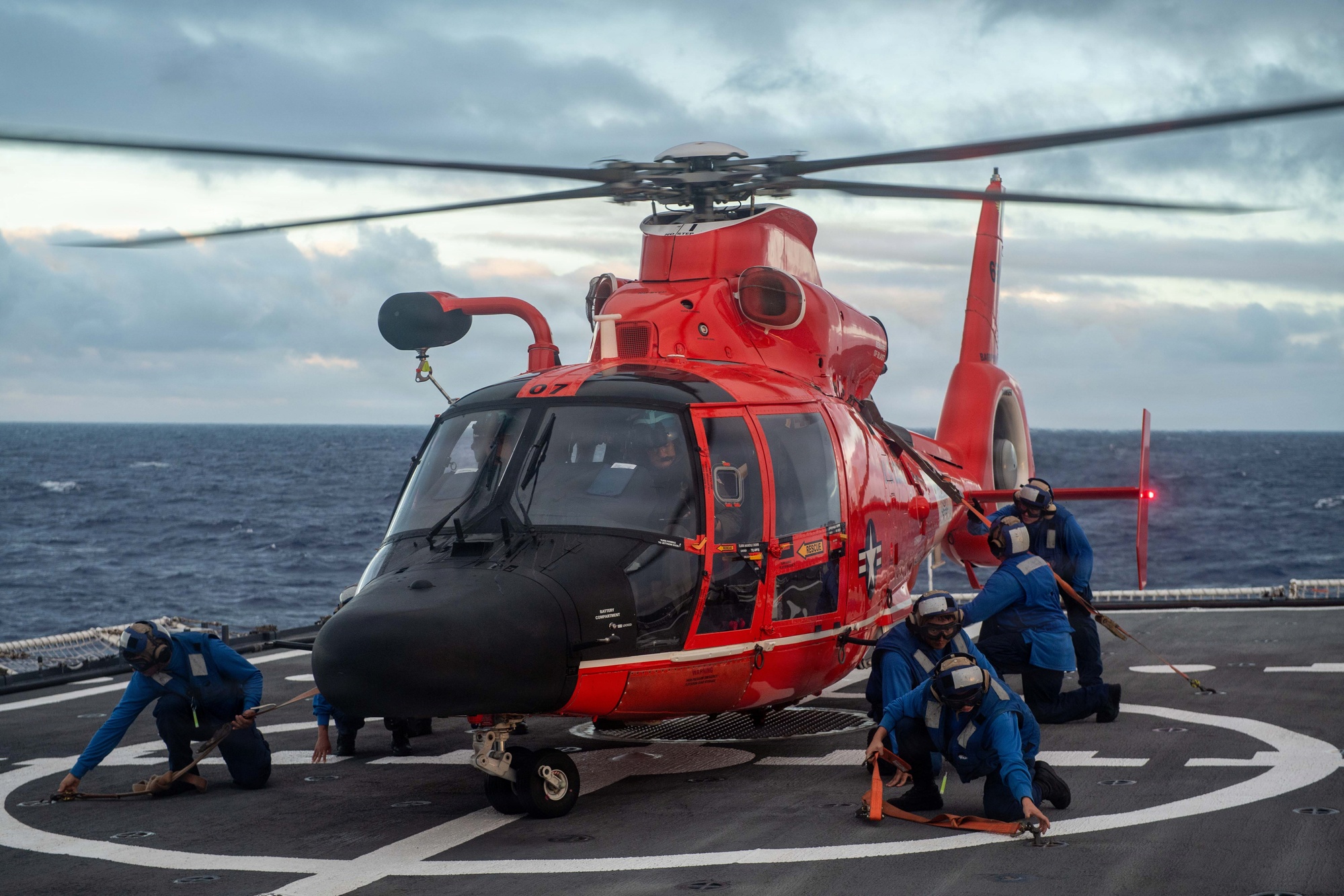
The focus this time was on VERTREP, or vertical replenishment by helicopter. The announcement stated that Yumi-hari and Midgett transferred supplies via aircraft, demonstrating agile logistics capabilities at sea. In terms of scale, it may seem small compared to large fleet exercises. However, what is truly at stake in the waters from the southwestern islands to the vicinity of Taiwan is not the number of vessels, but how many days a distributed force can be sustained.
The Significance of Coast Guard Participation
What I find noteworthy is the combination of the Japan Maritime Self-Defense Force, the Japan Coast Guard, and the U.S. Coast Guard. In gray zone situations, it is not necessarily the escort ships that come to the forefront first. The Japan Coast Guard's patrol vessels support the scene, the Japan Maritime Self-Defense Force provides information and air support from the rear, and the U.S. side complements broad deterrence, which is closer to reality than theoretical integrated operations.
Logistical Challenges After Valiant Shield
During the same period, Japan and the U.S. are increasing operational tempo connecting Kyushu, the southwestern region, and Guam through Valiant Shield 2026 and Resolute Dragon 26. Furthermore, there are reports that the U.S. military's Typhon medium-range missile system will be deployed in joint training in Kagoshima, making the firepower deployment along the first island chain more concrete than before. However, as firepower moves forward, the lines for fuel, ammunition, communication parts, and medical transport become thinner.
The U.S. Pacific Fleet's announcement positioned Pacific Atlas as a demonstration of the "ability to sustain distributed maritime operations." This expression is modest, but it carries significant weight for the Japan Maritime Self-Defense Force.
Remaining Weaknesses
During the Cold War, the Japan Maritime Self-Defense Force trained with a focus on SLOC (Sea Lines of Communication) defense. Today's challenge is not only to protect the same SLOC but also to manage logistics within the island lines that may come under attack. A single VERTREP by Midgett and Yumi-hari will not change the course of the battle. If such small procedures are not built up from peacetime, long-range firepower like the Type 12 surface-to-ship guided missile or Typhon may remain a political symbol just days later. The true challenge lies not in extending range, but in the endurance of logistics that supports that range.
Key Reference Information
- U.S. Pacific Fleet, U.S., Japanese forces conduct Pacific Atlas 26-1, 1 July 2026
- Ministry of Defense Joint Staff Office, July 10 announcement on Japan-U.S. joint training
- USNI News, U.S. and partners wrap Valiant Shield 2026, 1 July 2026
- The Japan Times, Typhon midrange missile system deployment reporting, 21 June 2026
U.S. and Japanese forces conducted the Pacific Atlas 26-1 exercise from June 15 to 19, 2026, off Yokosuka, verifying logistics capabilities for dispersed maritime operations. The exercise featured the U.S. Coast Guard Cutter Midgett and Japan Coast Guard Patrol Vessel Yumehari, demonstrating vertical replenishment (VERTREP) operations. This event aimed to assess communication and supply procedures for sustained operations in the region.
- The Pacific Atlas 26-1 exercise took place from June 15 to 19, 2026, off Yokosuka.
- The exercise involved U.S. and Japanese forces verifying logistics capabilities for dispersed maritime operations.
- Key units included the U.S. Coast Guard Cutter Midgett and Japan Coast Guard Patrol Vessel Yumehari.
- The focus was on vertical replenishment (VERTREP) operations using helicopters.
- The exercise aimed to test communication, supply procedures, and sustained operations concepts.