
2026 PLA Type 076 Drone Carrier Accelerates Formation: What Is Missing for Maritime Swarm Warfare?
 Li Minghui
2026 PLA Type 076 Drone Aircraft Carrier Accelerates Formation: What Is Missing for Maritime Swarm Operations?
Recently, discussions about China's "drone aircraft carrier" have noticeably intensified. What is most noteworthy here is not simply renaming the Type 076 amphibious assault ship as an aircraft carrier, but rather its potential to transform maritime drones from single-unit reconnaissance tools into sustainable operational units. Public footage shows that the Type 076 features a large, continuous flight deck, side elevators, and a deck layout compatible with fixed-wing drone operations. As for whether the electromagnetic catapult has reached a stable and practical state, public information remains insufficient, and photos cannot be interpreted as conclusions about combat capability.
What the Type 076 Truly Changes
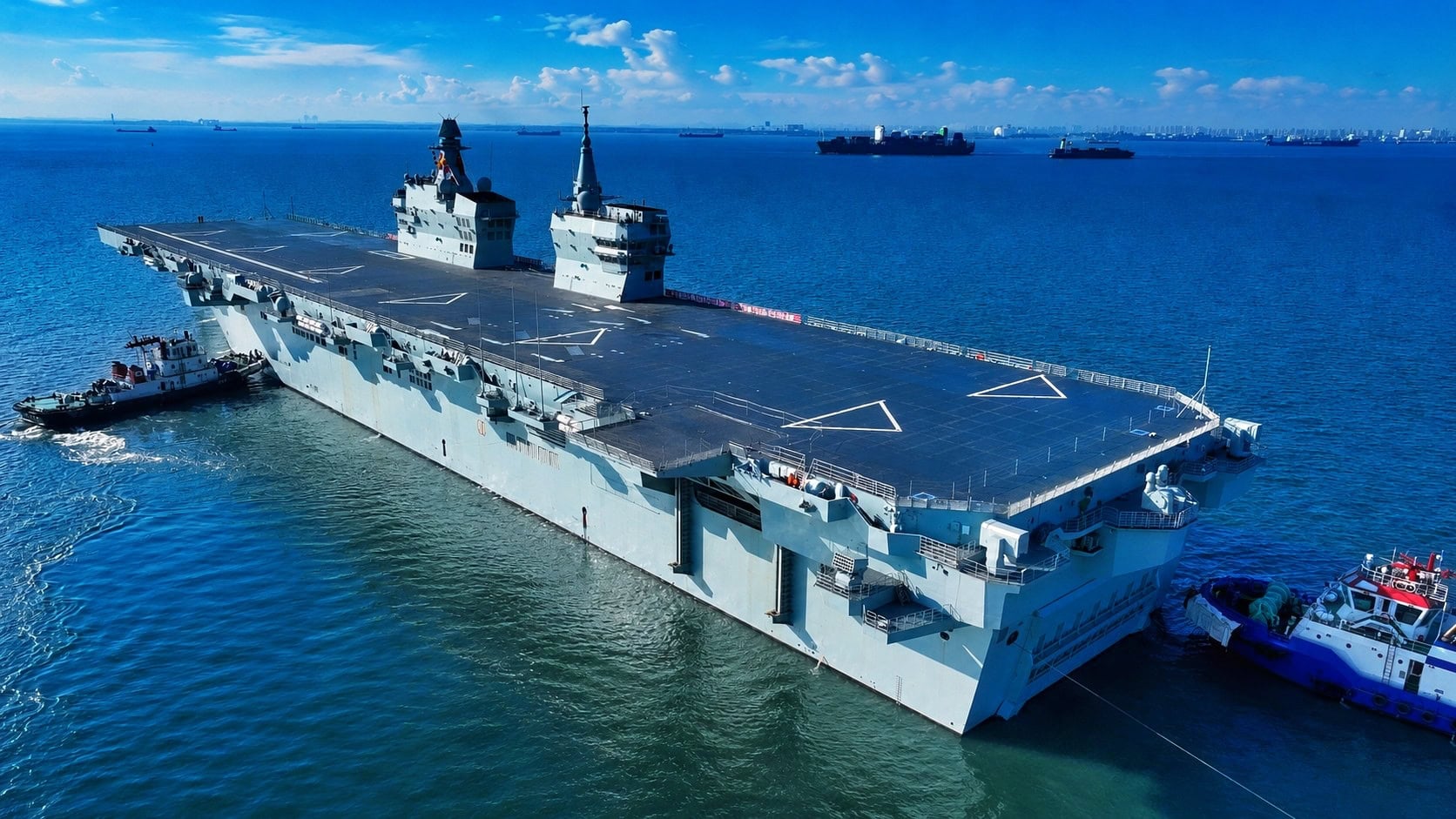
The core metric of traditional aircraft carriers is the sortie rate of manned carrier-based aircraft, while the Type 076 is more likely to pursue a different set of calculations: how many low-cost drones can be launched at once, whether they can maintain reconnaissance, deception, electronic suppression, and target indication hundreds of kilometers away, and whether they can be recovered or sacrifice some platforms after the mission. Drones are small, with low maintenance and training costs, making them suitable for converting deck space into a numerical advantage. In simple terms, this is not about replacing a batch of small aircraft on the Liaoning, but transforming the vessel into a mobile aerial node.
From Single Ship Demonstration to Systematic Operations
The November analysis by The Diplomat discusses China's "drone aircraft carrier" within the framework of swarm operations, pointing out that the controversy lies not in whether it can carry drones, but in command and control, data links, and mission coordination. This judgment is crucial. A drone swarm requires stable satellite communication or relay nodes, needs fleet air defense systems to protect the mother ship, and also requires land-based reconnaissance satellites, early warning aircraft, and long-range firepower to provide target cues. If any link fails, the swarm could devolve into a batch of expensive remote-controlled target drones.
From an equipment combination perspective, the Type 076 is best suited for three types of missions. The first is long-range maritime surveillance, providing continuous sea and air situational awareness for the Eastern and Southern Theater Commands; the second is to consume the opponent's air defense radar attention using decoys and electronic warfare drones; the third is to conduct saturation reconnaissance on surface vessels and coastal nodes, providing more reliable target data for anti-ship ballistic missiles, cruise missiles, or manned fighter jets. It may not necessarily need to carry heavy munitions; being able to make "target discovery" and "target exposure" cheaper already has tactical value.
Shortcomings Still Exist in Shipboard Support and Data Links
The author believes that the outside world tends to overestimate the Type 076's deck while underestimating its hangar and logistics. A swarm is not simply about stacking up the number of aircraft. High-frequency operations will quickly deplete batteries, engines, antennas, and composite material components, and the ship must also complete software loading, fault isolation, damage control, and recovery in sea conditions. If drones need to rely on shore-based personnel for remote operation, the fleet's autonomy in complex electromagnetic environments will be compromised. China's military industry has a scale advantage in drone manufacturing and communication equipment, but a high-reliability support system at sea has yet to be publicly verified.
The two recent analyses by The Diplomat regarding the extension of China's maritime and aerial forces and Taiwan Strait blockade exercises also hint at the same direction: the PLA is integrating long-range reconnaissance, unmanned systems, and maritime forces into a continuous denial network. Therefore, the Type 076 resembles a system node rather than a "super aircraft carrier" solely responsible for air superiority missions. Whether it can transition drones from demonstration flights to continuous operations at sea over several days is the key to assessing its value.
The Real Questions Remain Unanswered
Currently, there is not enough public evidence to prove that the Type 076 has developed mature carrier-based drone swarm capabilities. What is worth noting is not how large its deck is when it is launched, but whether future public footage will show fixed-wing drones being continuously catapulted, coordinated recovery, and completing missions under strong electromagnetic interference. If the PLA resolves these three aspects, the Type 076 could become a new aerial consumption and perception platform within the first island chain; if it cannot, it remains merely an advanced-looking experimental ship whose utility is still being validated.
References
China is accelerating the development of the 076-type drone carrier, which aims to deploy swarms of low-cost drones for military operations. The carrier is designed to enhance maritime surveillance and electronic warfare capabilities. However, challenges remain in command control and data link systems necessary for effective swarm operations. Currently, there is insufficient evidence to confirm the maturity of these capabilities.
- China is accelerating the development of the 076-type drone carrier.
- The carrier is designed to deploy swarms of low-cost drones for various military operations.
- Challenges remain in command control and data link systems for effective swarm operations.
- The PLA aims to enhance maritime surveillance and electronic warfare capabilities with this carrier.
- There is currently insufficient evidence to confirm the maturity of the drone swarm capabilities.