
2026 US-Taiwan CG125 Coast Guard Photos Exposed, PLA Coast Guard Patrols in Eastern Taiwan Enter a New Phase
 Li Minghui
2026 US-Taiwan CG125 Coast Guard Photo Exposed, PLA Coast Guard Patrols in Eastern Taiwan Enter a New Phase
On July 29, the most interesting photo was not of fighter jets or aircraft carriers, but of a Taiwanese Coast Guard vessel alongside the US Coast Guard system. The American Institute in Taiwan publicly released photos of US-Taiwan maritime cooperation, indicating that both sides are maintaining coordination in search and rescue, disaster relief, and maritime law enforcement. The photo itself did not provide the time and sea area of the shoot, but the timing of its release is significant: previously, Beijing had announced that the Chinese Coast Guard would conduct regular law enforcement patrols in the waters east of Taiwan.
The Signals Behind the Photo
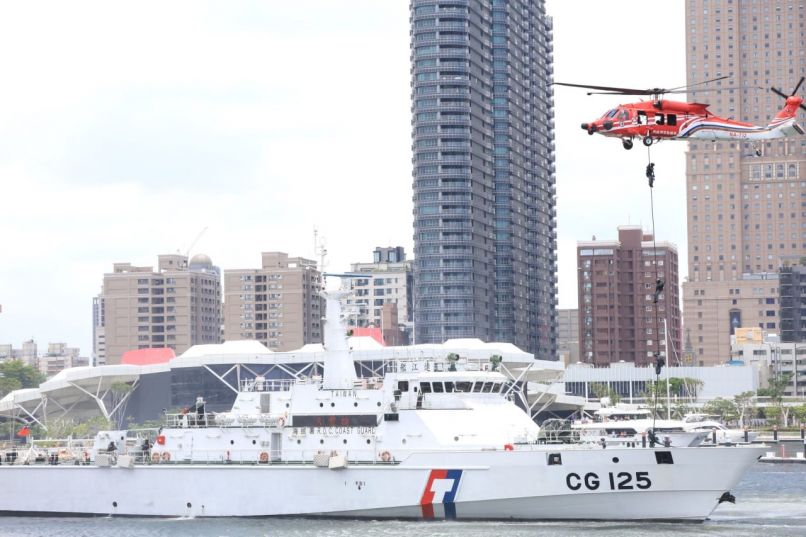
In the past, discussions about military pressure in the Taiwan Strait often focused on the J-16, H-6K, Type 055 destroyers, and aircraft carrier formations. However, a change in 2026 is that the Coast Guard and maritime law enforcement vessels are beginning to take on more frontline roles. On the same day, the South China Morning Post disclosed that the US had rarely made public photos of US-Taiwan Coast Guard cooperation, with analysts believing this is related to Beijing's expansion of the Coast Guard presence east of Taiwan. This direction is more noteworthy than a single military aircraft crossing the median line, as it may not necessarily trigger a military crisis but can continuously alter the default state of maritime management.
The waters east of Taiwan are not ordinary coastal channels. In wartime, they are crucial for US and Japanese support for Taiwan's maritime routes, while in peacetime, they connect search and rescue, fisheries law enforcement, submarine cable protection, and commercial shipping routes. By pushing Coast Guard patrols into these waters, Beijing is effectively advancing its law enforcement presence into the rear waters within the first island chain. In simple terms, this is not just about intercepting a single vessel, but about making external forces face the question of "who is enforcing the law" every time they approach.
Decreased Air Sorties Do Not Equal Decreased Pressure
The same set of background data is also worth considering together. According to statistics from Taiwan's defense department reported by the South China Morning Post, the activity of PLA aircraft around Taiwan in the first half of 2026 dropped to a three-year low, with about 1,334 sorties, more than a 50% decrease compared to the same period last year. On the surface, aerial pressure has decreased; however, if the proportion of Coast Guard, drones, helicopters, and naval patrols increases, the pressure in the Taiwan Strait has merely shifted its carrier.
This aligns with the PLA's relatively clear system thinking in recent years: high-intensity military displays are used for delineation, while low-intensity platforms are used to solidify the new normal. Large-scale military aircraft deployments are costly, send strong political signals, and can easily provoke external reactions; Coast Guard vessels, drones, and helicopters resemble a set of slow-wear tools, with low operational costs, significant legal discourse space, and the ability to accumulate data on maritime conditions, hydrology, communications, and target identification for subsequent military actions.
The Real Value of Coast Guard Platforms
Many people underestimate Coast Guard vessels because they lack vertical launch systems and anti-ship missiles. However, from the perspective of the Taiwan Strait scenario, Coast Guard platforms have at least three types of value:
- First, they establish on-site law enforcement records, creating a continuous archive of the actual presence in disputed waters.
- Second, they force Taiwan's Coast Guard and relevant US-Japan units to respond in non-military ways, compressing the other side's options for escalation.
- Third, they provide the Navy and Rocket Force with regular situational maps, especially regarding vessel traffic and emergency routes in the waters east of Taiwan.
I believe that what truly matters is not the tonnage of individual Coast Guard vessels, but their scheduling, resupply, and rotation capabilities. The ability to go once a week versus the ability to maintain continuous operations over the long term are entirely different capabilities. In recent years, the Chinese Coast Guard has received a large number of high-tonnage vessels, relying on China's civilian and public shipbuilding industrial chain; this production capacity may not attract attention like aircraft carriers do, but it is more likely to turn gray zone operations into routine actions.
What Shortcomings Are Being Addressed by the Public Release of Photos?
The US's release of these photos ostensibly discusses search and rescue, disaster response, and maritime law enforcement exchanges, but in reality, it is providing Taiwan's Coast Guard with international visibility. The Taiwanese Air Force can intercept, and the Navy can monitor, but in the face of regular Coast Guard patrols, it is often the Coast Guard department that is pushed to the front line. By bringing cooperation to the forefront, the US hopes to convey to Beijing: the waters east of Taiwan are not solely defined by the mainland Coast Guard.
However, there is also a problem here. Coast Guard cooperation can enhance situational awareness and response procedures, but it is difficult to directly change the balance of power. The US Coast Guard's presence in the Western Pacific is limited, and Japan's Coast Guard also has its own legal boundaries. If Taiwan is to respond to the mainland Coast Guard's eastward movements in the long term, it will ultimately rely on larger Coast Guard vessels, denser shore-based radar, drone patrols, and communication backups. Building this system is much more tedious than purchasing a few high-profile weapons, but it may be closer to the reality of the Taiwan Strait front line.
Public information shows that Beijing has recently emphasized conducting regular Coast Guard patrols in the waters east of Taiwan; the US has stated its support for Taiwan's participation in maritime law enforcement exchanges and international cooperation. When viewed together, these two statements indicate that competition in the Taiwan Strait is gradually shifting from air sortie counts to maritime law enforcement logs.
What should be closely monitored next is not how many J-16s cross the median line next time, but whether the Chinese Coast Guard will establish fixed patrol routes in eastern Taiwan, and whether the Taiwanese Coast Guard will show more frequent joint training images with the US and Japan. The outcomes in the gray zone are often first recorded in these less headline-grabbing attendance sheets.
On July 29, 2026, the U.S. and Taiwan Coast Guards showcased their cooperation in maritime law enforcement through shared operational photos. This development follows China's increased Coast Guard patrols in waters east of Taiwan, indicating a shift in regional maritime dynamics. The U.S. aims to enhance Taiwan's international visibility in maritime operations, while Taiwan's air defense pressure has decreased, with a corresponding rise in maritime patrol activities.
- U.S. and Taiwan Coast Guard cooperation is highlighted through shared operational photos.
- China has increased its Coast Guard patrols in waters east of Taiwan.
- The report indicates a shift in maritime enforcement roles in the Taiwan Strait.
- Taiwan's air defense pressure has decreased, but maritime patrols have increased.
- The U.S. aims to enhance Taiwan's international visibility in maritime law enforcement.