
2026 USS Cleveland Shows the US Navy Pacific Small Ship Gap
 Marcus Chen
2026 USS Cleveland Shows the US Navy Pacific Small Ship Gap
Sixteen Freedom-variant littoral combat ships is where the line ends. USS Cleveland entered service after its May 16, 2026 commissioning in Ohio, closing the Lockheed Martin and Fincantieri Marinette Marine production run and giving the Navy one more fast, shallow-draft hull. That sounds like a modest fleet-management event. It is more useful than that because it exposes a harder question for the Pacific: what does the U.S. Navy use when a destroyer is too valuable, a patrol boat is too light, and a frigate is not yet available in enough numbers?
The answer cannot simply be “send another Burke.” Anyone who has stood watch on a destroyer knows the problem. The ship can escort a carrier, provide air defense, hunt submarines, launch Tomahawks, screen logistics traffic, show presence, and answer every crisis tasker from Fifth Fleet to Seventh Fleet. It cannot be in three places at once. The Navy’s small-ship problem is not about prestige. It is about operating days.
Cleveland Adds Speed, Not Missile Depth
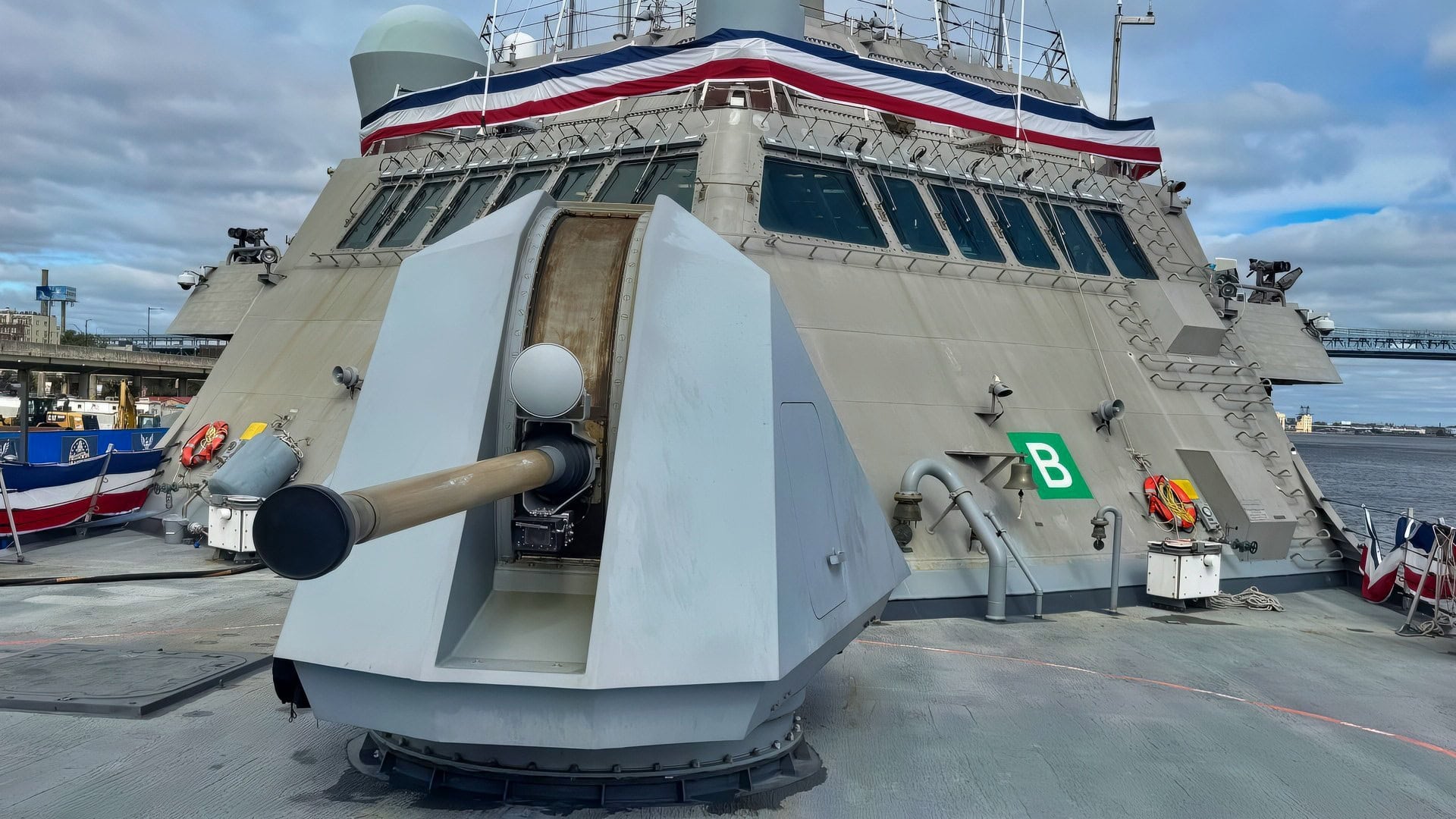
Army Recognition reported on May 18 that Cleveland is configured for maritime security, interdiction, escort, and near-shore surface warfare missions. Lockheed Martin lists the Freedom variant at 118.1 meters long, about 3,450 metric tons full-load displacement, 14.1 feet of draft, and more than 40 knots of speed. The basic package includes a 57mm Mk 110 gun, Rolling Airframe Missile or SeaRAM self-defense, COMBATSS-21 combat management, space for an MH-60 helicopter and MQ-8 Fire Scout, and a core crew of 50 with accommodations for 98 sailors.
Those numbers define the ship honestly. Cleveland is not an area-air-defense combatant. It is not a substitute for an Arleigh Burke-class destroyer with vertical launch cells. It is a fast armed utility player that can inspect traffic, chase small craft, support boarding teams, carry a helicopter, and put a self-defense missile layer around itself. That is useful, but it is not the same thing as surviving inside a Chinese anti-ship missile envelope while contributing meaningful long-range fires.
The U.S. Navy needs both kinds of ships. The Pacific does not give Washington the luxury of choosing only the high end.
The Pacific Arithmetic Is Uncomfortable
A shallow-draft ship that can make more than 40 knots has obvious appeal around archipelagos, straits, and crowded coastal approaches. The first island chain is full of those places. But geography turns speed into a partial answer. Guam to the Luzon Strait is roughly 1,500 nautical miles. Pearl Harbor to Guam is more than 3,300 nautical miles. San Diego to Yokosuka is roughly 5,000 nautical miles. A ship built around short-range weapons and local presence still needs fuel, maintenance, repair capacity, secure communications, and a reason to be forward before the shooting starts.
That is the part the commissioning ceremony cannot solve. Cleveland being based with the Atlantic-side Freedom fleet at Mayport gives the Navy another usable hull, but not automatically another Western Pacific day of presence. Moving small combatants into the theater requires tenders, allied ports, spare parts, pier space, and crews that can keep the ship ready after months of high-tempo operations.
For peacetime maritime security, the LCS mission makes sense. For war in the western Pacific, the ship needs a tighter job description. Escort lower-value logistics traffic. Patrol rear-area approaches. Provide a helicopter deck and boarding capability. Add sensors to a distributed network. Free destroyers from missions that do not require 90-plus missile cells. Those are real tasks. They are also secondary tasks.
The LCS Lesson Is About Assignment
The Freedom-class program has earned its reputation the hard way. Several early ships have already left service or been marked by sustainment and availability problems, while the original promise of rapid modular mission swapping never matched operational reality. The most charitable reading is not that LCS failed at everything. It is that the Navy tried to make a small ship answer too many questions.
Cleveland should not be judged by that original brochure. It should be judged by whether it can perform a narrow mission set at a price in crews, maintenance, and command attention that the fleet can afford. A 57mm gun and short-range missiles are enough for small-boat defense and maritime interdiction. They are not enough for contested sea control against the People’s Liberation Army Navy. An MH-60R and Fire Scout capacity can extend surveillance, but they do not turn the ship into a frigate. More than 40 knots helps reposition. It does not compensate for thin magazines.
The Navy often talks about distributed maritime operations as if distribution itself creates combat power. It does not. Distribution works only when each node has a job, a survivability plan, and a logistics chain behind it. Otherwise the fleet is just spreading scarcity over a larger map.
One More Hull Is Not a Force Design
China has spent years building a navy that can put large numbers of ships, aircraft, missiles, coast guard cutters, and maritime militia vessels into the same operating problem. The U.S. response cannot be only exquisite platforms at the top and improvised presence at the bottom. The Navy needs enough smaller combatants to handle routine sea-control work without burning destroyer service life, and enough survivable frigates or missile ships to fight when routine work turns violent.
USS Cleveland helps with the first part. It does not solve the second. That distinction matters because Washington keeps asking the fleet to be larger than it is. Red Sea missile defense, carrier escort, Atlantic patrols, homeland maritime security, and Indo-Pacific deterrence all draw from the same pool of crews and hulls.
The final Freedom-class ship is therefore not a footnote. It is a reminder that the Navy still has no clean answer for the middle of the fleet: ships cheaper and more numerous than destroyers, but tougher and better armed than constabulary patrol assets. Until that gap is filled, every Pacific plan will keep leaning on destroyers to do jobs that should not require a destroyer.
Cleveland can take some pressure off the fleet. It cannot change the math. The United States does not just need better ships in the Pacific. It needs enough of the right kind of ships to stop wasting its best ones on the wrong missions.
USS Cleveland was commissioned on May 16, 2026, in Ohio, enhancing the U.S. Navy's capabilities in the Pacific. The ship is designed for maritime security and surface warfare, featuring a 57mm gun and self-defense systems. However, it does not replace the need for more robust naval vessels like destroyers, as it lacks long-range missile capabilities. The commissioning highlights ongoing challenges in U.S. naval force structure and presence in the Pacific.
- USS Cleveland commissioned on May 16, 2026, in Ohio.
- The ship is configured for maritime security, interdiction, escort, and near-shore surface warfare.
- Cleveland is not a substitute for an Arleigh Burke-class destroyer.
- The ship has a speed of over 40 knots and a displacement of about 3,450 metric tons.
- The U.S. Navy needs more small combatants to handle routine sea-control work.