
216 drones over Russia show the limits of territorial air defense in 2026
 Dmitri Volkov
216 Drones Over Russia Show the Limits of Territorial Air Defense in 2026
216 downed drones in one night sound like a victorious number only until one remembers that on the same night the Saratov Oil Refinery, a fuel facility in the Rostov region, and, according to Ukrainian data, the linear production dispatch station Lazarevo in the Kirov region, approximately 1,300 kilometers from Ukrainian territory, were on fire. Russian bureaucracy loves to count interceptions because it is convenient accounting for success. Military economics sees it differently: if after 216 claimed interceptions gasoline rationing has to be introduced in Crimea and the oil pipeline infrastructure in the deep rear has to be patched up, it means the enemy has found not just a separate hole, but a systemic asymmetry.
The Geography of the Strike is More Important than the Number of Drones
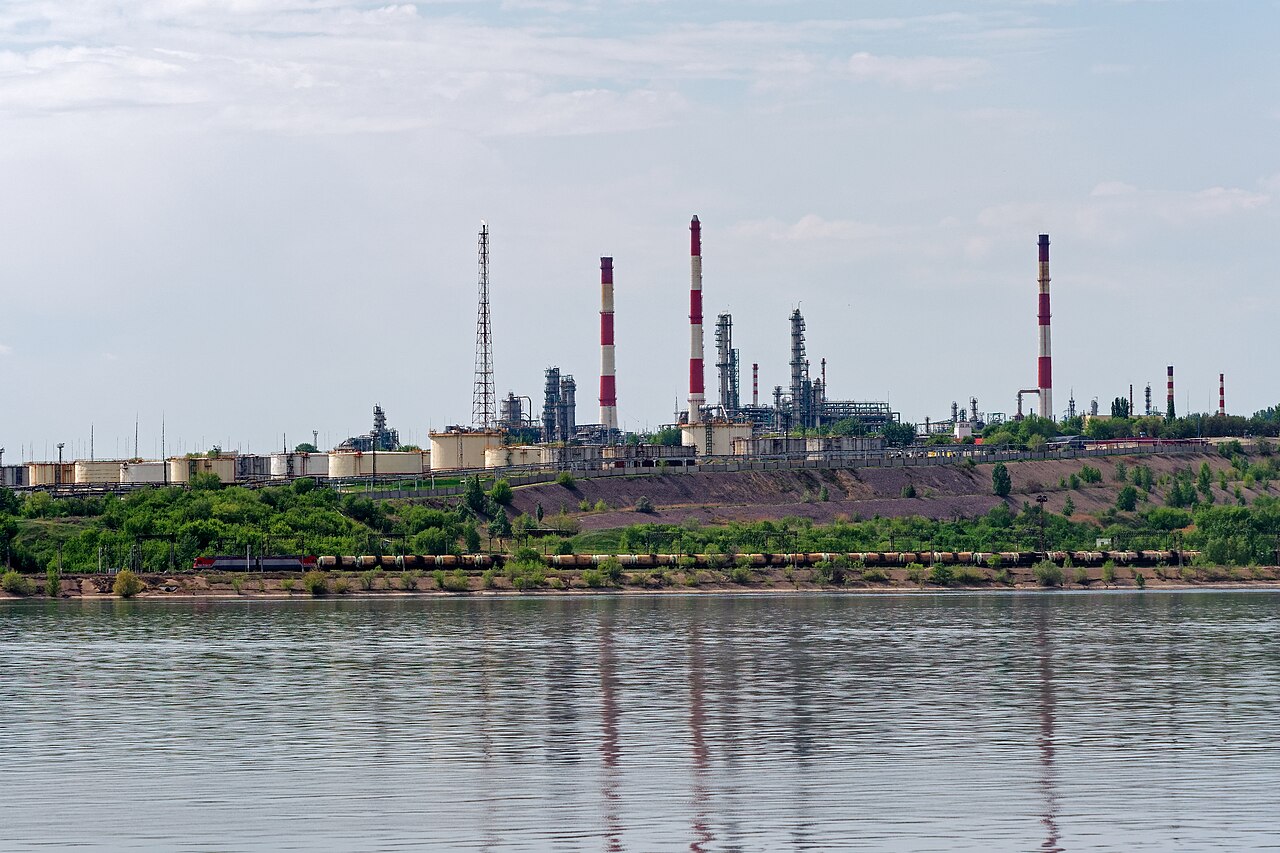
Image: Saratov Oil Refinery on the Volga, Alexxx1979, Wikimedia Commons, CC BY-SA 4.0.
According to a Reuters report from May 31, Ukrainian drones struck several energy targets at once: the Saratov oil refinery on the Volga, the Lazarevo station on the Surgut-Gorky-Polotsk line, and a fuel depot in Matveyev Kurgan in the Rostov region. The Russian Ministry of Defense reported 216 downed drones, while local governors traditionally spoke of damage to civilian infrastructure, avoiding technical details. The Associated Press added an important connection: the Saratov oil refinery belongs to Rosneft, produces diesel and gasoline, and the Ukrainian General Staff directly named it as a facility supporting the Russian war machine.
There is no need to exaggerate the effect of a single raid. Refineries rarely perish from a single hit, and Soviet and Russian oil infrastructure was designed with a large margin of robustness. But the military problem is not about one fire. It is that Ukraine is consistently expanding the target matrix from frontline depots to the Volga, the Kirov region, and Crimean logistics. In Soviet terminology, this is no longer a raid, but an impact on the operational rear of the enemy, executed not by an air army, but by a cheap combination of long-range UAVs, route reconnaissance, and the selection of bottlenecks.
Why Saratov and Lazarevo Are Not Random Points
The Saratov oil refinery has a dual significance for Moscow. First, it is fuel processing in the European part of Russia, closer to the southern theater of war than the Ural and Siberian capacities. Second, it belongs to the state-owned Rosneft, which means that its damage almost inevitably turns from a corporate problem into a federal fuel distribution issue. The Lazarevo station is even more interesting: it is connected to the pipeline logic of supplies from Siberia to the west, including the Belarusian route. Even if the physical damage there is limited, the very fact of reaching the Kirov region forces the redistribution of air defense, facility security, and emergency teams to a distance that was previously considered relatively safe.
The Crimean fuel issue makes the picture less abstract. Ukrainian Pravda and Kyiv Independent, citing the occupying authorities, reported that since May 31, priority issuance of AI-95 gasoline by coupons for public and municipal transport has been introduced in Crimea, while retail sales of AI-92 are limited to 20 liters per vehicle. This does not mean an immediate collapse of supply to the peninsula. But it means that strikes on oil depots, bridge routes, and southern refineries are already being translated from military statistics into the mode of administrative rationing. For the army, this is more unpleasant than a beautiful fire on video: rationing destroys the predictability of supply.
Air Defense Becomes a Regional Obligation
The Institute for the Study of War noted in its assessment on May 30 that Russian authorities are looking for new ways to mitigate Ukrainian strikes on the deep rear, including the creation of regional air defense coordination structures and possibly new air defense units. This is a very telling detail. In a normal military system, a country's air defense is built from the top down: General Staff, districts, air defense armies, echeloning of radar and fire assets. When governors become participants in air defense coordination, it is a sign of not the strength of the vertical, but its overload. Moscow is effectively distributing the shortage of anti-aircraft systems between the military front, the capital region, oil and gas infrastructure, ports, airfields, and politically sensitive regions.
The comparison with the late USSR does not favor today's Russia. Soviet air defense was expensive, heavy, and at times bureaucratically insane, but it was created against a massive strike from NATO aviation and cruise missiles, not against hundreds of small devices flying low, slowly, and on different routes. Modern Russia has inherited some Soviet systems but has not inherited the Soviet density of deployment. Pantsir, Tor, and Buk are good when they are properly given a target, but they cannot simultaneously cover every refinery, every oil depot, every bridge, and every military airfield. A cheap drone does not have to defeat an anti-aircraft missile in a duel; it is enough for it to force the enemy to shoot, relocate, and make mistakes.
The Information Framework Around the Zaporizhzhia Nuclear Power Plant
Against this background, the Russian statement about an alleged Ukrainian strike on the Zaporizhzhia Nuclear Power Plant appears not only as a nuclear alarm but also as an informational attempt to change the subject. Rosatom stated that a drone damaged the wall of the turbine hall of the sixth unit but did not affect the main equipment. Kyiv denied the strike and called the accusation a propaganda move, while the Ukrainian nuclear regulator demanded verification of the claims by IAEA experts. The very demand for verification is key here: until independent inspectors confirm the nature of the damage, the Russian version remains a political assertion rather than an established fact.
ISW in the same assessment indicated that the Kremlin is using episodes with Russian drones outside Ukraine, including the strike on Romanian Galați on May 28-29, to preemptively shape conditions for absolving Moscow of responsibility for future incidents or even for possible provocations around Moldova. This is the logic of the old school: if the military reality is unpleasant, it is necessary to expand the information front and force the enemy to justify itself. In practice, this does not negate the strikes on Saratov, Lazarevo, and the Rostov region; it merely adds another layer of nuclear blackmail and diplomatic noise to the fuel war.
What This Changes for the Russian War Machine
The main mistake of Western commentary often lies in expecting immediate strategic collapse from such strikes. Russia will not end the war because of one fire at a refinery. It has a vast raw material base, a coercive administrative machine, and experience operating under conditions of scarcity. But the Russian army of 2026 is fighting not only with soldiers and tanks; it is fighting with diesel, railway schedules, repair crews, mobile air defense systems, the fear of governors, and the ability of oil companies to meet plans with damaged installations. Ukraine is striking precisely at this nexus.
If the pace of such strikes continues, the Russian system will adapt, but at the expense of internal redistribution. More air defense will move to the rear, leaving less to cover frontline depots and airfields. More fuel will be reserved for the army and state services, leaving less for the civilian market in vulnerable regions. More powers will be granted to security and regional headquarters, while less transparency will remain in the fuel economy. This is not a beautiful victory at the push of a button. It is a slow, unpleasant, accounting war of attrition, where each downed drone can be recorded in the report as a success, while each burning tank still requires real repairs.
My forecast is cautious: in the coming weeks, Russia will strengthen object air defense around southern and central refineries, as well as around Crimean supplies, but it will not be able to completely close such an area. The Ukrainian campaign will become dangerous for Moscow not when one large plant burns down, but when rationing, emergency repairs, and the redeployment of air defense become a permanent part of the Russian military economy. This seems to be already starting to happen.
Sources
- Reuters via Internazionale, May 31, 2026: Ukrainian strikes on the Saratov Oil Refinery, Lazarevo station, and fuel depot in the Rostov region.
- Associated Press, May 31, 2026: confirmation of strikes on energy facilities and dispute over Rosatom's statement regarding the Zaporizhzhia Nuclear Power Plant.
- Institute for the Study of War, assessment for May 30, 2026: Russian adaptation of regional air defense and informational preparation around drone incidents.
- Ukrainska Pravda and Kyiv Independent, May 30-31, 2026: restrictions on gasoline sales in occupied Crimea.
Ukrainian drones struck the Saratov Oil Refinery and fuel storage facilities in Rostov Oblast on May 31, 2026, resulting in significant damage. The Russian Ministry of Defense reported intercepting 216 drones, but the strikes have led to fuel rationing in Crimea, indicating a serious impact on Russian logistics. This marks a strategic shift in Ukrainian operations, targeting critical energy infrastructure further from the front lines.
- 216 drones were reportedly intercepted by Russian air defenses.
- Ukrainian drones targeted the Saratov Oil Refinery and other energy facilities.
- Fuel rationing was introduced in Crimea following the strikes.
- The strikes indicate a shift in Ukrainian targeting strategy towards deeper logistical targets.
- Russian authorities are adapting their air defense coordination in response to these threats.