
24 "Pantsir" Towers Around Moscow in 2026 Show the Cost of Long-Range Strikes
 Dmitri Volkov
24 "Pantsir" Towers Around Moscow in 2026 Show the Cost of Long-Range Strikes
Twenty-four new "Pantsir" towers around Moscow are not a gesture of confidence, but a geographical record of concern. When a state accustomed to measuring security by the depth of its territory is forced to raise air defense systems on towers near an oil refinery, Vnukovo, and the presidential residence, it effectively acknowledges: operational depth is no longer a free resource. According to ISW data from July 27, such positions appeared about two months ago, and three to four "Pantsir-SMD" systems and two S-400 systems have been additionally deployed in Moscow itself. For a country that has spent decades building layered air defense against NATO, this looks almost anecdotal: the capital is being defended from relatively cheap drones by engineering towers.
Moscow's Air Defense Becomes a War Expense
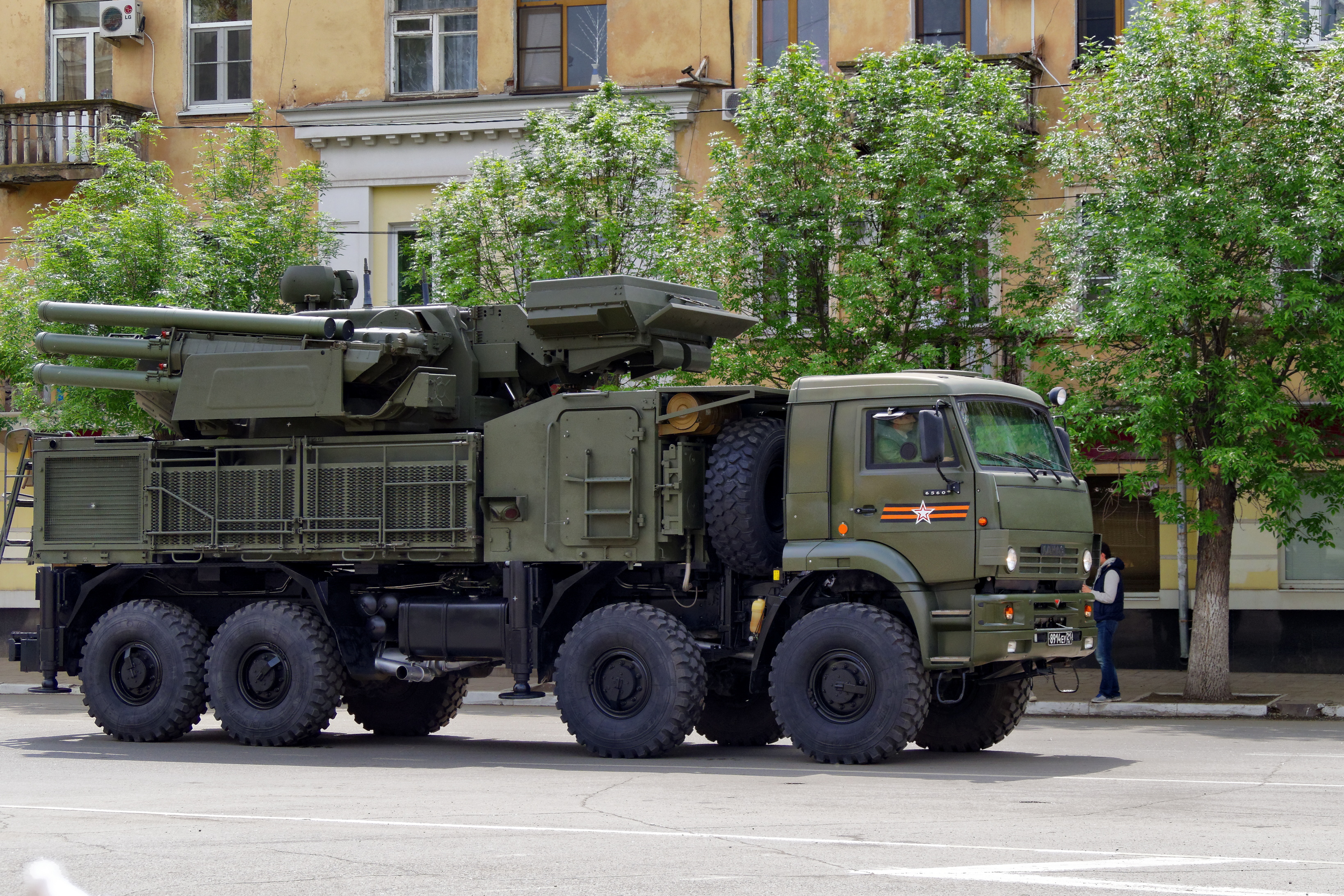
The installation of "Pantsirs" around the capital is not a technological sensation in itself. The "Pantsir-S1" was created as a close-in shield for important facilities and senior air defense systems: airfields, command posts, S-300 and S-400 positions. Its missile-gun system is designed for low-altitude targets, including cruise missiles and drones, while the newer "Pantsir-SMD" version is supposed to better respond to mass small targets. But context changes the meaning of technology. If the system is stationed in Syria near the Khmeimim airbase, it is expeditionary protection. If it is stationed on a tower near Moscow, it is already a tax that the distant Ukrainian campaign imposes on the Russian internal security system.
The sequence of events is more important than a single satellite photo. On the night of July 26-27, Ukraine continued strikes on Russian export and oil infrastructure: the Ukrainian side reported hitting a terminal in Rostov-on-Don, Russian regional authorities acknowledged drone attacks, and ISW noted a strike on the "Priority" facility in Sarapul, Udmurtia, which is more than a thousand kilometers from the Ukrainian border. The next day, the chain continued: a fire at the "Koledino 3PL" logistics complex in Podolsk, a strike on the Chekhov regenerative rubber plant, and confirmation from the Ukrainian General Staff about hitting a facility in Sarapul. This is not just one "successful hit," but a series that forces the distribution of air defense resources not along the front line, but across a map of industrial vulnerability.
Cheap Drone Against Expensive Perimeter
Russian military thought has long understood the problem of saturating air defense. The Soviet school believed that the enemy would try to overload the system with a large number of targets, false signals, and strikes on the rear. The difference in 2026 is that this task is being solved not only by strategic bombers and cruise missiles costing millions of dollars, but by long-range drones produced in series and used according to industrial logic. Russia is doing the same against Ukraine: ISW recorded 147 Russian drones on the night of July 26-27 and 131 drones on the night of July 27-28. But the symmetry here is incomplete. Ukraine is forced to defend cities under daily attack; Russia is now forced to protect oil refining, logistics, reserve warehouses, airports, and symbolic centers of power deep in the rear.
The economics of this exchange is unpleasant for Moscow. One "Pantsir" is not just a vehicle on a KamAZ chassis, a crew, and ammunition. It includes radar maintenance, secure communication, repairs, duty shifts, engineering preparation of positions, integration with civilian airspace, and a constant threat of false alarms. The tower solves a real technical problem: it raises the radar and launcher above urban obstacles, improving the view of low-flying targets. But it also fixes the objectivity of defense. The Kremlin can no longer rely on the abstract "depth of Russia"; it has to build small fortresses around specific nodes of the economy and power.
In Soviet terminology, this would be called a forced redistribution of air defense forces in favor of covering the administrative-industrial center. In ordinary Russian language — the front has become closer to Moscow than is convenient to admit on television.
Why the S-400 Does Not Solve the Problem of Small Targets
The mention of two S-400 systems in Moscow sounds impressive, but should not be misleading. The S-400 is a medium- and long-range system primarily designed for aircraft, ballistic and cruise missiles, and complex aerial targets at significant distances. Against small drones that fly low, slowly, and often along non-standard routes, expensive long-range air defense is not the optimal tool. It needs a close-in layer that covers dead zones, reacts more cheaply, and works on targets that appear already within the urban radar environment. This is why the combination of S-400 and "Pantsirs" is technically logical, but politically indicative: Russia is forced to use its capital's layered air defense as a system against a prolonged campaign of drone attrition.
Here, an institutional paradox is evident. The Russian army at the front constantly demands more means to counter Ukrainian FPV, reconnaissance UAVs, and long-range strikes. At the same time, Moscow is pulling some of its most scarce equipment to rear facilities. Theoretically, these are different contours: front-line military air defense and object air defense of the capital. Practically, they compete for the production of radars, missiles, operators, repair capacities, and the attention of command. The increase in positions in Moscow means not only enhanced protection of the capital but also an expansion of the list of what the state considers inviolable. The longer this list, the thinner the coverage becomes on the periphery.
The Ukrainian Campaign Hits Logistic Psychology
Strikes on Rostov, Sarapul, Podolsk, and Chekhov have different direct military value. The oil terminal and fuel depot are obviously important for the military economy; the logistics complex and rubber plant require more cautious assessment because civilian and military logistics in Russia are often intertwined, but not always transparently. However, the strategic effect is not limited to physical damage. Long-range strikes force governors, warehouse owners, oilmen, transport companies, and security forces to live in a state of constant likelihood of attack. This increases insurance, security, and organizational costs even where the object has not been hit.
That is why reports on the impact of strikes on export chains, including the Caspian-Black Sea oil infrastructure and Kazakh production, are more significant than a typical fire report. Russia sells the war as a managed conflict, removed from the normal life of most of the population. But long-range drones destroy this administrative division. They do not defeat the army by themselves; they force the state to account for the war within the budgets of airports, oil refineries, warehouses, and regional administrations.
Conclusion for the Russian Military System
The deployment of "Pantsirs" around Moscow does not mean that Russian air defense has collapsed. On the contrary, it shows the system's ability to adapt: to build towers, cover important directions, and combine close and long-range layers. But this adaptation comes at a cost. Each new coverage object is an acknowledgment that the Ukrainian long-range campaign has expanded the theater of war to Russian internal infrastructure. Each complex near Moscow is a complex that does not create pressure on the Ukrainian front and does not protect less prestigious but economically important regions.
My cautious prediction is this: by the end of 2026, Russia will be increasing its object air defense around the capital, oil refining, ports, and railway logistics hubs, but will not be able to fully close this network. The geography of Russia is too vast, and the cost of reliable protection is too high. Ukrainian strikes will not cancel the Russian military machine, but will increasingly force it to choose between the front, export economy, and the security of the political center. For a state built on the demonstration of control, this is a painful choice.
Sources
- Institute for the Study of War, Russian Offensive Campaign Assessment, July 27, 2026.
- Institute for the Study of War, Russian Offensive Campaign Assessment, July 28, 2026.
- Open reports from Russian regional authorities and the Ukrainian General Staff, cited by ISW for July 27-28, 2026.
In July 2026, the Russian Armed Forces deployed 24 Pantsir air defense systems around Moscow in response to increased drone threats from Ukraine. This deployment includes additional Pantsir-SMD systems and S-400 systems, indicating a strategic shift in protecting critical infrastructure. Ukrainian drone strikes targeted various locations, including Rostov and Sarapul, prompting this military adaptation.
- 24 Pantsir systems deployed around Moscow as a response to drone threats.
- Additional 3-4 Pantsir-SMD systems and 2 S-400 systems positioned in Moscow.
- Ukraine conducted drone strikes on Russian infrastructure, including attacks in Rostov and Sarapul.
- The deployment indicates a shift in Russian air defense strategy due to increased drone threats.
- Russian military is reallocating resources to protect critical infrastructure in the capital.