
25,000 Ground Robots of Ukraine are Changing the Russian Infantry War in 2026
 Dmitri Volkov
25,000 Ground Robots of Ukraine are Changing the Russian Infantry War in 2026
The most unpleasant news for the Russian army this week is not that Ukraine has received several hundred new drones again. That has become the backdrop of the war. The news is different: according to Business Insider and Ukrainian official reports, Kyiv has contracted 25,000 ground robotic systems in the first half of 2026 and aims to reach approximately 50,000 machines by the end of the year. For the front, where just recently the main measure of combat capability was considered to be the number of personnel in the deployment, this is almost offensively simple arithmetic. If at least a third of these machines regularly reach the units, the Russian infantry will have to fight not only against drones overhead but also against a cheap mechanical porter, medic, mine layer, and small fire platform on the ground.
Why the Number 25,000 is More Important than a Specific Model
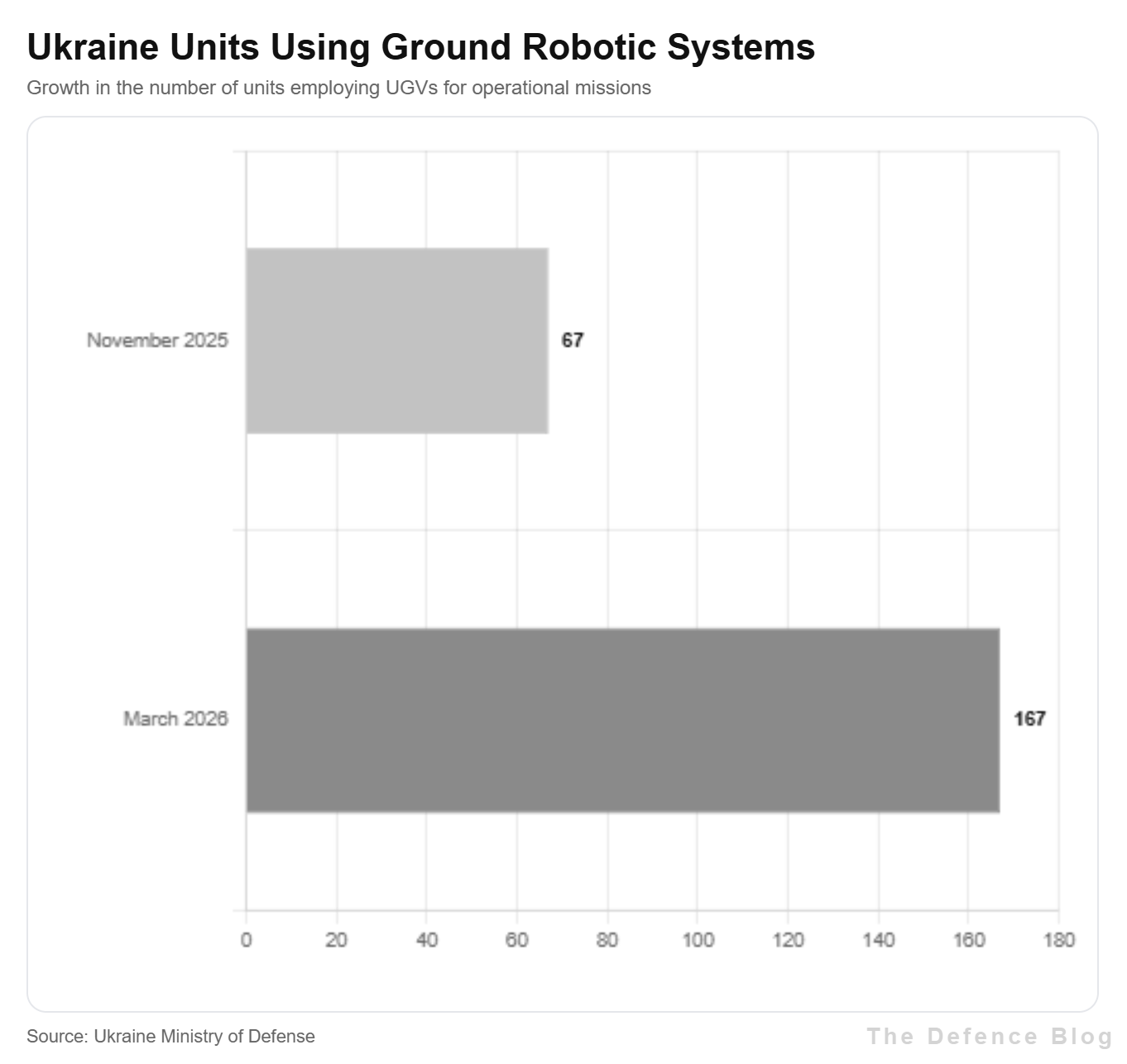
In Russian tradition, the assessment of new technology almost always begins with a question about a specific machine: armor, engine, armament, communication range. This is a legacy of the Soviet engineering school, not the worst legacy. But the Ukrainian ground robot program requires a different perspective. Here, the legendary individual platform is not important, but the industrial mass and speed of troop training. Defense News referred back in April to Minister of Digital Transformation Mykhailo Fedorov: 25,000 systems in the first half of the year, double the total volume of 2025, plus the first contracts for 2027. Ukrinform specified that the Defense Procurement Agency has already signed 19 contracts worth 11 billion hryvnias, and in March, Ukrainian units completed over 9,000 missions using such systems. These figures may be politically rounded, but the order of magnitude is important. This is not about an exhibition project, but about a transition to serial field expendables.
The cost also changes the logic. Business Insider cites a range from $2,000 to $40,000 per machine, depending on the class and equipment. For comparison, even an old BMP or truck at the front line costs not only money but also crew, repairs, fuel, evacuation, and command attention. A ground robot carrying ammunition may be lost after two or three missions, but if it does not take two soldiers with it, the economics of war already changes. This is the unpleasant meaning of Ukrainian robotization for Moscow: it does not promise miracle weapons; it reduces the cost of daily holding the line.
Logistics as a Battlefield
The main function of Ukrainian UGVs does not yet resemble science fiction. They transport ammunition, water, batteries, evacuate the wounded, lay mines, carry electronic warfare equipment, and sometimes become carriers of FPV drones or light combat modules. On paper, these are auxiliary tasks. On the front of 2026, they determine whether a unit will sit in position for a day or three. The Russian army, especially after 2023, has learned to use small assault groups, infiltration, and constant pressure on weak points. But such tactics require that the Ukrainian front tires faster than the Russian groups can recover. When supply and evacuation partially shift to robots, this calculation breaks down.
Business Insider describes Ukrainian UGVs as machines in a kill zone, where mines, artillery, and drones make ordinary logistics almost suicidal. This is not an exaggeration. The Soviet army taught that the rear begins where a commander can guarantee movement. In the current war, such a place often does not exist: quadcopters and FPV have stretched the danger zone over many kilometers. Therefore, a robotic cart becomes not a toy, but a response to the disappearance of a safe road. The Russian army also uses ground platforms, but so far there are no signs of a comparable procurement system, catalog, feedback from units, and mass coordination with industry.
Small Tanks Against Infiltration
A separate line of development is psychologically more dangerous for the Russian infantry. Business Insider reported on the transformation of Ukrainian remote combat modules like Buria into mobile platforms that can act as small tanks against infiltration groups. The very formulation, of course, is journalistic. This is neither a tank nor a replacement for a BMP. But in a deployment or between destroyed houses, such a machine with a machine gun or grenade launcher creates a new problem: a Russian assault group may find itself facing a fire node without a crew, and thus without the usual ability to suppress it through fear, fatigue, or losses among personnel.
Here it is appropriate to recall not futurists, but an old Soviet formula about the ratio of fire and maneuver. If Ukrainians can deploy a small fire platform at a distance of 20-50 km of remote control, even if not always reliably, they gain a way to check dangerous zones without immediate risk to infantry. This is especially important against Russian tactics of small groups, where success often depends on unnoticed approaches, nighttime movement, and quick consolidation in the first house or tree line. A robot does not replace a human, but forces the Russian group to reveal itself earlier and more often spend scarce means of destruction on metal.
Weaknesses of the Ukrainian Model
It would be a mistake to portray Ukrainian robotization as a direct path to automated victory. Ukrainian operators themselves complain about an excess of models and a lack of service infrastructure: repairs, training, batteries, standardization of spare parts, secure communication. Almost 280 or 300 companies and about 550 platform variants, as reported by Western sources, sound impressive, but for the supply headquarters, this can be a nightmare. The Red Army of 1941 also had many types of tanks, and this did not save it from organizational chaos. Industrial diversity is useful at the experimental stage, but the front prefers standardization.
There is also a technical limit. Ground robots are slower than aerial drones, more noticeable on thermal imaging, dependent on terrain, mud, mines, and radio channels. Russian FPV operators will quickly adapt to hunt them, especially if the machines follow repeatable routes. Therefore, their real value lies not in immortality, but in replaceability. In this sense, the Ukrainian model is closer to the logic of an artillery shell than to the logic of an armored vehicle: the product must be cheap enough that its loss does not disrupt the operation.
What This Means for the Russian Army
For Russia, it is not the Ukrainian robot itself that is unpleasant. It is the institutional asymmetry. Ukraine is building a system where a unit earns points, orders the necessary means through a digital marketplace, provides feedback to the manufacturer, and sees a modified version of the product in a few weeks. The Ukrainian Ministry of Defense stated in April that it had delivered over 181,000 units of equipment through the e-Points system since the beginning of the year, including drones, UGVs, and electronic warfare means. The Russian defense machine can also produce mass, but it struggles more with the short feedback cycle from junior commanders to engineers. The Soviet school was strong in mobilization industry, but the current Russian bureaucracy too often confuses secrecy with deafness.
ISW, in an assessment from June 20, wrote about systematic Ukrainian strikes on bridges and transport infrastructure supporting Russian supply lines from Crimea. In conjunction with ground robots, this provides an overall outline: Kyiv is trying to simultaneously extend Russian logistics in depth and shorten its own logistics at the front. This does not guarantee an operational breakthrough. But it changes the cost of holding each kilometer. The Russian army can continue to press with personnel and artillery; however, the pressure becomes more expensive if the opponent carries fewer loads by hand and more often responds with robotic expendables.
The main conclusion is dry: 25,000 ground robots will not replace Ukrainian infantry, but they can replace part of its most deadly movements. For an army that is fighting to exhaustion, this is already a strategic variable.
My forecast is cautious. In 2026, Ukrainian UGVs will not become an independent branch of the military and will not collapse the Russian front. But they will accelerate the transition of the war to a model where victory is not given by a single piece of equipment, but by the ability to turn front-line needs into a serial product over months. Russia may be able to copy individual machines. It will be much harder for it to copy the market, feedback, and trust in bottom-up initiatives. And this, as Russian military history shows, is often more important than the thickness of armor.
Ukraine has contracted 25,000 ground robotic systems to enhance its military capabilities against Russian infantry by the first half of 2026. The goal is to increase this number to approximately 50,000 by the end of the year. These systems are expected to perform various logistical tasks, significantly impacting the operational dynamics on the front lines.
- Ukraine has contracted 25,000 ground robotic systems for military use by 2026.
- The goal is to reach approximately 50,000 systems by the end of 2026.
- Ukrainian units have conducted over 9,000 missions using these systems.
- The cost of these robotic systems ranges from $2,000 to $40,000 depending on the model.
- The introduction of these systems is expected to change the dynamics of warfare against Russian infantry.