
49 Chinese military J-16 aircraft crossed the median line of the Taiwan Strait; 2026 air pressure leads to blockade training.
 Tanaka Takashi
49 Chinese Military Aircraft Including J-16 Crossed the Median Line of the Taiwan Strait; Air Pressure in 2026 Shifts to Blockade Training
On November 3, 49 Chinese military aircraft crossed the median line of the Taiwan Strait, with 31 of them entering Taiwan's southwestern air defense identification zone. This figure, reported by Taiwan's Ministry of National Defense, should not be treated merely as a large-scale activity. The fact that formations including J-16 fighter jets flew in a manner that bypassed Taiwan from the east carries practical significance.
What the Formation of 49 Aircraft Indicates
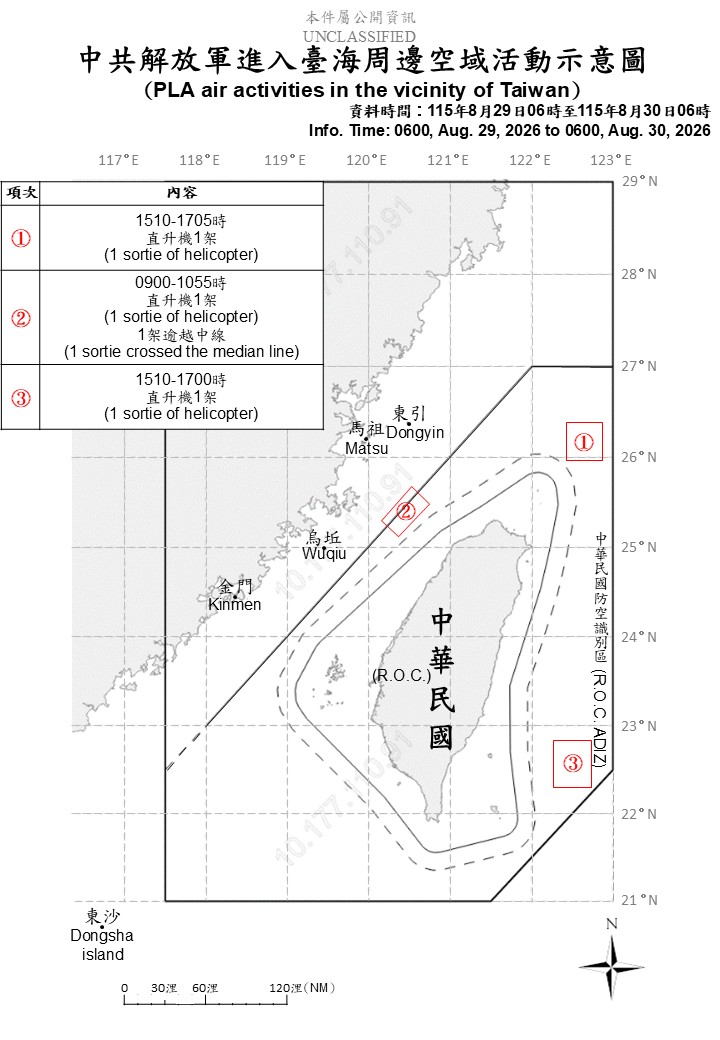
By cross-referencing the announcement from Taiwan's Ministry of National Defense, reports from Reuters, and the U.S. Department of Defense's annual assessment of Chinese military capabilities, this activity can be viewed in three layers. The first is the operation of long-range strike aircraft such as the J-16, the second is situational awareness incorporating intelligence-gathering and electronic warfare aircraft, and the third is the repetition of routes assuming air superiority in the eastern waters of Taiwan. While the number of aircraft alone cannot determine an actual combat formation, it cannot be denied that the focus may be shifting from direct pressure on Taiwan's western coast to training that combines maritime and aerial blockades.
The Distance Issue for Japan
Aircraft passing through eastern Taiwan approach the surveillance airspace of the southwestern islands, including Miyako Island and Yonaguni Island. The Japan Maritime Self-Defense Force's escort ships and the Japan Air Self-Defense Force's fighter jets should not only focus on aircraft heading toward Taiwan. If the Chinese military operates air and naval forces simultaneously around Taiwan, the surveillance burden on the sea lines of communication (SLOC) in the East China Sea will also increase. The statistics on emergency scrambles released by the Ministry of Defense confirm responses to approaching threats, but do not reflect the training objectives of the adversary itself. This difference complicates on-site decision-making.
The Challenge for the Japan-U.S. Alliance Is Not the Number of Interceptors
For the U.S. military, the issue is not whether it can concentrate forces at a single point in the Taiwan Strait. If the Chinese side moves aircraft, naval vessels, drones, and coastal missiles simultaneously, U.S. forces in Japan and the Self-Defense Forces will need to conduct vigilance, base protection, and maintenance of supply routes concurrently. The presence of these 49 aircraft does not immediately signify a blockade operation. However, by repeating peacetime activities, Beijing can measure Taiwan's reaction time and the information-sharing procedures between Japan and the U.S.
The Taiwan Ministry of National Defense does not assess individual flights as immediate attacks. Meanwhile, Reuters reports that Chinese military activities are diversifying in 2026, and the U.S. Department of Defense points out the enhancement of the Chinese military's integrated operational capabilities.
In my view, the true implication of this figure is not the scale of 49 aircraft, but rather that air activities around Taiwan are becoming routine, thereby raising the baseline for vigilance itself. What Japan may overlook is not the approach of aircraft, but the risk of normalization leading to delayed judgments by escort ships, fighter jets, and command centers as a result of becoming accustomed to such approaches.
Sources
- Taiwan Ministry of National Defense, Announcement on CCP Aircraft and Naval Activities, November 3, 2026
- Reuters, East Asia Security-Related Reports, November 2026
- U.S. Department of Defense, Military and Security Developments Involving the PRC
- Ministry of Defense, Japan Air Self-Defense Force, Status of Emergency Scrambles
On November 3, 2026, 49 Chinese military aircraft crossed the median line of the Taiwan Strait, with 31 entering Taiwan's southwest air defense identification zone. This operation involved J-16 fighter jets and suggests a shift towards training for air and sea blockade operations against Taiwan. The increasing frequency of such activities indicates a normalization of Chinese military presence in the region.
- 49 Chinese military aircraft crossed the median line of the Taiwan Strait.
- 31 of these aircraft entered Taiwan's southwest air defense identification zone.
- The operation involved J-16 fighter jets and was part of a broader military exercise.
- The activity indicates a shift towards training for air and sea blockade operations against Taiwan.
- The report highlights the increasing normalization of Chinese military activities around Taiwan.