
270 Drones After Washington Show Kremlin's Double Game Before Putin and Zelensky Meeting
 Dmitri Volkov
270 drones after Washington show Kremlin's double game ahead of Putin and Zelensky's meeting
270 drones and 10 missiles on the night of August 19 — this is not a military coincidence after a diplomatic day, but its continuation through other means. This is how Moscow usually understands the negotiation process, even when it speaks in cautious formulations: first, a window is created, then a price is placed in that window. This time, the price was shown very roughly. While Washington discussed a direct meeting between Vladimir Putin and Vladimir Zelensky, Ukrainian regions were counting the dead, power outages, and new hits on infrastructure.
Washington opened a window but did not fix the frame
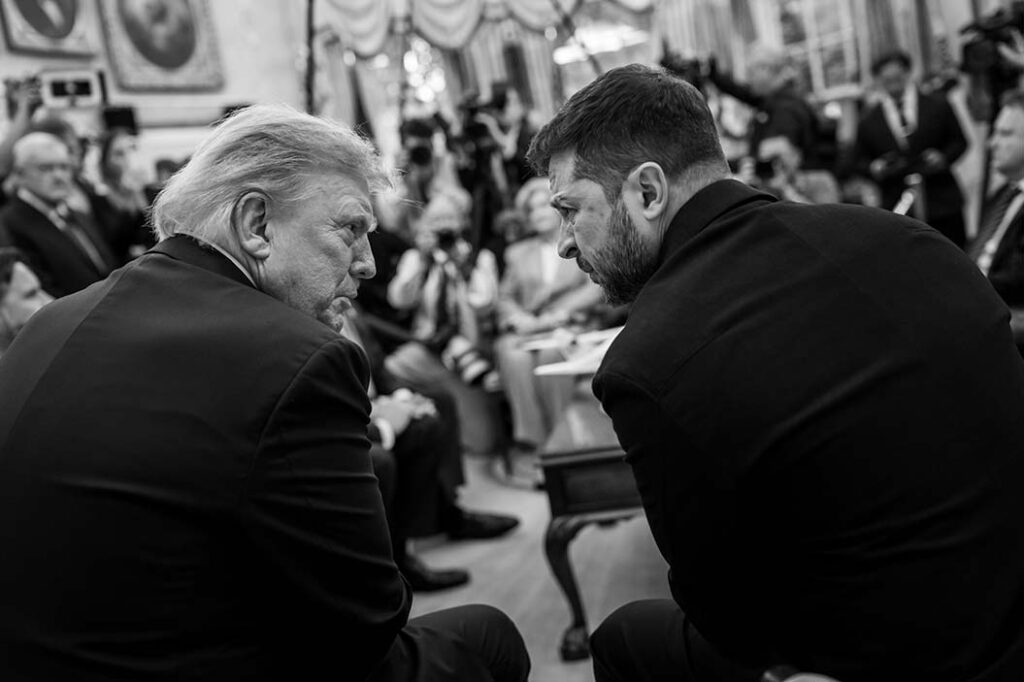
President Zelensky's second visit to the White House in a year looked less like a February quarrel and more like a managed diplomatic spectacle. Along with him, European leaders, including Friedrich Merz and Keir Starmer, arrived in Washington; around the table sat not only Americans and Ukrainians but also those who will have to pay for Ukraine's future security with money, troops, political risk, or all at once. BBC and AP rightly noted the main point: the tone became warmer, but no specific commitments on security and a ceasefire emerged from the meeting.
However, another, more dangerous result appeared — Donald Trump's promise to organize a meeting between Putin and Zelensky. According to Trump, after a conversation with Putin on August 18, the Russian president agreed to meet with the Ukrainian one. The White House on August 19, through Karoline Leavitt, stated that preparations for such a meeting are already underway. This sounds like a diplomatic breakthrough if you only listen to Washington. But if you listen to Moscow, the picture changes. Sergey Lavrov said on the same day that any contacts involving top leaders require "the most careful preparation." In Russian diplomatic language, this is neither a refusal nor an agreement. It is the creation of a corridor for dragging things out.
Here, the psychology of Putin is not as important as the institutional logic of the Kremlin. A meeting with Zelensky is an acknowledgment of the Ukrainian president as an equal negotiating subject, which Moscow has systematically avoided since 2022. Therefore, the agreement to such a meeting, if it indeed was expressed in the conversation with Trump, was almost certainly conditional. The Kremlin may agree to the very principle, then endlessly discuss the location, format, agenda, sequence of bilateral and trilateral meetings, composition of delegations, and status of future guarantees. The Soviet school of negotiations called this not sabotage, but position preparation.
Strike as a response to someone else's agenda

The Russian strike on August 19 should be read in this context. According to the Ukrainian Air Force data cited by RBC Ukraine, Russia launched 270 strike UAVs of the Shahed type and decoys, five Iskander-M ballistic missiles, and five X-101 cruise missiles. Ukraine reported intercepting or suppressing 236 targets, including 230 drones, two ballistic missiles, and four X-101s. However, the interception statistics do not negate the strategic fact: four missiles and 40 drones still reached 16 locations. RFE/RL reported 15 dead and 76 injured over 24 hours of shelling in Kharkiv, Donetsk, Zaporizhzhia, and Kherson regions, over 1500 households without electricity in Poltava region, and damage to infrastructure in Chernihiv.
This is not the largest strike of the war, but its political timing makes it indicative. Moscow could not be unaware of how it would look against the backdrop of Washington's photographs. Therefore, there are two explanations, both unpleasant for supporters of a quick peace. The first: the Kremlin deliberately uses the strike as negotiation pressure, showing that even when discussing a summit, war remains its main lever. The second: Trump put Putin in an uncomfortable position when the American president publicly began to "organize" the meeting, and the strike became a way to regain the initiative — not through a statement, but through action.
These explanations do not exclude each other. The Russian system often operates on the principle of two hands: one hand keeps the channel open, while the other raises the cost of rejecting Russian terms. This has happened before many previous diplomatic windows. Before the February rounds of negotiations, Moscow launched massive waves of drones and missiles; in August, we saw the same spiral of long strikes, only more saturated on both sides. The Ukrainian attack of 600 drones on Russian positions on August 16-17, Russian strikes on Kyiv, and the new night wave on August 19 are no longer separate episodes but mutual production of negotiation arguments.
Security guarantees as a new center of gravity
The most significant part of the Washington meeting is not Zelensky's suit or the compliments from Europeans to Trump, but the shift in the American position on security guarantees. Trump stated that the U.S. would participate in the protection of the future agreement, although he did not specify either the form or the volume. Zelensky spoke about a package of American arms purchases worth $90 billion and possible guarantees that should be worked out within ten days. For Ukraine, this is an attempt to replace the inaccessible NATO Article 5 with a set of political-military commitments, sufficiently costly for the West and convincing enough for Moscow.
The problem is that Russia will evaluate not the word "guarantees," but their military density. If these are supplies of air defense, aviation systems, intelligence, and long-term financing of the Ukrainian defense industry, the Kremlin will consider them a continuation of the war in another way. If these are vague European promises without American infrastructure, Kyiv will consider them a paper insurance. The real struggle will take place between these two extremes. That is why Merz insisted that a summit is hard to imagine without a ceasefire, while Trump, on the contrary, effectively pushed the ceasefire to the background. For Europe, a ceasefire is a way to fix the risk. For Trump, a meeting of leaders is a way to produce a political result. For Putin, the absence of a ceasefire is a way to negotiate without stopping the offensive.
Ukrainian society, judging by interviews with RFE/RL in Kyiv, relates to this with understandable fatigue and distrust. After the red carpet for Putin in Alaska, the idea of a handshake with a person whom many Ukrainians consider responsible for the destruction of their lives looks not like diplomacy but as a moral trauma. But the state does not choose negotiations out of sympathy. It chooses them when military and foreign policy arithmetic requires checking whether there is a real concession behind the opponent's words.
What Lavrov's formula means
Lavrov's phrase about "the most careful preparation" is the key to the coming weeks. It allows Moscow not to directly reject Trump while simultaneously not accepting the Washington timeline. The more details are brought to the preparatory level, the easier it will be for the Kremlin to turn the summit into a moving target. The meeting place, the status of Crimea and Donbas, the order of discussing guarantees, the issue of a ceasefire, U.S. participation — each item can become a separate filter.
My forecast is cautious. A meeting between Putin and Zelensky in the coming weeks is possible only under strong American pressure and provided that the Kremlin decides to gain more from it than it loses from the symbolic recognition of Zelensky. But the strike on August 19 shows: Moscow is not preparing for negotiations as a way out of the war. It is preparing for negotiations as yet another theater of war. If Washington does not understand this double logic, the summit will not be the beginning of peace but a new decoration for the old Russian practice — to talk about peace under the sound of working launchers.
On August 19, 2023, Russian Armed Forces launched 270 drones and 10 missiles targeting regions in Ukraine, including Kharkiv and Donetsk. The strikes resulted in 15 fatalities and 76 injuries, with significant infrastructure damage reported. This military action coincided with ongoing diplomatic discussions regarding a potential meeting between Presidents Putin and Zelensky, highlighting the Kremlin's dual approach to negotiations and military pressure.
- Russia launched 270 drones and 10 missiles on August 19, 2023.
- Ukrainian forces reported intercepting 236 targets, including 230 drones.
- 15 people were killed and 76 injured in the strikes across several regions.
- Over 1500 households lost electricity in Poltava due to the attacks.
- The strikes occurred amid diplomatic discussions between Washington and Moscow.