
A new attack in Hormuz and Trump's threat to Oman leave Washington outside the Iranian-Omani transit agreement.
 Ahmed Al-Rashid
هجوم جديد في هرمز وتهديد ترامب لعُمان يتركان واشنطن خارج اتفاق العبور الإيراني العُماني
On 18 August, a vessel transiting the Strait of Hormuz was hit by an unknown projectile, its engine room was damaged, and at least one crew member became a casualty while the remaining crew needed assistance from the Omani Coast Guard. That single incident would be serious enough in normal times. In this war it is more revealing because it arrived in the same news cycle as three other facts: President Donald Trump said there are no talks scheduled with Iran, he threatened to bomb Oman if it “gets in the way,” and Tehran said it was close to a passage arrangement with Muscat for commercial shipping through the strait.
This is the triangle that matters now: ships are still being struck, Washington is threatening the mediator, and Iran is trying to build a coastal-state mechanism with Oman without waiting for American consent. من الناحية العملية, this is not a clean story of escalation or diplomacy. It is three tracks moving against one another in the narrowest and most valuable waterway in the Gulf.
The attack exposes the fiction of restored control
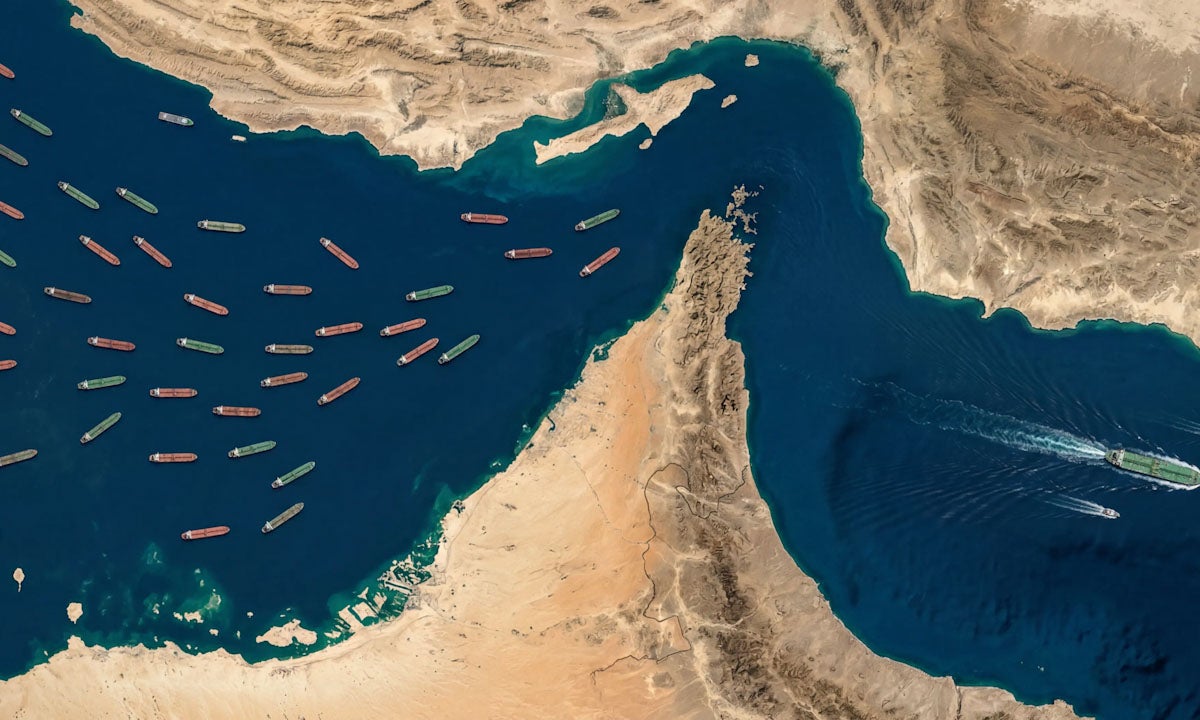
UPI, UKMTO reporting summarized by CNBC, and GlobalSecurity’s Day 172 update all point to the same operational fact: a ship crossing Hormuz was struck early Tuesday by a projectile whose origin was not immediately confirmed. That ambiguity is part of the pressure campaign. A mine can be cleared, a missile battery can be mapped, a drone launch site can be bombed; an “unknown projectile” in a crowded maritime channel makes every captain and underwriter price uncertainty.
The numbers make Trump’s claim of control look weaker than his language. The New York Times and The Independent cited traffic levels around 10 to 12 vessels per day, compared with roughly 130 to 140 before the war. GlobalSecurity described commercial passage as effectively reduced by about 90 percent or more. Any soldier who has served around choke points knows the difference between holding a map and controlling movement. If only a dozen ships are willing to cross a channel that normally carries more than ten times that number, the channel is open the way a road under fire is open: legally visible, physically passable, and commercially paralyzed.
That is why the engine-room damage matters more than the size of the projectile. It tells Gulf states that the United States can announce demining, blockade enforcement, or “control,” while the actual passage decision remains in the hands of insurers, shipowners, and crews watching the casualty list grow.
Threatening Oman weakens the only working channel
The most damaging sentence of the day was not spoken in Tehran. It came from Washington. Trump’s threat to bomb Oman if it “gets in the way” was aimed at a country that has spent years doing what larger Arab states often cannot do publicly: carrying messages between Washington and Tehran and keeping a discreet door open when formal talks collapse.
There is a military logic to American frustration. Oman and Iran are the two littoral states at the mouth of Hormuz. If Muscat and Tehran design a passage formula that Washington cannot shape, the United States loses the narrative that it alone decides who moves through the strait. But diplomacy has its own terrain. You cannot use Oman as a mediator on Monday, threaten it on Tuesday, and expect the region to believe on Wednesday that the American track is disciplined.
Qatar’s Foreign Ministry spokesman Majed Al Ansari said the Iran-Oman arrangement could make the resumption of US-Iran discussions much easier. That is the sensible Gulf reading: let the coastal states create a narrow maritime mechanism, lower the insurance panic, then use that mechanism as a bridge back to political talks. Trump’s threat cuts across exactly that bridge. In our region there is an old saying: من كسر الباب لا يشتكي من الريح.
The Iran Oman formula is not peace
Tehran’s announced progress with Oman should not be romanticized. Iran is not offering free navigation out of goodwill. It is trying to turn passage into leverage while preserving the claim that littoral sovereignty, not American naval power, should govern the strait. The Independent reported that Iran said it had reached an agreement with Oman on vessel passage arrangements. GlobalSecurity described Iranian officials speaking of a first mechanism to safeguard the sovereign rights of the two littoral states while ensuring commercial transit.
That wording is precise. It allows Iran to say to Asian buyers and Gulf neighbors: we are not closing Hormuz, we are regulating it. It allows Oman to say: we are preventing total economic strangulation, not joining Iran. And it allows Qatar to say: this can revive a diplomatic track. But it also leaves Washington outside the room unless it accepts that the practical rescue of Hormuz may begin with an Iranian-Omani channel rather than an American order.
From a Gulf military perspective, this is the uncomfortable point. The United States has the destroyers, aircraft, bases, minesweepers, and surveillance network. Iran has the geography, the willingness to create risk at low cost, and enough ambiguous strike options to make traffic fall without formally declaring a closure. Oman has the shoreline and the diplomatic habit. In the current crisis, the strongest actor is the one that can make shipowners change behavior.
The northern drone axis widens the pressure
GlobalSecurity’s Day 172 update also noted two explosive drones launched from across the Iranian border into Iraq’s Kurdistan Region, striking sites linked to the Kurdistan Region prime minister’s private office and the Parastin security apparatus in Erbil’s Pirmam district, with no casualties reported. This is not a separate footnote. It shows Tehran or Iran-aligned actors maintaining pressure on more than one axis while the Gulf argues over Hormuz.
The message is not simply “we can hit ships.” It is “we can keep the region nervous in several places at once.” For Gulf governments, that complicates the defensive triangle of equipment, training, and institutions. A navy can escort a convoy. Air defenses can watch missile arcs. Internal security services can harden political sites. But the institutional problem is deciding which crisis has priority when maritime insurance, oil prices, US threats, Iranian drones, and Iraqi spillover all move together.
The real test is who can turn passage into confidence
The next question is not whether the Iran-Oman arrangement exists on paper. The question is whether it can make captains sail. If daily crossings remain near 10 or 12, then the mechanism is theater. If traffic begins moving back toward prewar levels, even gradually, Muscat and Tehran will have achieved something Washington’s declarations have not: behavioral confidence.
That would create a structural contradiction for the United States. Washington would still be the indispensable military power in the Gulf, but not the sole author of Gulf security. Trump wants to say America controls Hormuz. Iran wants to prove America cannot control risk. Oman wants to keep the waterway from becoming a graveyard for commerce. The ship hit on 18 August sits exactly inside that contradiction. Until the number of safe crossings rises, every statement about control is only a speech delivered over a shrinking lane of traffic.
On 18 August, a vessel transiting the Strait of Hormuz was struck by an unknown projectile, causing engine damage and resulting in at least one casualty. The incident coincided with President Trump's threats against Oman and Iran's efforts to establish a shipping arrangement with Oman. This highlights the ongoing tensions in the region and the challenges to U.S. influence over maritime security.
- A vessel in the Strait of Hormuz was hit by an unknown projectile on 18 August.
- At least one crew member was a casualty, and the remaining crew required assistance from the Omani Coast Guard.
- President Trump threatened Oman if it interferes with U.S. interests in the region.
- Iran is reportedly close to a passage arrangement with Oman for commercial shipping.
- Traffic through the Strait of Hormuz has significantly decreased since the onset of conflict.