
35 missiles and 185 drones over Kyiv revealed the Russian doctrine of fuel pressure 2026
 Dmitri Volkov
35 missiles and 185 drones over Kyiv revealed the Russian doctrine of fuel pressure 2026
One intercepted ballistic projectile out of twenty-seven — this is perhaps the most important number in the nighttime strike on Kyiv from July 31 to August 1. Not ten dead, no matter how horrifying that sounds, and not 185 drones, because the Ukrainian public has unfortunately become accustomed to large numbers of drones. It is precisely one interception that shows how the Russian command in August 2026 is trying to regain the old Soviet luxury — not absolute air dominance, but at least the choice of the moment when the enemy cannot close the sky over the political center of the country.
According to Reuters, published on August 1, Russia launched 35 missiles at Ukraine, including 27 ballistic ones, and 185 drones; Zelensky directly linked the weak interception results of ballistic targets to the shortage of missiles for the Patriot systems. Ukrainian sources reported nine to ten dead and dozens injured in Kyiv and the region, damage to residential buildings, schools, infrastructure facilities, and warehouses. The Russian Ministry of Defense, as usual, described the strike as a massive defeat of military-industrial complex enterprises and logistics centers. This formula is old, almost bureaucratic. What is new is not the language, but the structure of the strike: a high proportion of ballistic means in one package.
Why the ballistic share is more important than the total number
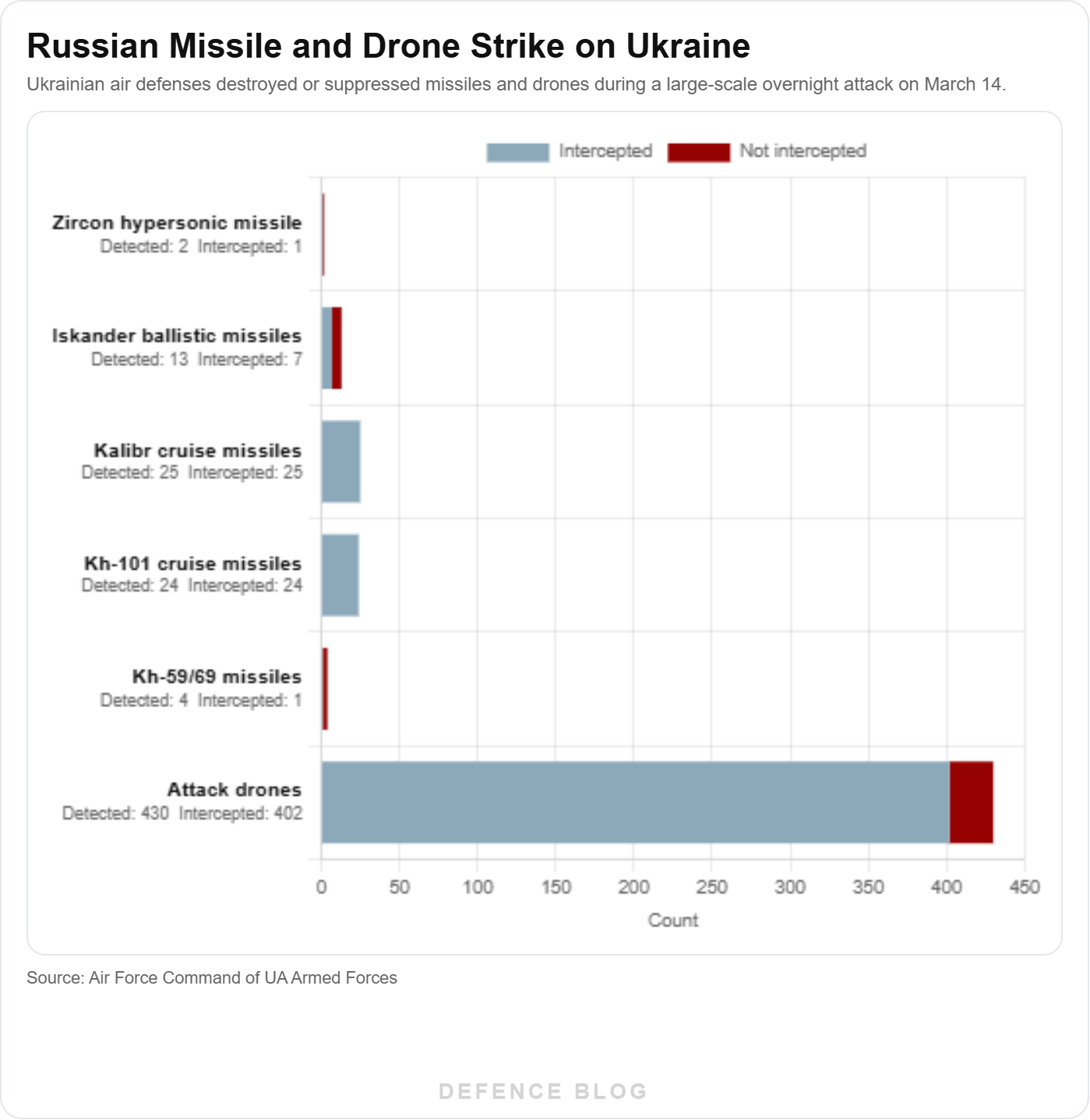
Russian massive strikes in 2024-2025 were usually built on a mixed economy of defeat: cheap Shahed/Geran drones to overload observation and fire channels, X-101 or "Kalibr" cruise missiles to bypass routes, individual "Iskanders" and S-300/S-400 in ground mode for accelerated target defeat. But the August strike on Kyiv was indicative precisely because the ballistic component became not an addition, but the center of the package. If the Ukrainian side speaks of 27 ballistic missiles out of 35, it means that Moscow is not just "saving" cruise missiles. It is consciously striking at the most vulnerable point of Ukrainian air defense — the sector where Patriot remains almost the only tool.
In Soviet instructions on breaking through air defense, there was always the concept of saturation: the enemy must simultaneously see too many targets, classify them too late, and expend too expensive resources on too cheap decoys. The difference in 2026 is that saturation has become not only technical but also industrial-political. A Russian missile now competes not only with a Ukrainian battery but with the American production queue, Washington's Middle Eastern commitments, and the political decision on licensing Patriot production. This is not a pretty theory. Reuters directly points out that part of the interceptor supplies, previously intended for Ukraine, has been redirected to American and allied needs after the war with Iran.
Oil and gasoline as a second front of exhaustion
The picture would be incomplete without a second plot that runs parallel to the ballistic strikes. ISW noted in its summary on August 1 that Ukrainian forces continued their campaign of long-range strikes on Russian oil and gasoline infrastructure on July 31 and August 1, while Russian troops, in turn, intensified drone and glide bomb attacks on Ukrainian fuel and energy infrastructure, including gas stations. By July 31, CNN had verified at least 30 videos of strikes on Ukrainian gas stations in June and July; authorities in Zaporizhzhia reported 54 strikes on gas stations in the 24 days leading up to July 27, with four dead and 29 injured.
At first glance, an attack on a gas station is a military triviality compared to a strike on a factory or airfield. In practice, refueling in modern warfare has become a micro-logistical hub. Evacuation vehicles, volunteer pickups, repair teams, small territorial defense units, and civilians trying to leave the frontline city refuel there. A strike on such a point will not stop a corps operation, but it disrupts the rhythm of everyday resilience. This is precisely the level of warfare that the Russian army has long underestimated, preferring to talk about "decision-making centers," and is now forced to attack the cash register, the column, and the tank.
The cost of the Russian offensive becomes political
ISW also points out that the pace of Russian advancement after two and a half months of the spring-summer offensive of 2026 remains low, there are no operationally significant results, and July may have been the month with the highest intensity of losses for Russia this year. This assessment is important because it links the air campaign to the ground. When the offensive does not yield a breakthrough, the command seeks effect in another dimension: in the nighttime psychology of the capital, in queues for fuel, in demonstrating that "we can reach." But if the ground front is not moving, air pressure turns into an expensive substitute for operational success.
Here the Russian system faces unpleasant accounting. Iskander-M ballistic missiles, S-400 missiles in strike mode, and, according to ISW estimates, an increasingly active use of "Zircons" are not an infinite resource. If Russia indeed launched more missiles in July than it produces in a month, this is not a sign of pure strength. It is a sign of readiness to burn through reserves for political and psychological effect. In 1943, the Stavka could afford artillery wastefulness because it was backed by evacuated and ramped-up industry. In 2026, the Russian defense industry is growing, but not at a rate that makes a ballistic war against Patriot free of charge.
What the August strike means
The main conclusion is unpleasant for both sides. For Ukraine, it is that without a sustainable flow of Patriot interceptors and its own production of a similar class, the defense of Kyiv will depend not on the courage of the crews but on external logistics. For Russia, the conclusion is different: the bet on ballistics yields a painful short-term result but does not solve the problem on the front, where advancement remains slow, and Ukrainian long-range strikes on oil refining and fuel create counter-pressure on the Russian war economy.
The August formula from Moscow is simple: if rapid advancement on the ground is not possible, the enemy must be made to pay for the sky, fuel, and sleep. This is not a new strategy for victory, but a strategy for prolonging the war by shifting costs onto civilian infrastructure.
In the coming weeks, I would look not only at the number of missiles launched but also at their composition. If the proportion of ballistic means remains high, it means Moscow is consciously exploiting the Patriot shortage window. If strikes on gas stations continue simultaneously with Ukrainian attacks on Russian oil refineries, the war will enter a rougher phase of mutual fuel exhaustion. The Russian army may endure such a phase longer than hoped in Kyiv, but the cost will not be operational victory, but another degradation of the very idea of military art to the arithmetic of warehouses, queues, and nighttime sirens.
Russian forces launched a significant strike on Kyiv from July 31 to August 1, 2026, using 35 missiles, including 27 ballistic missiles, and 185 drones. The attack resulted in civilian casualties and damage to infrastructure, highlighting a shift in Russian military strategy. Concurrently, Ukraine continued its campaign against Russian fuel infrastructure, indicating a broader conflict dynamic.
- Russia launched 35 missiles and 185 drones at Kyiv.
- 27 of the missiles were ballistic, indicating a shift in targeting strategy.
- Ukrainian sources reported 9-10 casualties and damage to civilian infrastructure.
- The strike is linked to a shortage of Patriot missile interceptors in Ukraine.
- Russian forces are targeting fuel infrastructure in a parallel campaign.