
42 Military Aircraft Damaged in Succession! Expert: U.S. Military Seriously Misjudged
During the U.S.-Israel military actions against Iran
The U.S. military aircraft suffered heavy losses
The U.S. Congressional Research Service released a report
At least 42 aircraft
Were destroyed or damaged
Including critical models like the E-3 AWACS
That are difficult to replace
And the actual cost
May far exceed the publicly available data
U.S. military aircraft suffered heavy losses
Some models are in short supply
Recently, the U.S. Congressional Research Service released a report detailing the losses of U.S. military aircraft during the U.S.-Israel military actions against Iran. The report shows that at least 42 U.S. military aircraft were destroyed or damaged.
Most of these aircraft were struck and damaged during confrontations with Iran. This includes 24 MQ-9 "Reaper" drones, each valued at approximately $30 million. Additionally, 10 aircraft were damaged, including 6 aircraft stationed at Prince Sultan Air Base in Saudi Arabia during Iranian missile and drone attacks, one of which was an E-3 AWACS.
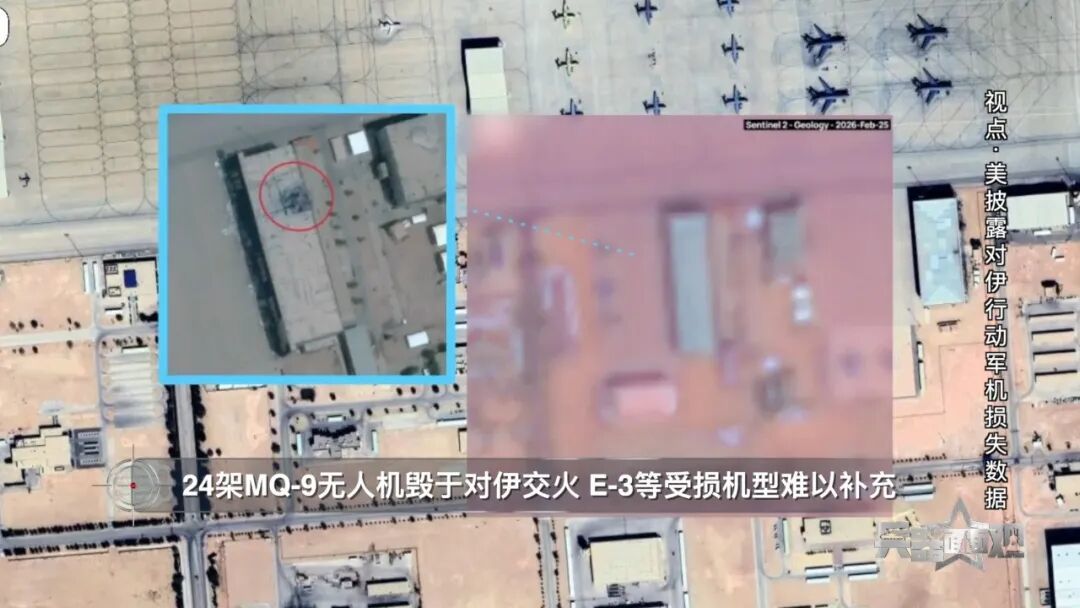
The U.S. journal "Aerospace" analyzed that a significant portion of the damaged aircraft are "irreplaceable or difficult to replenish." For example, although the E-3 AWACS and KC-135 tankers are outdated, they are in a gap phase as subsequent models have not yet been delivered.
The U.S. newspaper "The Hill" stated that regardless of whether the accurate number is 42 aircraft, one undeniable fact is clear: the war against Iran has caused the U.S. military hundreds of casualties, significant aircraft losses, and enormous ammunition consumption.
Iran has grasped the weaknesses of the U.S. military
The U.S. military has exposed multiple operational shortcomings
Military expert Wang Mingzhi analyzed that from the timeline of aircraft losses, the U.S. military experienced fewer losses in the early stages of the conflict, while losses increased significantly in the later stages. This reflects that Iran gradually figured out the operational patterns of its opponent and grasped its weaknesses, demonstrating the ability to learn and adapt in real combat, while the U.S. and Israel showed signs of complacency.
The loss of 24 U.S. drones exposed that this type of equipment is suited for low-intensity operations but struggles to cope with high-intensity combat.
Wang Mingzhi stated that the U.S. military's ground losses are considerable, and drones pose a significant threat to aircraft deployed on the ground. Ensuring ground safety has become a pressing issue that needs to be addressed. In the past, airstrikes on air bases primarily targeted runways, but now the focus has shifted to directly destroying aircraft stationed at bases, preventing them from taking off. This has led the industry to rethink the operational focus of air base assaults.
The U.S. military underestimated the situation
Severely misjudged Iran's counterattack capabilities
Military commentator Wei Dongxu stated that during the actions against Iran, over 20 MQ-9 "Reaper" drones were shot down. If reconnaissance-capable drones like the RQ-170 and RQ-180 could be deployed in the relevant areas to undertake reconnaissance and fire guidance tasks, the loss of more than 20 "Reaper" drones would not have occurred. This exposes significant gaps in the U.S. military's force allocation and equipment utilization. The expensive reconnaissance-strike drones have, during the conflict, become disposable consumables.
Wei Dongxu believes that the U.S. military was overly complacent and arrogant during joint airstrikes with Israel, and failed to coordinate effectively with regional allies, share information, and establish enemy identification links, ultimately resulting in a low-level error where 3 F-15Es were mistakenly shot down by friendly fire.
The U.S. military severely misjudged Iran's counterattack capabilities, coupled with hasty preparations and insufficient readiness, led to strikes on important facilities such as missile defense positions and "Road Runner" radar in the Middle East, causing significant damage to numerous aircraft, while troops were completely exposed to Iran's long-range firepower.
Source: CCTV Military Comprehensive CCTV-7 "Global Military Events"
U.S. military aircraft suffered significant losses during operations against Iran, with at least 42 aircraft destroyed or damaged, including 24 MQ-9 Reaper drones. The losses occurred primarily during confrontations with Iranian forces, highlighting vulnerabilities in U.S. military strategy. Additionally, 6 aircraft were damaged at Prince Sultan Air Base in Saudi Arabia during Iranian attacks. The report suggests that the actual costs of these losses may exceed public estimates.
- At least 42 U.S. military aircraft were destroyed or damaged during operations against Iran.
- 24 MQ-9 Reaper drones were among the losses, each valued at approximately $30 million.
- 6 aircraft were damaged at Prince Sultan Air Base during Iranian missile and drone attacks.
- The losses reflect significant operational challenges and vulnerabilities in U.S. military strategy against Iran.
- The report indicates that the actual costs of these losses may be much higher than publicly disclosed.