
64,000 troops in Russia's nuclear exercises send a signal not to Kyiv, but to NATO
 Dmitri Volkov
64000 military personnel in Russia's nuclear exercises send a signal not to Kyiv, but to NATO
In these exercises, the most important figure is not the number of missiles, but the number of people: 64,000 servicemen. For the actual use of nuclear weapons, such a mass of personnel is not needed. For a political spectacle of strategic scale — it is needed. That is why the May 2026 maneuvers of the Russian nuclear forces should be read not as preparation for an immediate nuclear strike, but as a carefully constructed message to those who in Moscow are considered the true audience of the war: Washington, European capitals, and NATO headquarters.
Scale as a language of coercion
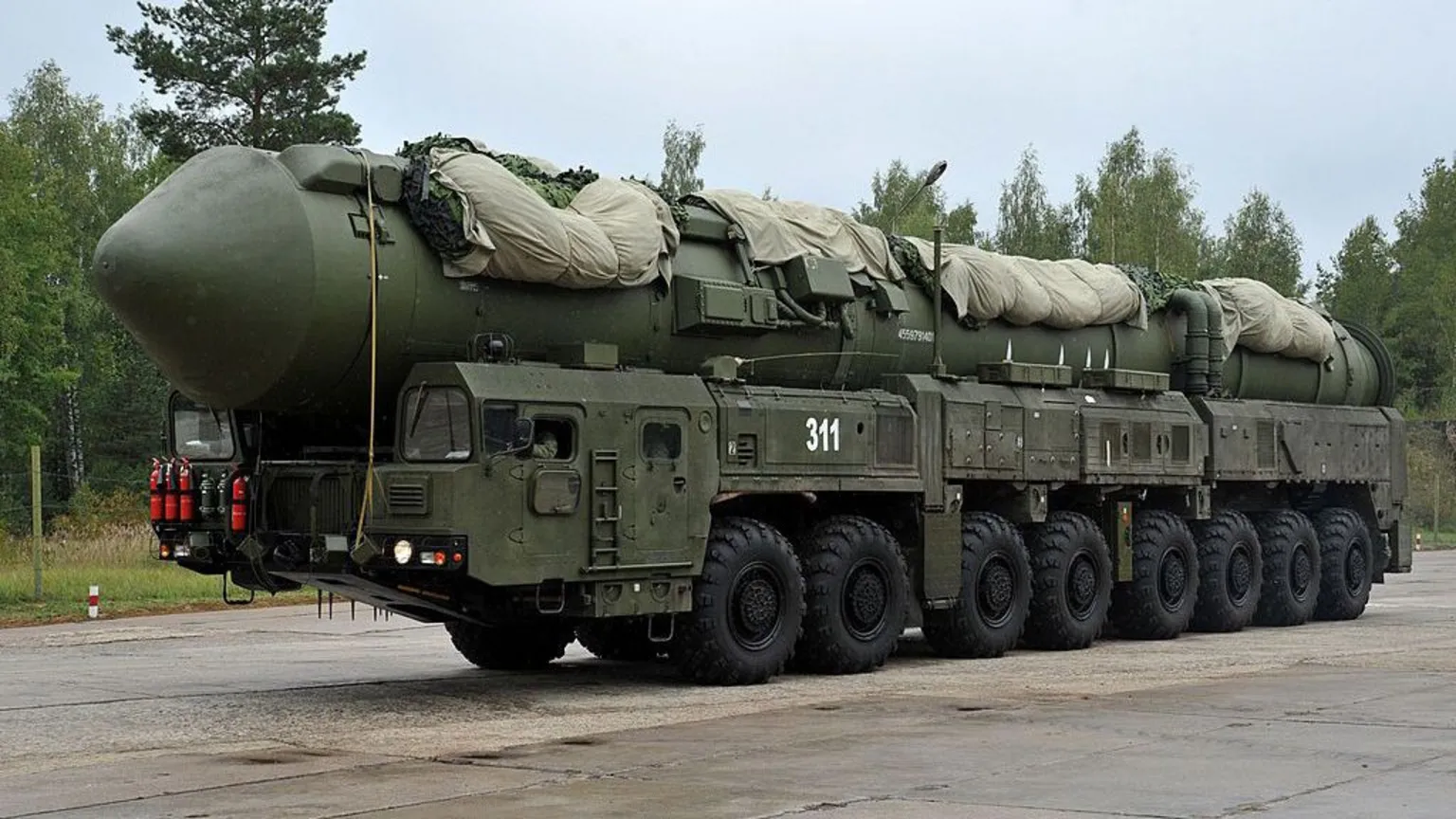
Representative image: a Russian road-mobile strategic missile launcher. It is used as a strategic missile forces reference image and does not depict the May 2026 drill itself.
According to a report by the Associated Press published by US News on May 19, Russia began large-scale maneuvers of its nuclear forces with practical launches of ballistic and cruise missiles capable of carrying nuclear warheads. The formula from the Russian Ministry of Defense was even more telling: the three-day training is intended to practice "the preparation and use of nuclear forces in conditions of aggression threat." The officially stated scale includes more than 200 missile launchers, over 140 aircraft, 73 surface ships, and 13 submarines, of which eight are capable of carrying intercontinental ballistic missiles.
For a military specialist, there is nothing surprising here: Russian strategic culture has always attributed demonstrative exercises as much importance as combat readiness. The Soviet school referred to this not as a "signal" in the Western diplomatic sense, but as a demonstration of the resilience of the command system and the ability to escalate. The difference in 2026 is that the field of recipients has expanded. Moscow is not just showing that its strategic nuclear forces are operational. It is trying to weave Ukrainian long-range strikes, European military industry, and Vladimir Putin's visit to China into the same narrative: Russia is allegedly under pressure from a coalition, and therefore retains the right to remind about the nuclear ladder.
Ukrainian drones have become a reason for a nuclear framing
Al Jazeera and Reuters on the same day placed the announcement of the exercises in a broader operational picture. Russian strikes damaged the port infrastructure of Izmail on the Danube, Ukraine reported intercepting Russian drones in the Odessa region and Kharkiv, while Russian authorities claimed to have shot down Ukrainian drones in the direction of Moscow, Rostov region, and Yaroslavl, where oil refining infrastructure is located. This is an important connection. Moscow cannot completely stop the Ukrainian campaign of long-range drone strikes by military means, but it can politically reframe it as part of "aggression" supported by nuclear powers.
This is where the new Russian nuclear doctrine comes into play. Its most dangerous element is not that it automatically triggers the use of nuclear weapons. There is almost never any automation in such documents. The danger lies elsewhere: a conventional attack by a non-nuclear state, if supported by a nuclear power, can be interpreted as a joint attack. This lowers not the technical threshold for launch, but the political threshold for threat. After each Ukrainian strike on an oil refinery, airfield, or Moscow direction, the Kremlin gains the opportunity to tell Europeans: your intelligence, your components, your money, and your permissions for range make you participants in one chain.
This does not mean that Russia intends to use nuclear weapons against Ukraine or NATO tomorrow. Such an interpretation would be too simplistic and, worse, useful for Russian propaganda. A more accurate explanation looks different: Moscow is trying to raise the political cost of Western support for Ukraine before that support becomes even deeper, industrial, and long-term.
The Belarusian component brings the signal closer to Europe
The Belarusian component has a separate significance. The Russian message about the exercises emphasizes coordination with Minsk, and Russian nuclear assets are already deployed in Belarus. The mention of the "Oreshnik" system in the Belarusian context is particularly important not because of its technical characteristics, some of which remain classified or politically exaggerated, but because of geography. Belarusian territory turns abstract Russian nuclear rhetoric into a problem of immediate European range.
For Poland, the Baltic states, Germany, and the northern flank of NATO, this is not so much a new combat reality as a new form of pressure on the decision-making process. European assistance to Ukraine is increasingly shifting from the transfer of stockpiles to industrial planning: ammunition, air defense systems, drones, long-range strike capabilities, repair facilities. Russian exercises respond precisely to this trend. The Kremlin is trying to convince European governments that every new level of support for Ukraine will be accompanied not only by a conventional response on the front but also by nuclear noise around the eastern flank.
There is an old Russian military saying: "to show the saber does not mean to strike." But in politics, sometimes it is enough to show the saber for a long time for the opponent to start arguing with themselves. This is the practical goal of the maneuvers: not to defeat Ukrainian drones with nuclear forces, but to create an internal debate in Western capitals about the risk of escalation.
The Beijing backdrop enhances but does not replace the military meaning
Putin's visit to China, coinciding with the exercises, adds another layer. Moscow shows that its strategic pressure on Europe is not occurring in diplomatic isolation, but against the backdrop of demonstrative ties with Beijing. This does not mean that China approves of every Russian nuclear threat. Chinese policy is traditionally more cautious in public nuclear rhetoric. But for the Kremlin, the visual aspect is important: while Russian missiles are practicing launches, the President of Russia is going to meet the main non-Western partner to discuss energy, economy, and strategic resilience.
For Europeans, this should sound like a warning of a prolonged resource war. Russia does not promise a quick victory. It promises that it can connect frontline pressure, strikes on Ukrainian infrastructure, threats of nuclear escalation, and diplomatic support from China for years. This is an unpleasant but rational construct: if it is not possible to quickly break the Ukrainian defense, one can try to slowly break the patience of Western sponsors.
What these exercises change in practice
Militarily, the exercises confirm what was already known: the Russian nuclear triad remains a working tool of the state, not a museum decoration. The naval component, including eight submarines with intercontinental ballistic missiles, is particularly important for demonstrating the survivability of a retaliatory strike. The aviation and missile components allow for showcasing flexibility in scenarios — from cruise missiles to ballistic launches from ranges on Russian territory.
But politically, something else is more important. Russia links three lines into one narrative: Ukrainian deep strikes are presented as "Western aggression by the hands of Kyiv"; European defense mobilization is portrayed as preparation for direct confrontation; the Chinese visit demonstrates that Moscow is not alone and does not intend to yield under pressure. This scheme does not prove Russia's strength. It proves that the Kremlin understands its weakness in conventional war and is trying to compensate for it with a nuclear lever.
My forecast is cautious. In the coming weeks, these maneuvers are unlikely to lead to a qualitatively new nuclear threat. But they will become part of a repeating pattern: the deeper Ukraine strikes at Russian military and energy infrastructure, and the more systematically Europe increases support for Kyiv, the more often Moscow will translate conventional war into the language of strategic deterrence. The real risk here is not in a single order for a launch, but in the gradual acclimatization of all parties to the idea that nuclear rhetoric becomes a normal accompaniment to the European war.
Sources: Associated Press via US News, 19 May 2026; Russian Ministry of Defence statements cited by AP/US News; Al Jazeera and Reuters, 19 May 2026.
Russia conducted nuclear exercises involving 64,000 troops in May 2026, signaling to NATO and European capitals. The exercises included over 200 missile launchers, 140 aircraft, and 13 submarines, demonstrating military readiness. This event is framed as a response to Western support for Ukraine and coincides with President Putin's visit to China, emphasizing strategic partnerships.
- 64,000 troops are participating in nuclear exercises in Russia.
- The exercises are intended to send a political message to NATO and European capitals.
- Over 200 missile launchers, 140 aircraft, 73 surface ships, and 13 submarines are involved in the exercises.
- The exercises are framed as a response to perceived Western aggression and support for Ukraine.
- The exercises coincide with President Putin's visit to China, highlighting strategic ties.