
7 Iranian Ballistic Missiles Towards Kuwait and Bahrain Reveal the Limits of Gulf Deterrence After Attacking Qeshm Radars
 Ahmed Al-Rashid
7 Iranian Ballistic Missiles Towards Kuwait and Bahrain Reveal the Limits of Gulf Deterrence After Striking Qeshm Radars
On the evening of June 5, 2026, U.S. Central Command announced that Iran had launched seven ballistic missiles towards Kuwait and Bahrain, just hours after downing four attack drones heading towards the Strait of Hormuz. Six missiles were intercepted, and the seventh did not reach its target, after which U.S. forces struck Iranian coastal radar sites in Gork and Qeshm Island. This is not a side incident in a fragile ceasefire, but a practical test of the entire Gulf defense concept: who controls the skies over the Gulf at the first minute, and who pays the price for interception at the tenth minute?
Details of the Engagement and Its Military Implications
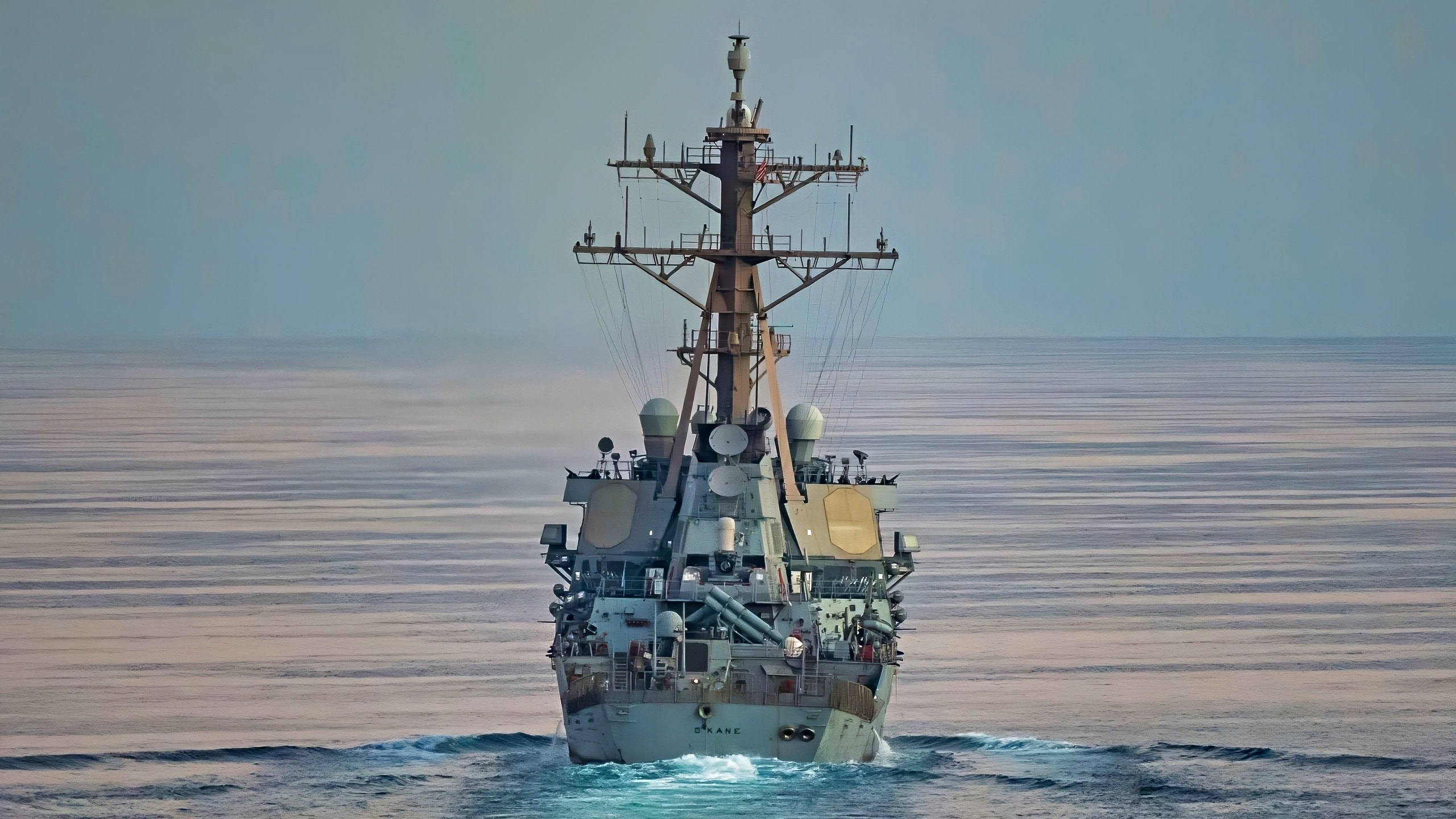
The numbers in the U.S. statement are small compared to some waves of conflict since February, but they are significant because they are concentrated. Four suicide drones towards the maritime corridor, then seven ballistic missiles towards two countries hosting essential U.S. infrastructure: Kuwait, where important logistical and air bases are located, and Bahrain, home to the U.S. Fifth Fleet. The Iranian Revolutionary Guard stated, through Iranian media, that it targeted U.S. bases in both countries and responded to U.S. strikes. Kuwait and Bahrain reported alerts and interceptions, with Kuwait describing the attacks as a direct act of aggression.
From a military perspective, striking the radars in Gork and Qeshm is not just about punishment. These two sites overlook one of the narrowest and most expensive maritime corridors in the world. The coastal radar there does not launch missiles, but it sees ships, connects the maritime picture to command centers, and helps choose the timing for launching drones or coastal missiles. When Washington strikes the radar after downing the drones, it is signaling that maritime defense will not be limited to killing the projectile in the air; it will also target the eye of the network that sees the target.
The True Value of the Seven Missiles
The question is not whether Iran succeeded in inflicting significant U.S. losses. According to CENTCOM, there are no injuries among U.S. military personnel, and claims of damage at the Fifth Fleet headquarters were denied by the U.S. The more important question is that Iran is still capable, after more than three months of U.S. and Israeli strikes, of producing a fire rhythm that forces Kuwait, Bahrain, and the U.S. Navy into a state of alert within hours. The U.S. president himself mentioned in an interview with NBC, according to Reuters, that Iran may still possess about 21 or 22 percent of its missile stockpile. If this estimate is correct, the problem is not in the percentage but in how it is used.
The ballistic missile here becomes a political tool before it is a tool of destruction. Seven missiles do not break a fortified U.S. base if most are intercepted, but they break the sense that the Gulf can return to normal life while negotiations are ongoing. Every alarm in Manama, and every partial closure or disruption at a Kuwaiti airport, reminds Gulf capitals that the war is not only on the Persian shore. From my experience in reading the military geography of the region, the Gulf does not need comprehensive bombing to feel paralyzed; it is enough for the flight schedule, port security, and tanker movement to become hostages to a sudden Iranian decision.
The Triple Capability Problem in Gulf Defense
Gulf countries have spent enormous amounts over the past two decades on Patriot, THAAD, long-range radars, and command and control systems. But military capability is not made of iron alone. It is a triangle: equipment, training, and institutions. Equipment exists to varying degrees. Training has improved significantly compared to what it was ten years ago. However, the joint institution, that is, the ability to manage a cross-border air and missile battle without waiting for the American hand, remains the weakest link.
The incident of June 5 clearly illustrates this. The threat came in a composite form: drones towards Hormuz, missiles towards Kuwait and Bahrain, and U.S. strikes on radars in Iran. This requires a single operational picture that does not recognize the political borders between Kuwait, Bahrain, Qatar, the UAE, and Saudi Arabia. In the ideal operations room, the Gulf officer sees the missile's trajectory from the moment of launch, knows which battery has the best interception angle, and also knows when not to launch because an American platform or Aegis ship will handle the threat. In reality, Washington remains the central mind in most of this picture.
And here lies the paradox that many do not like to hear at defense exhibitions: possessing an air defense system does not mean having the decision to use it efficiently from a political and military standpoint. A country can buy the battery, but it does not easily acquire a doctrine of joint operation, a culture of data sharing, or trust among neighbors. The Gulf has many systems, but it is still searching for a single system.
Qeshm and Gork and the Battle of the Eye Before the Battle of Arms
Choosing coastal radars as a U.S. target highlights an aspect that often gets lost in Arab analysis, as we prefer counting missiles over understanding networks. Iran does not always need to close Hormuz with large ships or visible naval mines. It is enough to impose organized fog on ship movements: it sees who approaches, threatens those who do not request coordination, and launches cheap drones when it wants to raise the cost of insurance. Thus, Qeshm Island and Gork become part of an economic battle, not just military sites on the map.
The U.S. strike on the radars may temporarily reduce Iran's ability to monitor part of the strait, but it does not end the problem. Radars can be compensated for, or some can be relocated or integrated with other reconnaissance sources. The broader lesson is that any force wanting to protect Hormuz must strike the entire Iranian targeting cycle: reconnaissance, command, launch platform, and the political message that tells ships that crossing requires permission. If the political message remains, even a destroyed radar does not mean a safe passage.
Kuwait and Bahrain as a Frontline, Not as Rear States
Kuwait and Bahrain have been viewed in the Gulf military imagination as rear bases or U.S. support centers, not as a frontline in the classical sense. The June attacks break this perception. Bahrain is small in size, and any missile alert there quickly turns into a national event. Kuwait is deeper, but it carries the memory of 1990 and understands what it means for civilian infrastructure to become part of military pressure. The previous strike that hit Kuwait International Airport, killing one person and injuring dozens according to AP and The Guardian reports, makes every subsequent attack more politically sensitive.
Iran knows this. It does not need to win popular sympathy in the Gulf; it only needs to make hosting U.S. forces more costly for governments. This is the logic of Iranian deterrence as it appears now: we do not directly prevent the American presence, but we turn it into a daily burden on the host state. In contrast, Washington wants to prove that Gulf bases are not hostages, and that any attack will be met with strikes on components of the Iranian targeting network. Between these two logics lie the Gulf capitals, not in a spectator position but in a position of land where calculations are taking place.
The Conclusion That Comforts No One
The engagement of June 5 does not prove that Iran has regained its superiority, nor does it prove that the United States has closed the military file. It proves something more disturbing: the war has entered a phase of pain management, not a phase of resolution. Iran can launch limited salvos sufficient to keep the Gulf tense. The United States can intercept most of them and strike the radars, but it cannot make Kuwait and Bahrain safe from danger with just a statement from Tampa. As for the Gulf states, they see once again that the American umbrella is necessary, but it is not a substitute for a joint Gulf defense decision.
In the old military adage: he who does not have his eye does not have his weapon. Iran is trying to keep its eye on Hormuz, and Washington is striking that eye, while the Gulf is buying many lenses but has not yet built a single viewing room. This is the knot that any ballistic missile, even if it falls into the sea, will still be able to reveal.
Sources
- U.S. Central Command, “CENTCOM Forces Defeat Missiles, Drones Launched by Iran”, 5 June 2026.
- Associated Press, “US military says it shot down Iranian missiles and drones”, 5 June 2026.
- Reuters, “US attacks Iranian sites after Iran launches drones, in latest Gulf flare-up”, 6 June 2026.
- The Guardian, “Kuwait and Bahrain targeted by Iran after exchange of fire with US”, 6 June 2026.
Iran launched seven ballistic missiles towards Kuwait and Bahrain on June 5, 2026, with six intercepted and one failing to reach its target. The U.S. retaliated by striking Iranian radar sites. This incident underscores the ongoing military tensions in the Gulf and the challenges faced by Gulf defense systems.
- Iran launched seven ballistic missiles towards Kuwait and Bahrain on June 5, 2026.
- Six missiles were intercepted, and one did not reach its target.
- The U.S. responded by striking Iranian coastal radar sites.
- The incident highlights the military tensions in the Gulf region.
- Iran's actions are seen as a test of Gulf defense capabilities.