
88 Drones and One Ballistic Strike — The Russian Air Campaign Tests the Limits of Ukraine's Air Defense
 Dmitri Volkov
88 drones and one ballistic strike — the Russian air campaign tests the limits of Ukraine's air defense
Russia spent one night deploying 88 drones and at least one ballistic missile, but more important than the number itself is another circumstance: 38 of the devices were jet-powered. This is not just another mass raid, but a test of the Ukrainian air defense system's resilience. Moscow is gradually turning the air campaign into a war of attrition, where the cost of interception and reaction time become as important as strike accuracy.
Jet speed changes the economics of the raid
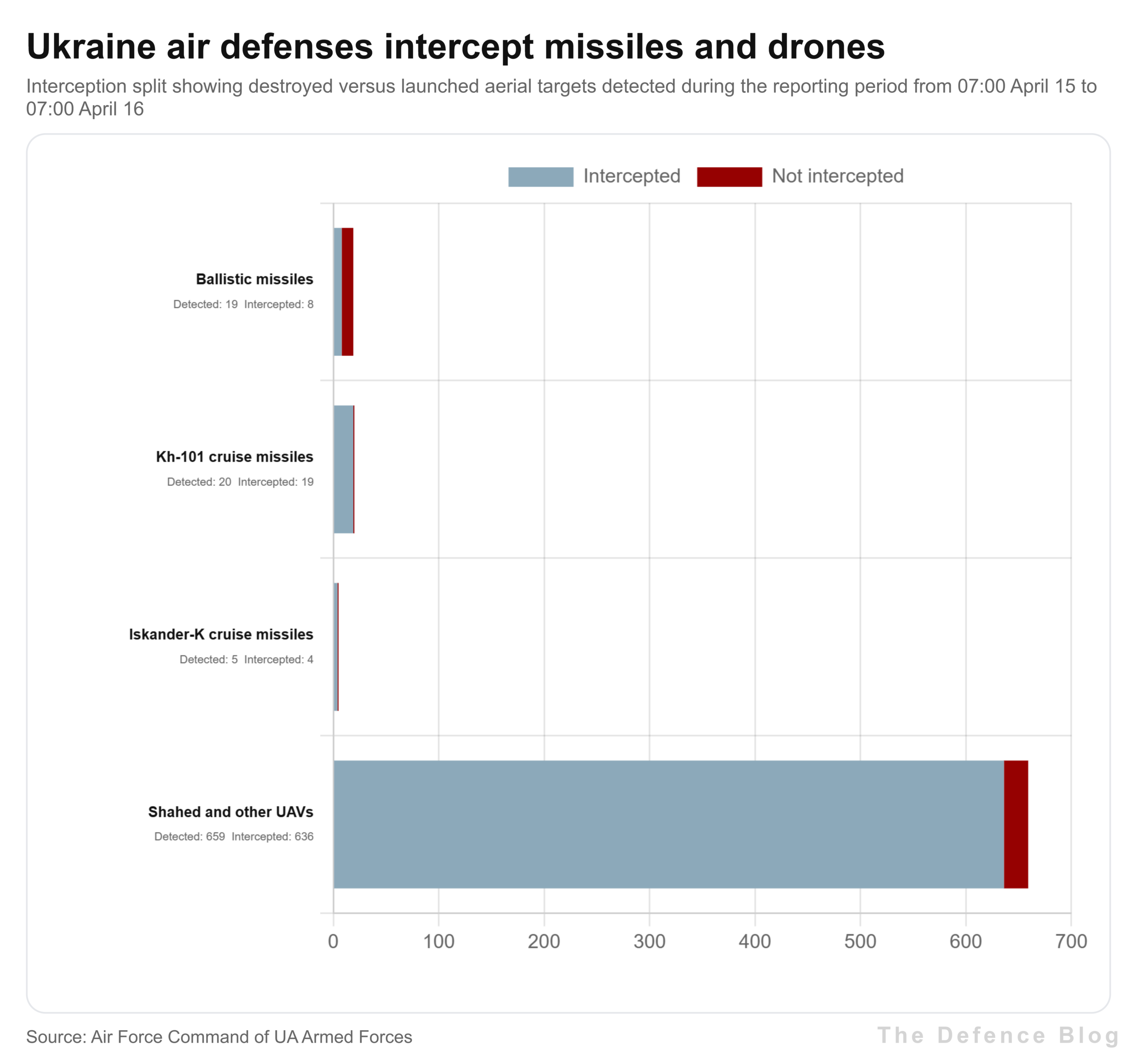
According to Ukrainian sources, on the night of October 28, Russian forces used a missile designated as "Iskander-M/S-400" and 88 devices of the "Shahed" type, among which 38 were jet-powered (The Kyiv Independent, October 28, 2026). The basic "Geran-2," based on the Iranian Shahed-136, flies relatively slowly and gives defenders more time to detect and allocate targets. The jet-powered modification reduces this window and simultaneously increases the demands on radars, mobile fire groups, and short-range missiles.
Here, a fundamental difference emerges between tactical success and operational effect. Even if a significant portion of the drones is shot down, Russian command gains valuable data on where the scarce anti-aircraft systems are located, which routes remain open, and how much time the Ukrainian side needs to make decisions. In the Soviet military school, such reconnaissance by combat would be called preparation for fire impact. In 2026, it is carried out by a serial product that costs much less than an interceptor missile.
The main weak point — not the number of systems
Vladimir Zelensky stated that Ukraine needs to intercept about 150 Russian ballistic missiles per month, while annually it receives approximately 150 Patriot missiles from the United States (The Kyiv Independent, October 28, 2026). This comparison does not mean that all 150 Patriot missiles are intended for one specific threat or that each Russian ballistic missile requires a Patriot. But the order of magnitude reveals a structural problem: an expensive echelon of defense cannot indefinitely cover space if the enemy simultaneously saturates it with cheap drones, decoys, and faster jet-powered devices.
Technically, the Patriot remains the most valuable means against ballistic targets. Its AN/MPQ-65 radar and PAC-3 family missiles provide interception at the terminal phase of the trajectory; however, the battery is limited by its ammunition, reload time, and the need to cover priority objects. The "Iskander-M" uses a quasi-ballistic trajectory and can maneuver in the terminal phase, complicating the calculation of the meeting point. Therefore, Ukraine's problem is not the absence of air defense per se, but the mismatch between the width of the protected territory and the speed at which the most valuable interceptors are consumed.
The Russian strike model resembles an industrial conveyor
In recent years, Moscow has built a system in which drone raids serve simultaneously as a weapon, a testing ground, and a tool for economic pressure. The Iranian design provided the foundation, but Russian industry transformed it into a scalable series, altering navigation, communication, warheads, and engines. Jet-powered variants cannot be considered wonder weapons: they are more expensive, more noticeable due to their thermal signature, and do not negate vulnerability to electronic warfare means. Their function is different — to close the gap between slow mass drones and expensive cruise missiles.
Official Russian reports usually measure success by the number of destroyed targets. For analysis, another metric is more important — how many hours and missiles Ukraine is forced to spend to defend one object. If an expensive missile is used to destroy a cheap device, Moscow achieves a partial economic effect even in the absence of significant destruction. This does not imply automatic superiority for Russia: the production of interceptors, distribution of radars, and adaptation of mobile groups can change the calculation. But the initiative in choosing the pace currently lies with the attacking side.
Strategic significance for war and negotiations
The air campaign also serves a political purpose. The Kremlin seeks to prove that the Ukrainian rear remains vulnerable and that Western assistance is not keeping pace with the growing demand for anti-missiles. On the same day, Kyiv discussed with European partners the strengthening of air defense and defense-economic cooperation. The timing does not prove a unified design, but for the Russian doctrine of pressure in negotiations, such a backdrop is crucial: strikes should create a sense of an inevitable cost for continuing resistance.
However, this tool has its limits. Air defense does not have to shoot down everything to maintain state stability; it is sufficient to protect critical infrastructure, command nodes, and industry better than the enemy can destroy them. Ukraine is also ramping up its own interceptor drones and cheap munitions, which gradually reduces the advantage of mass raids. Therefore, today's figure of 38 jet-powered devices is an indicator of Russian adaptation, but not yet proof of a change in the strategic balance.
Cold forecast
Russia will expand mixed attacks, combining slow "Gerans," jet drones, and ballistic missiles in one sequence. Ukraine will respond by distributing sensors, increasing the production of cheap interceptors, and demanding that partners supply not only batteries but also a steady flow of munitions. The outcome of this race will not be determined by a single night with 88 devices, but by the industry's ability to sustain the pace for months. If Western supplies of Patriot remain episodic, the Russian model of attrition will become more dangerous; if Kyiv receives layered defense and a cheap interception layer, the current "conveyor" will prove to be an expensive way to demonstrate power.
Sources
On October 28, 2026, Russian Armed Forces launched an air campaign against Ukraine, deploying 88 drones and 1 ballistic missile to test the limits of Ukrainian air defense. Among the drones, 38 were jet-powered, indicating a shift in tactics aimed at overwhelming Ukrainian defenses. This operation highlights the ongoing challenges Ukraine faces in intercepting Russian missile threats while managing its own air defense resources.
- 88 drones and 1 ballistic missile were used in the attack
- 38 of the drones were jet-powered
- Ukraine needs to intercept about 150 Russian ballistic missiles per month
- The Russian air campaign aims to exhaust Ukrainian air defenses
- Ukraine is increasing its own drone capabilities