
A-50U Transitioned to Daily Duty — Ukrainian Missiles Forced the VKS "Eyes" into Deep Rear
 Dmitri Volkov
A-50U Transitioned to Daily Duty — Ukrainian Missiles Forced the "Eyes" of the Aerospace Forces into Deep Rear
In the first half of June, A-50U long-range radar detection aircraft were hardly seen in the air. An analysis of over 1,600 reports on Russian aviation flights from June 4 to August 2, conducted by the Ukrainian monitoring community "CyberBorosno," shows that from June 4 to June 22, the AWACS aircraft were not involved in duty against Ukraine at all (according to Militarnyi, August 15, 2026). Then came a sharp turnaround. Daily flights, dispersal across airfields in the Urals, and the simultaneous launch of four aircraft on July 7, almost the entire combat-ready fleet. Between these two dates lies the Ukrainian cruise missile campaign, which forced the Russian command to reconsider the role of the most expensive aircraft in its arsenal.
From Downtime to Maximum Readiness
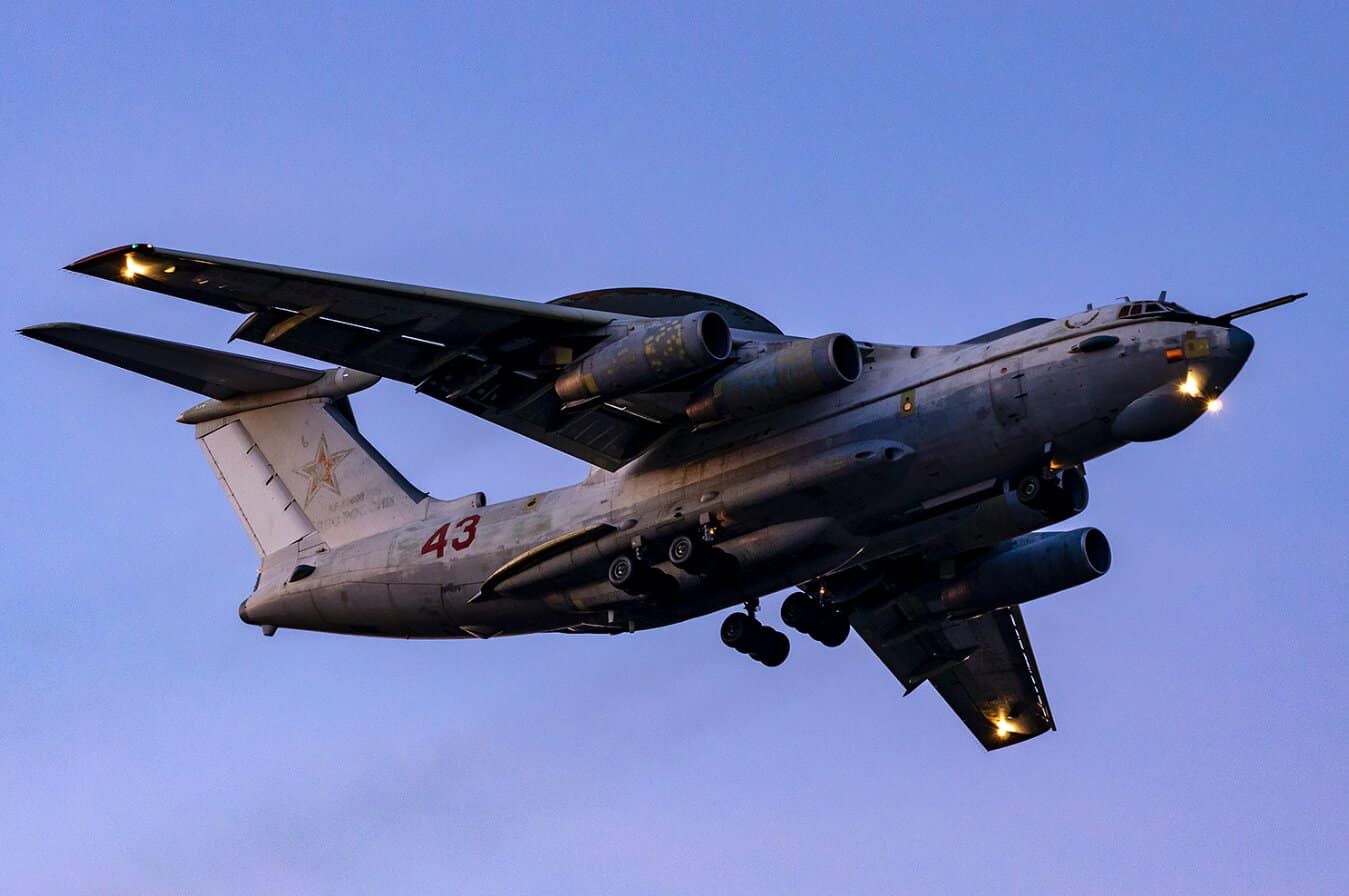
The dynamics recorded by "CyberBorosno" leave no room for coincidence. From June 4 to June 22, reports on the movement of Russian aviation only mentioned the commissioning of the repaired aircraft "47 red" and flights along the route Vorkuta — Olenya. The A-50Us themselves were not deployed for operations against Ukraine. Starting June 23, the situation changed: one aircraft, primarily at night, began to patrol the rear areas of the Ulyanovsk and Samara regions — and this activity continued until the end of the studied period, amounting to about 60 takeoffs. A key episode occurred on July 4, when the A-50U became a decisive element in repelling the attack of Ukrainian cruise missiles. Before this day, the aircraft primarily took off from the "Ivanovo" and "Ulyanovsk" airfields; after that, flights from there ceased. The basing was dispersed deeper into the rear — to "Bolshoye Savino" (Perm), "Orenburg-2," and "Chelyabinsk." On July 7, the enemy launched four A-50Us into the air simultaneously — almost the entire combat-capable fleet.
The Cost of the Issue — Thirteen Aircraft for the Entire Country
To understand what such an operational mode means, one must recall the scale of the fleet. During the Soviet era, the industry produced about 31 A-50 aircraft; to this day, approximately 13 remain in various versions: about 10 in service with the Russian Aerospace Forces (3–4 in the basic A-50 version and 7 in the upgraded A-50U) and the rest in India (according to Militarnyi). Thus, the "eyes" of Russian aviation consist of ten machines built between 1983 and 1990, based on the Il-76 platform with the "Shmel" radio-technical complex based on the Soviet computer "Argon-50." The modernization to A-50U at the Taganrog Aviation Scientific and Technical Complex named after Beriev replaced analog equipment with digital based on Intel components, lightened the aircraft, and expanded its capabilities: detection of low-observable targets at low altitudes and operation in conditions of active electronic countermeasures. The radar of the complex tracks aircraft and cruise missiles at ranges of up to 700 kilometers, while optical-electronic systems detect the trails of ballistic missiles at distances of up to 800 kilometers.
A Shield That Cannot Be Reproduced
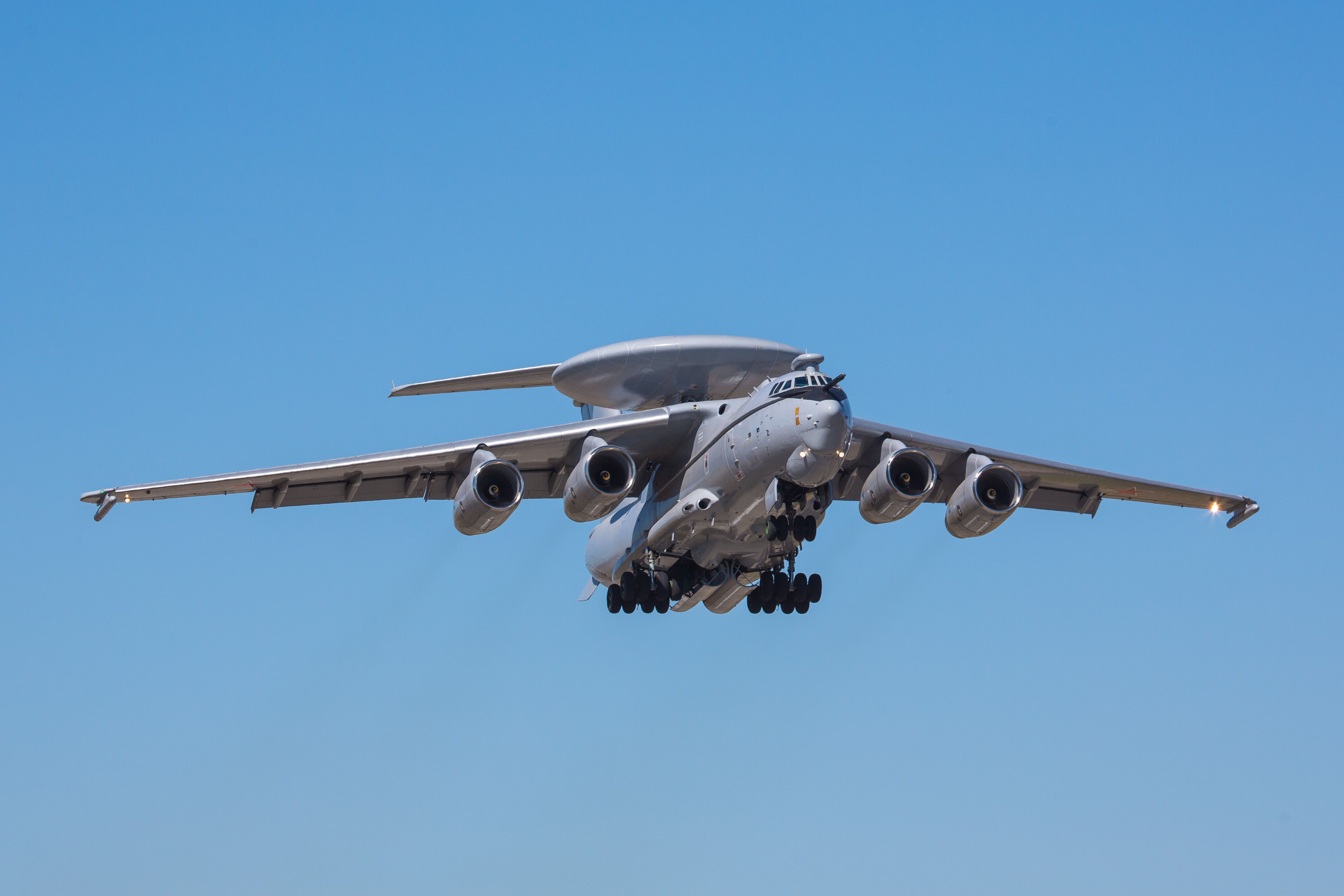
The main distinguishing feature of the A-50U from any other element of Russian defense is its irreproducibility. The prospective A-100 on the Il-76MD-90A platform has not yet moved beyond the prototype stage; there is no serial production, and in the foreseeable future, the Russian defense industry cannot compensate for the loss of even one aircraft (according to Militarnyi). Each downed aircraft is a permanent loss. The Ukrainian Air Forces became the first in the 21st century to shoot down an AWACS aircraft: on January 14, 2024, the named A-50U "Sergey Atayants" (tail number 37, RF-93966) was destroyed over the Sea of Azov — a machine that had been operating from the Belarusian airfield Machulishchi since the beginning of the war. Since then, each takeoff of the A-50U represents a conscious risk costing hundreds of millions of rubles and dozens of trained specialists: a crew of 5 people plus 10–11 operators of the "Shmel" complex, trained at the 610th Combat Application Center in Ivanovo.
A Doctrinal Shift That Is Not Spoken Aloud
The Soviet and Russian doctrine assigned an offensive role to AWACS aircraft: external target designation for fighters, guidance on aerial targets, and detection of Ukrainian aviation deep in the rear. Now, the most expensive aircraft of the Aerospace Forces performs the function of a flying radar picket over its own rear — essentially, an air element of air defense against cruise missiles, a role that the classic Soviet school assigned to ground radar stations. This is not tactical improvisation, but a forced doctrinal shift: ground radars in the Ulyanovsk and Samara regions apparently do not provide the required warning time, and the command pays for this with a fleet resource that cannot be replenished.
The numbers speak for themselves. About 60 flights over forty days with a fleet of seven upgraded aircraft is a mode close to the maximum allowable for airframes 35 years old. The simultaneous launch of four aircraft on July 7 means that half of the entire combat-capable fleet of A-50Us was in the air — and this is considering that one aircraft was likely undergoing repairs or crew retraining. The asymmetry of costs is disheartening: a Ukrainian cruise missile costs hundreds of thousands of dollars, while the Russian response requires tens of thousands of hours of flight time on a non-reproducible resource.
Here, a historical parallel is appropriate. In the summer of 1941, the Soviet Air Forces lost thousands of aircraft on airfields because dispersal had not been practiced; the lesson was learned for decades to come — and now the same principle of aviation dispersal is being applied under the pressure of not bombers, but cruise missiles and drones. Only in 1941 could losses be replenished within a year, while the A-50U cannot be replaced in even ten years.
"The A-50U is the only element of Russian aviation that cannot be bought, produced, or quickly trained. Every hour of its duty over Ulyanovsk brings closer the moment when it will have to be preserved more than used" — this is how one can rephrase the conclusion reached by both Ukrainian and Western monitoring groups.
Limits of Dispersal
Is the strategy working? So far — yes, with caveats. Perm, Orenburg, and Chelyabinsk are located 1,000–1,500 kilometers from the territory controlled by Ukraine, which takes the aircraft out of reach of most Ukrainian strike assets. But the cost is time. Each flight from the Urals to the duty areas over the Volga consumes hours that could be used to control the airspace over the front line, where Russian aviation is increasingly operating blind. Meanwhile, Ukraine demonstrates that distance is not a constant: on August 15, its cruise missile "Flamingo" struck the Savasleyka airbase in the Nizhny Novgorod region and a factory in Samara — at a range of about 700–900 kilometers (according to Kyiv Independent). If this radius continues to grow, the Ural refuge will also fall within the strike zone — and then the command will face a choice between losing its eyes and blinding them.
My forecast, with caveats, is as follows. By the end of 2026, the Russian Aerospace Forces will maintain the A-50U fleet at the cost of its accelerated depletion: the daily duty mode will remain the norm, dispersal will go even deeper into Siberia, and the number of aircraft simultaneously in the air will only increase during moments of Ukrainian missile attacks. But this resource is finite, and there are no ways to replenish it: the A-100 remains a mirage, and the "modernization" of old airframes at the Taganrog plant cannot compensate for the loss of crews. The Ukrainian side apparently understands this — and therefore continues to strike not at the aircraft themselves, but at airfields, logistics, and repair bases, making dispersal increasingly costly. Wars of attrition rarely end with loud battles; more often — with the quiet decision not to launch into the air what cannot be replaced.
A-50U aircraft of the Russian Aerospace Forces transitioned to daily operational duty in response to increased Ukrainian missile threats, conducting reconnaissance over Ulyanovsk and Samara from June 23, 2023. Significant activity included a crucial role in countering a missile attack on July 4, with four aircraft simultaneously deployed on July 7. The operational fleet is limited to about 10 aircraft, highlighting the strategic importance and vulnerability of these assets.
- A-50U aircraft were inactive from June 4 to June 22, 2023.
- Daily flights resumed on June 23, 2023, with significant activity noted.
- On July 4, A-50U played a crucial role in countering a Ukrainian missile attack.
- Four A-50U aircraft were simultaneously airborne on July 7, 2023.
- The A-50U fleet is limited to approximately 10 operational units in Russia.