
Africa Corps deploys an Infauna vehicle in Mali — the war of Russian convoys enters the electromagnetic era in 2026
 Marie Dubois
Africa Corps deploys an Infauna vehicle in Mali — the Russian convoy war enters the electromagnetic era in 2026
In Bamako, sometimes a single image can shift the map of military capabilities. A photograph released on October 31 and then shared again on November 1 shows a Russian electronic warfare vehicle RB-531B Infauna alongside the Africa Corps in Mali. The identification is not officially confirmed, and the exact location of the shot remains unknown. However, the silhouette, its eight-wheeled armored chassis, and its antennas correspond to equipment designed to disrupt communications and neutralize remotely detonated mines.
Equipment made for Malian roads
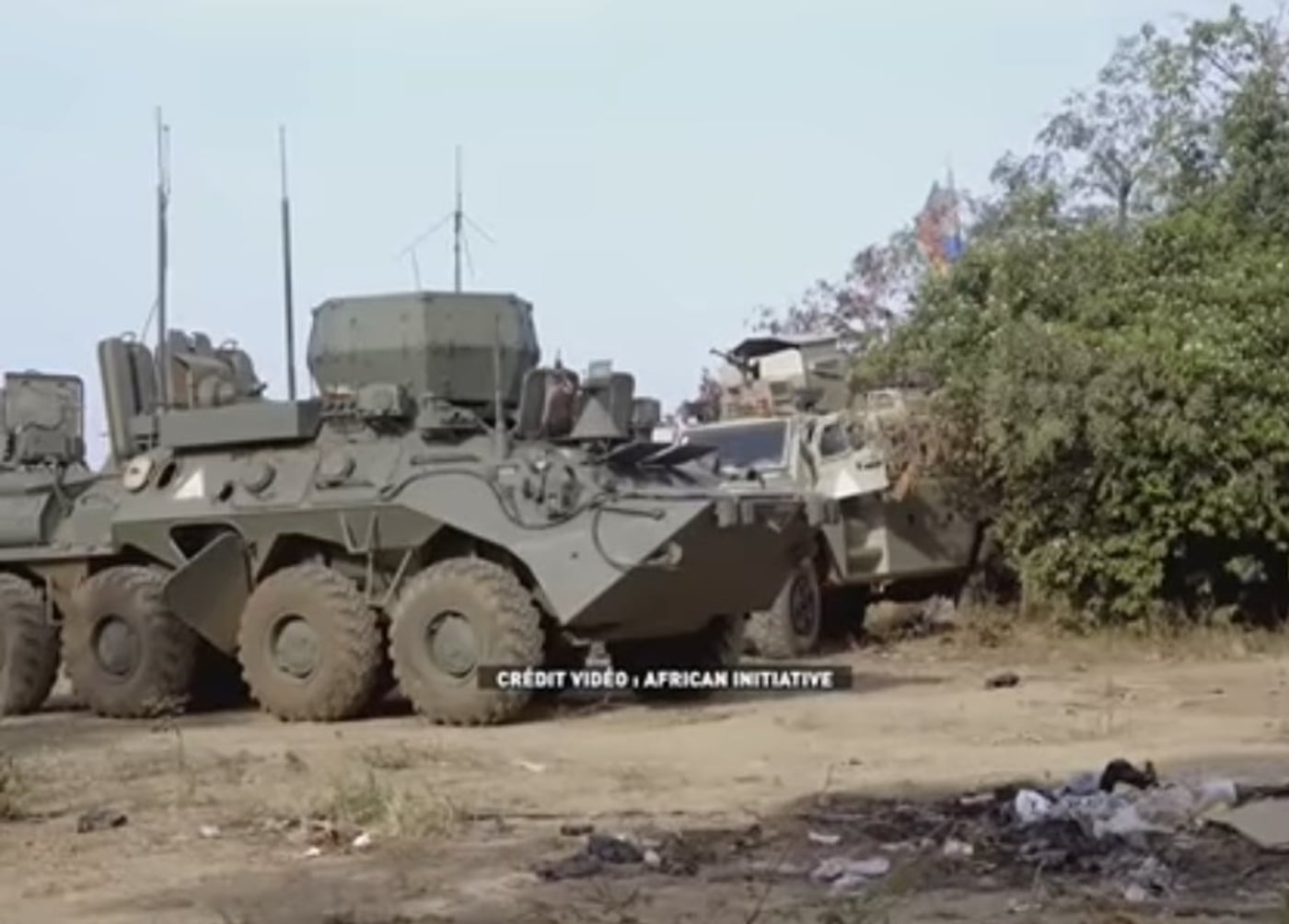
The RB-531B is mounted on a K1Sh1 chassis derived from the BTR-80. Its mission is not to win a tank duel. It is meant to jam radio links, prevent the triggering of improvised explosive devices, and, according to the presentation from the Russian exporter, produce an aerosol screen capable of concealing a convoy. In northern and central Mali, where the routes between bases are long, dusty, and predictable, this combination addresses a very concrete threat.
Groups affiliated with JNIM — the Support Group for Islam and Muslims — do not need to hold a road permanently to make it dangerous. They only need to monitor a convoy's habits, place a charge, and then choose the moment when a patrol is most vulnerable. Jamming does not eliminate the ambush, but it can break the chain that makes it effective: observation, transmission, triggering, and calling for reinforcements.
The operational signal behind the photograph
Defence Blog reports that the recent image comes from an open-source account, Hammer Of War, and that a second photograph taken in June 2025 shows a comparable Russian system with the Africa Corps. However, this second machine could be an R-934BMV Borisoglebsk-2, more focused on jamming enemy networks. The distinction matters. An Infauna primarily protects a platform or convoy against radio links and remote-controlled mines; a Borisoglebsk-2 more broadly targets the enemy command network.
What can be established is therefore limited but useful: Moscow seeks to provide its force in Mali with specialized capabilities, not just transport vehicles and rifles. This suggests an adaptation to the losses suffered on the ground. In April, fighters linked to al-Qaeda and Tuareg separatists forced Russian and Malian forces to withdraw from Kidal. The Moscow Times then geolocated videos showing a convoy leaving the city and destroyed armored vehicles. The onboard electronics here are a response to lessons learned, not just a symbol of prestige.
Electronic warfare does not rebuild territorial control
However, one must avoid a conclusion that is too comfortable for Bamako and Moscow. A jamming vehicle protects a column within a limited radius and duration. It does not automatically provide information on secondary tracks, does not secure the villages crossed, and does not replace a human presence capable of distinguishing an informant from a civilian. On the ground, the Malian problem remains that of controlling the spaces between fortified points.
A system like the Infauna can complicate the use of a radio detonator. It does not neutralize a charge triggered by cable, pressure, or direct observation. It also does not block an attack launched after immobilizing the vehicle. To be effective, it must be integrated into a complete procedure: route reconnaissance, radio discipline, demining, escort, medical evacuation, and immediate intelligence exploitation. It is precisely this architecture that is lacking in Sahelian forces when they extend their lines without increasing their surveillance capacity.
A tactical advantage, a strategic bill
The possible arrival of the Infauna also reveals the new division of labor between the Malian army and the Africa Corps. The Russians provide the equipment and experience accumulated in Ukraine, while Malian units remain essential for local intelligence, guides, and holding positions. This complementarity can improve the survival of convoys. It also creates a dependency: without maintenance, spare parts, trained operators, and electromagnetic mapping, the vehicle becomes an expensive armored box.
The temptation will be strong to use jamming as a general insurance. This is a mistake. In the Sahel, the adversary quickly observes frequencies, routes, and schedules. They change methods as soon as a countermeasure appears. JNIM does not need to defeat the Infauna; they can simply wait for the convoy to exit its protection bubble or shift pressure to routes where no specialized system is present.
What to watch for now
The next serious indication will not be a new photograph, but the repetition of this type of capability across several axes, particularly between Bamako, Mopti, and Gao. It will also be necessary to check if Malian forces modify their movement procedures and if attacks using explosive devices change form. At this stage, neither Russia nor Mali has confirmed the identity of the vehicle, its arrival date, or its area of operation. This caution is essential.
My judgment is nonetheless clear: the Infauna, if properly deployed in Mali, shows that the Africa Corps is beginning to treat convoys as an electromagnetic spectrum problem, rather than just an issue of armor. This may reduce some losses on major routes. It will not give Bamako control of the north. The next battle will likely take place at the exit of the jammed area, where the road becomes long, silent, and uncontrolled by anyone.
Sources
Africa Corps deployed an RB-531B Infauna electronic warfare vehicle in Bamako, Mali, on November 1, 2026. This vehicle is intended to disrupt communications and neutralize remote-controlled mines, enhancing convoy protection against threats from JNIM affiliates. The deployment reflects a strategic adaptation to operational challenges faced by Russian and Malian forces.
- An Infauna electronic warfare vehicle was deployed by Africa Corps in Mali.
- The vehicle is designed to disrupt communications and neutralize remote-controlled mines.
- The deployment is part of a strategy to enhance convoy protection against threats from JNIM affiliates.
- The vehicle's effectiveness is limited to specific operational contexts and requires comprehensive procedures for optimal use.
- The presence of the Infauna indicates a shift in tactics for the Africa Corps in Mali.