
After the fall of Kidal, Moscow secures the Sahel with an expanded military pact
 S.W
S.WAfter the Fall of Kidal, Moscow Locks Down the Sahel with an Expanded Military Pact
Niamey, July 31 — Three months after being ousted from Kidal by a coalition of jihadists and Tuareg rebels, the Russian African Corps is not leaving the Sahel. It is taking root there. A joint statement released on the night of July 30 to 31 in Niamey formalizes the expansion of military cooperation between Russia and the Alliance of Sahel States (AES) — Mali, Burkina Faso, and Niger — well beyond the strictly security framework.
Russian Foreign Minister Sergei Lavrov blessed the agreement during a multilateral summit in the Nigerien capital. The pact extends the so-called "3+1" framework to economic and financial areas, including cooperation between central banks. It is no longer just military assistance: Moscow is building a parallel state architecture in one of the most unstable regions in the world.
The Debacle That Is Not Named
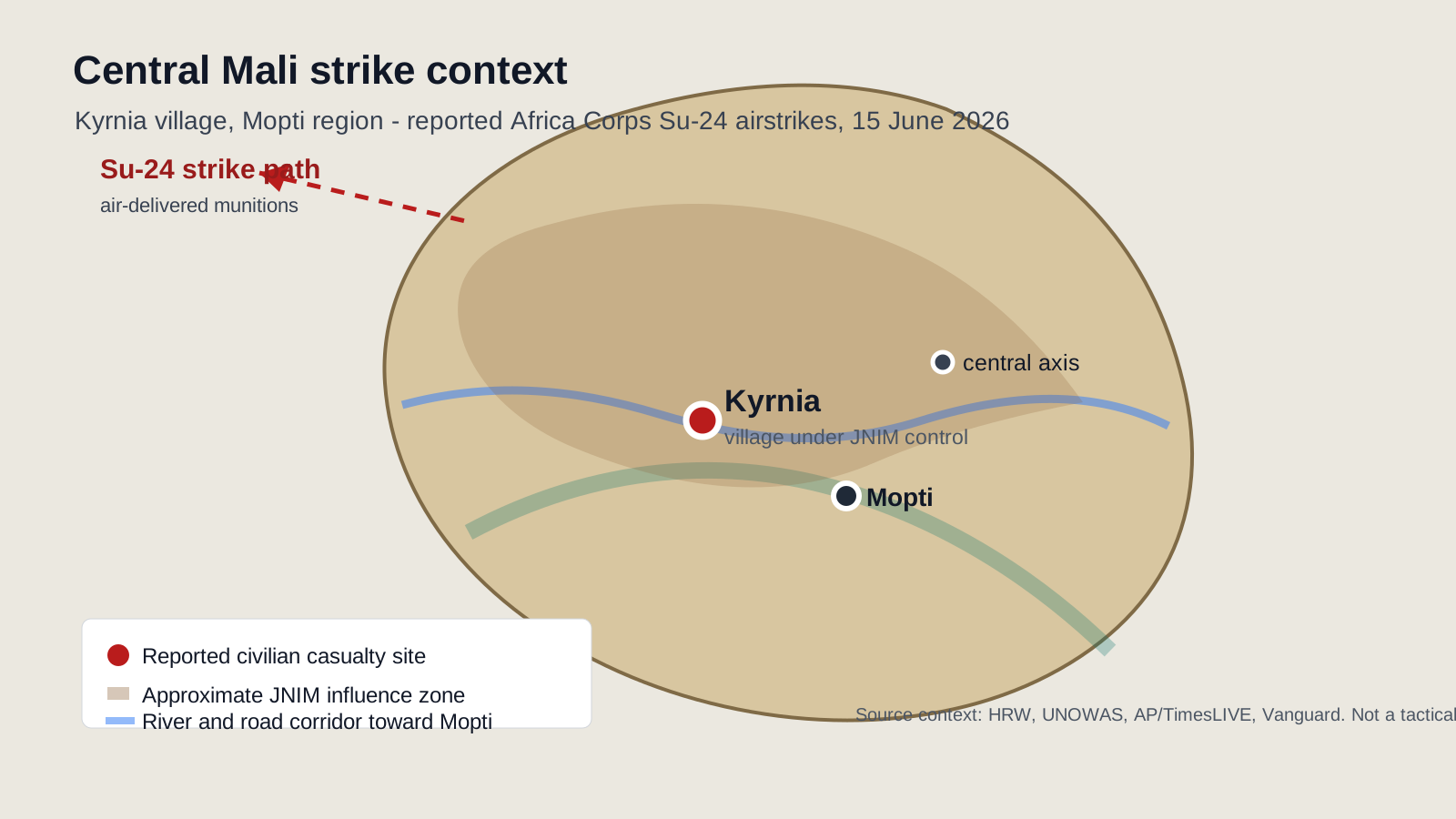
The timing is not coincidental. On April 26, 2026, fighters from the Azawad Liberation Front (FLA) and JNIM — the jihadist coalition linked to al-Qaeda — launched an unprecedented coordinated offensive, the largest since the Tuareg rebellion of 2012. Five cities were hit simultaneously: Bamako, Kati, Gao, Kidal, and Mopti. Within forty-eight hours, Malian Defense Minister Sadio Camara — the architect of the partnership with Moscow — was killed in the assault on the Kati command center. The head of intelligence, Modibo Koné, was seriously injured.
The Russian African Corps — the structure under direct Kremlin command that replaced the Wagner Group in 2025 — hastily abandoned Kidal, Aguelhok, and Tessalit. A Mi-35 helicopter, shot down with its crew and mobile fire group, was left behind. Entire caches of weapons were seized by the FLA. Images of Russian armored vehicles leaving Kidal amid the mockery of rebel pick-ups circulated widely on social media.
It is an operational disaster. But in Niamey, on July 31, no one mentioned it.
From Barkhane to Africa Corps: The Handover is Complete
The expanded pact comes in a strategic void that France and the West have left wide open. In June 2026, Captain Ibrahim Traoré's Burkina Faso formally severed all diplomatic relations with Paris, accusing the former colonial power of supporting "subversive" networks. Mali and Niger had already completed their break in previous years. The three countries have also left ECOWAS and the Rome Statute.
The result is historic: France, which deployed more than 5,000 troops as part of Operation Barkhane five years ago, is completely ousted from central Sahel. Every airbase, every logistical corridor, every command relationship that Paris maintained since independence is now either empty or occupied by Russian advisors. The shift occurred in less than three years.
On the ground, when one evacuates a position without ensuring the transition of human intelligence — informants, local contacts, acquaintances known by their first names — one does not just lose territory. One loses the map itself. This is exactly what happened between the French departure and the Russian arrival.
The Russian Paradox: Stronger on Paper, Weaker on the Ground
The gap between the diplomatic narrative and operational reality is striking. The Niamey statement mentions increasing military-technical cooperation and promises to strengthen the AES Unified Force — 5,000 to 6,000 men launched in December 2025. But on the ground, the African Corps has already retreated from northern Mali to focus on protecting Bamako and the ruling junta.
According to analyst Benedict Manzin from the British firm Sybiline, Russian forces are now adopting a "supporting role": air support, intelligence, training — rather than direct combat. On July 26, 2026, a joint Malian-African Corps ambush eliminated eight fighters near Niono, in the Ségou region. A tactical-level action, 1,300 kilometers from the northern front, where the FLA holds Kidal and where JNIM claims partial control of Mopti, Sévaré, and Gao.
The arithmetic truth is brutal: with fewer than 2,000 men over a territory the size of France and Spain combined, the African Corps does not have the mass to hold northern Mali. The Kremlin knows this. The juntas do too, even if they will never admit it publicly.
The Push Towards the Gulf of Guinea
Moscow's ambition does not stop at the borders of the AES. In March 2026, the Russian ambassador to Togo and Benin stated that Moscow hoped to use the port of Lomé as a logistical hub to supply the landlocked Sahel, with plans for railway development. The push towards the Gulf of Guinea is explicit and methodical.
At the same time, Beijing is filling the economic void left by the withdrawal of French capital, with infrastructure and mining contracts multiplying in the three AES states. The Sahelian geopolitics of 2026 is no longer a Franco-Russian competition: it is a complete multipolar realignment, where Moscow provides security, Beijing provides infrastructure, and where the juntas skillfully play each partner against the other.
The Familiar Trap
There is a trap in this configuration that I know well. It is the one in which France fell for an entire decade: believing that military support for unpopular and weakened regimes can stabilize a region that these regimes no longer control.
The Malian junta has just lost its Defense Minister and its capital is under partial blockade, with supply routes cut off by JNIM. Burkina Faso, which dissolved all its political parties in January 2026, is suffering drone attacks in its northern and eastern regions. Niger is instrumentalizing anti-French rhetoric to mask a security disaster, with Niamey airport itself having been targeted in January. These are not reliable partners. They are survival regimes, betting their legitimacy on an external alliance — just as their predecessors did with Paris.
What Is to Come
The pact of July 31 will change nothing in the short-term military dynamic. It is a diplomatic façade, not an operational solution. JNIM continues to advance southward and now threatens Benin, Togo, and Côte d'Ivoire. The Islamic State in the Sahel maintains its presence in eastern Burkina Faso and the tri-border area. The FLA, emboldened by Kidal, has no reason to negotiate.
The question is not whether the Russia-AES pact will hold. It will hold, because the juntas have nowhere to go and Moscow needs this African showcase. The question is whether this alliance can produce anything other than statements — and on this point, the last three months offer little reason for optimism.
The Sahel is becoming what Afghanistan was for the Soviet Union in the 1980s: a theater where technological superiority and ideological rhetoric collapse upon contact with the ground. The difference is that today, there is not even a Kabul to defend — only besieged capitals and ministers being buried.
On July 31, 2026, Russia expanded its military cooperation with the Alliance of Sahel States (AES) during a meeting in Niamey, involving 5,000 to 6,000 personnel. This agreement extends beyond military assistance to include economic and financial collaboration. The Russian African Corps is solidifying its presence in the region, while the security situation continues to worsen due to jihadist threats and the complete withdrawal of French forces from central Sahel.
- Russia expands military cooperation with the Alliance of Sahel States (AES) including Mali, Burkina Faso, and Niger.
- The Russian African Corps is establishing a parallel state architecture in the Sahel.
- The pact includes economic and financial cooperation beyond military assistance.
- The situation in the Sahel is deteriorating with ongoing threats from jihadist groups.
- The French military presence has been completely removed from central Sahel.