
AI in Ukrainian UAVs 50–200 km Breaks the Logistics of the Russian Army in 2026
 Dmitri Volkov
AI in Ukrainian UAVs 50–200 km Disrupts Russian Army Logistics in 2026
The Ukrainian Ministry of Defense described on June 12 a matter that at first glance appears to be a technical detail: medium strike drones are learning to match images with pre-loaded satellite data, bypass air defense zones, and distinguish a decoy from a real vehicle. In practice, this is not a detail, but a transition from a craft drone to a cheap operational strike tool. For the Russian army, accustomed to compensating for poor intelligence with mass and supply routes, such a change is more unpleasant than another single strike on an oil depot.
Why the Range of 50–200 Kilometers Has Become a Separate Level of Warfare
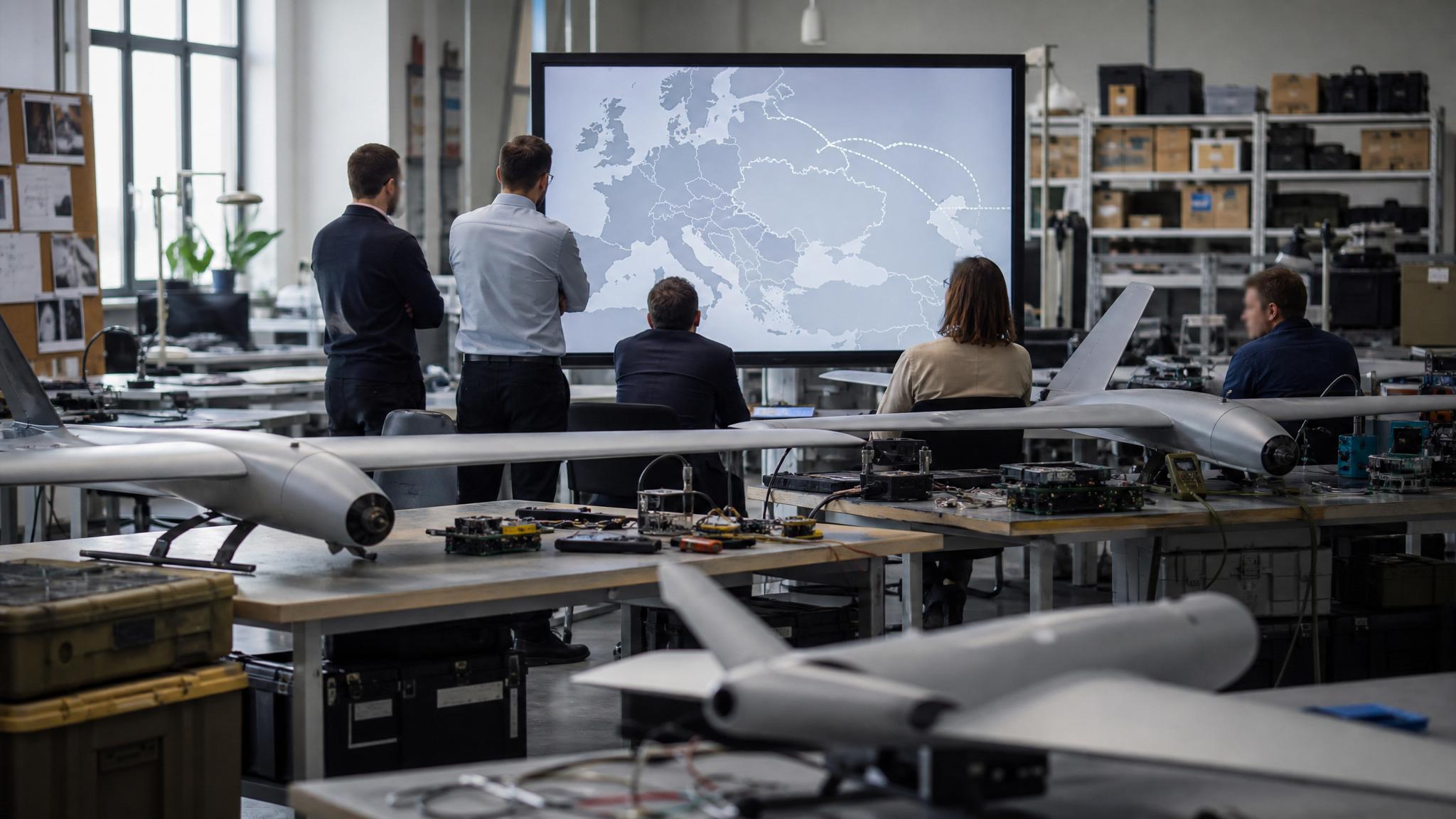
The classic front line in this war has long ceased to be a line. But until recently, there was a relative division: FPV and small drones terrorized the tactical depth, while long-range UAVs and missiles struck factories, warehouses, and airfields. Now a third layer has emerged between them — the Ukrainian middle strike campaign, that is, strikes approximately 20–200 kilometers behind the front. The Guardian described on June 11 how this layer operates along the P-280 road along the Azov coast, connecting Rostov-on-Don, Mariupol, Melitopol, and Crimea. According to the Ukrainian command of unmanned systems, military cargo traffic on this route has fallen by 71% in two weeks. Even if this figure is taken with a grain of military rhetoric, the order of the phenomenon is clear: it is not about beautiful videos of burning trucks, but about a systematic reduction in the throughput of the land corridor.
Russian logistics in the southern grouping is not a luxury. It depends on long supply lines, bridges over Chonhar and Henichesk, limited railway infrastructure, and vulnerable fuel truck columns. The Soviet school, which I still encountered in textbooks, built logistics as a massive, redundant system: if one route is knocked out, a second echelon comes in; if a bridge is destroyed, engineering units quickly create a bypass. The modern Russian army has retained a love for massing but has not preserved the Soviet engineering density. Therefore, a drone costing tens of thousands of dollars begins to perform tasks that previously required aviation, artillery preparation, or a sabotage group.
AI Here Is Not Magic, But Risk Accounting
The Ukrainian Ministry of Defense claims that the new systems use optical cameras and onboard computers to navigate in conditions of GPS jamming and electronic warfare. The algorithm compares the current image with saved satellite images, clarifies the position based on landmarks, calculates the trajectory, and then helps identify the target. If the task is an air defense position, the neural network highlights a launch system or radar station; if the task is logistics, it looks for the silhouette of a truck, tanker, engineering vehicle, or warehouse. An important detail: the system must also distinguish false targets from real ones by comparing geometry, surface, and thermal signatures.
One should not romanticize this with the word autonomy. In war, the term AI is often sold as a miracle, although in reality, it is a statistical discipline: fewer route errors, fewer hits on false targets, less dependence on the operator in the electronic warfare zone. But it is this prose that makes the technology dangerous. The Russian defense builds anti-drone protection as a set of separate barriers — electronic warfare, camouflage, false positions, mobile groups, movement restrictions. AI navigation turns these barriers into variable tasks that can be recalculated before each flight. This does not eliminate electronic warfare, but reduces its margin: each new suppression complex requires time and personnel, while each new drone route costs much less.
Decentralization vs. Russian Verticality
Kyiv Post, citing CNN, previously described another component of the same logic: Ukrainian long-range operations rely on distributed launch sites, false drones, and software control of a large number of devices. The commander of the Deep Strike unit with the call sign Vector spoke about dozens of launch sites and the ability to work with thousands of UAVs. In Russian military culture, this sounds almost indecent. The Russian system loves a single center, an approved plan, and a vertical chain of command. The Ukrainian system, forced to live under constant pressure, bets on decentralization and rapid iteration.
Here arises an unpleasant paradox for Moscow. Russia has a much larger industrial base, more missile nomenclature, and significant experience in electronic warfare. But in this particular niche, the advantage goes not to the one with more metal, but to the one who updates software, routes, datasets, and tactical procedures faster. This resembles not World War II, but a late Soviet problem with microelectronics: there are tanks, there is a school, there are designers, but the update cycle is too slow. A Soviet general could afford to lag in interface if he had a thousand artillery pieces. A Russian commander in 2026 cannot afford a slow cycle when his fuel truck is visible from the air 80 kilometers from the front.
What This Means for the Russian Army
The first consequence is an increase in hidden logistics costs. If the P-280 or a similar route turns into a hunting corridor, Russian units have to break up columns, move at night, take to back roads, spend more fuel and time, build temporary shelters, and allocate more personnel for security and repairs. In the reports of the General Staff, this rarely looks like a loss. The vehicle is not always destroyed; sometimes it simply did not arrive on time. But in operational economics, a delay in ammunition can be just as important as the loss of a warehouse.
The second consequence is pressure on Russian air defense in the near and medium rear. The Guardian provides data on the use of American Hornets with a range of about 150 kilometers and Ukrainian Morrigans about two meters long, launched from simple guides. Such devices do not require an airfield and do not resemble a traditional air threat. To cover every road, bridge, repair brigade, and column, Russia would have to create almost a continuous detection grid. This is possible on paper, but too expensive in real war, where radars themselves become targets.
The third consequence is a blow to movement discipline. A Russian logistics officer is now forced to choose between bad options: travel on the main road and risk a strike, detour and lose time, wait and disrupt the supply schedule. In an army where much relies on orders from above and fear of punishment, such micro-decisions quickly turn into chaos. The Ukrainian goal here is not necessarily to destroy all trucks. It is enough to make the Russian rear consider each trip a separate combat operation.
Limits of Ukrainian Advantage
Of course, this does not mean an automatic collapse of the Russian front. Russia has ways to adapt: more false targets, mobile groups with heavy machine guns and short-range air defense systems, observation balloons, nets over roads, and the creation of temporary warehouses closer to units. The Russian army is learning slowly, but it is learning, and dismissing it as an immobile bureaucracy would be analytical laziness. Moreover, Ukrainian AI systems depend on the quality of data, electronics, communications, production of airframes, and batteries. Any mass technology has its failure ceiling.
However, the main conclusion remains. Ukraine is shifting the war from the level of striking individual targets to the level of coercing the Russian rear into constant uncertainty. This is precisely the kind of pressure that is poorly visible on the map but is well felt in the pace of the offensive. The Russian army may still advance in certain areas of Donbas, but if its operational depth of 50–200 kilometers becomes a zone of regular hunting, the cost of each kilometer of the front increases. In 2026, the Russian rear is no longer a rear in the old sense. It becomes an extension of the front line, only with fuel trucks instead of trenches.
The cold forecast is simple: the Russian army will not collapse from AI drones, but its familiar arithmetic of mass and supply will deteriorate until Moscow learns to protect not individual objects, but the entire movement system.
Sources
- Ukrainska Pravda, June 12, 2026 — report on the Ukrainian Ministry of Defense data on AI navigation of medium strike UAVs.
- The Guardian, June 11, 2026 — data on the P-280 road, middle strike campaign, reduction of military cargo traffic by 71%, and strikes on bridges.
- Kyiv Post, June 1, 2026 — information on false UAVs, distributed launch structure, and the use of AI to bypass Russian air defense.
- ISW, June 11, 2026 — assessment of the operational effect of Ukrainian medium-range strikes on Russian ground lines of communication.
Ukrainian medium strike drones are disrupting Russian military logistics along the R-280 route, with a reported 71% decrease in cargo traffic. These drones utilize AI for navigation and target recognition, creating a new layer of warfare that complicates Russian supply operations. As a result, Russian forces are forced to adapt their logistics strategies, leading to increased operational costs and risks.
- Ukrainian medium strike drones are using AI to navigate and identify targets, disrupting Russian logistics.
- Cargo military traffic on the R-280 route has decreased by 71% over two weeks.
- Ukrainian operations are creating a new layer of warfare between tactical drones and long-range strikes.
- Russian logistics are heavily reliant on vulnerable supply routes and infrastructure.
- The Ukrainian strategy aims to force Russian logistics into a state of constant uncertainty.