
AI is meant to speed up ‘kill chain,’ not control it, commanders say

Source: Task & Purpose
Loading...Strong SignalCredibility: 81%
Report Content
U.S. military leaders have repeatedly tried to assure troops and the American public that artificial intelligence, or AI, is not going to replace human beings as the final decision-makers on when to carry out a military strike. But the extent to which AI will be involved in the “kill chain” remains fluid, even as the technology continues to be used in combat.
During recent combat operations against Iran, the U.S. military used AI to “deploy over 2,000 munitions to 2,000 distinct targets within 96 hours,” according to a sworn declaration from Cameron Stanley, the Pentagon’s chief digital and AI officer.
The Independent first reported on Stanley’s statement, which Task & Purpose confirmed is authentic.
Former commanders who spoke to Task & Purpose described it as being less about AI in the kill chain, which refers to the process of identifying and striking targets, and more about speeding up the analysis of when and where to strike.
“I think my experience, kind of more on terrorism, was we were collecting a huge amount of information,” said retired Army Gen. Joseph Votel, who led U.S. Central Command from 2016 to 2019. “We oftentimes were leaving a lot of information on the floor, so to speak, because we just didn’t have the processing capability — we didn’t have the number of analysts.”
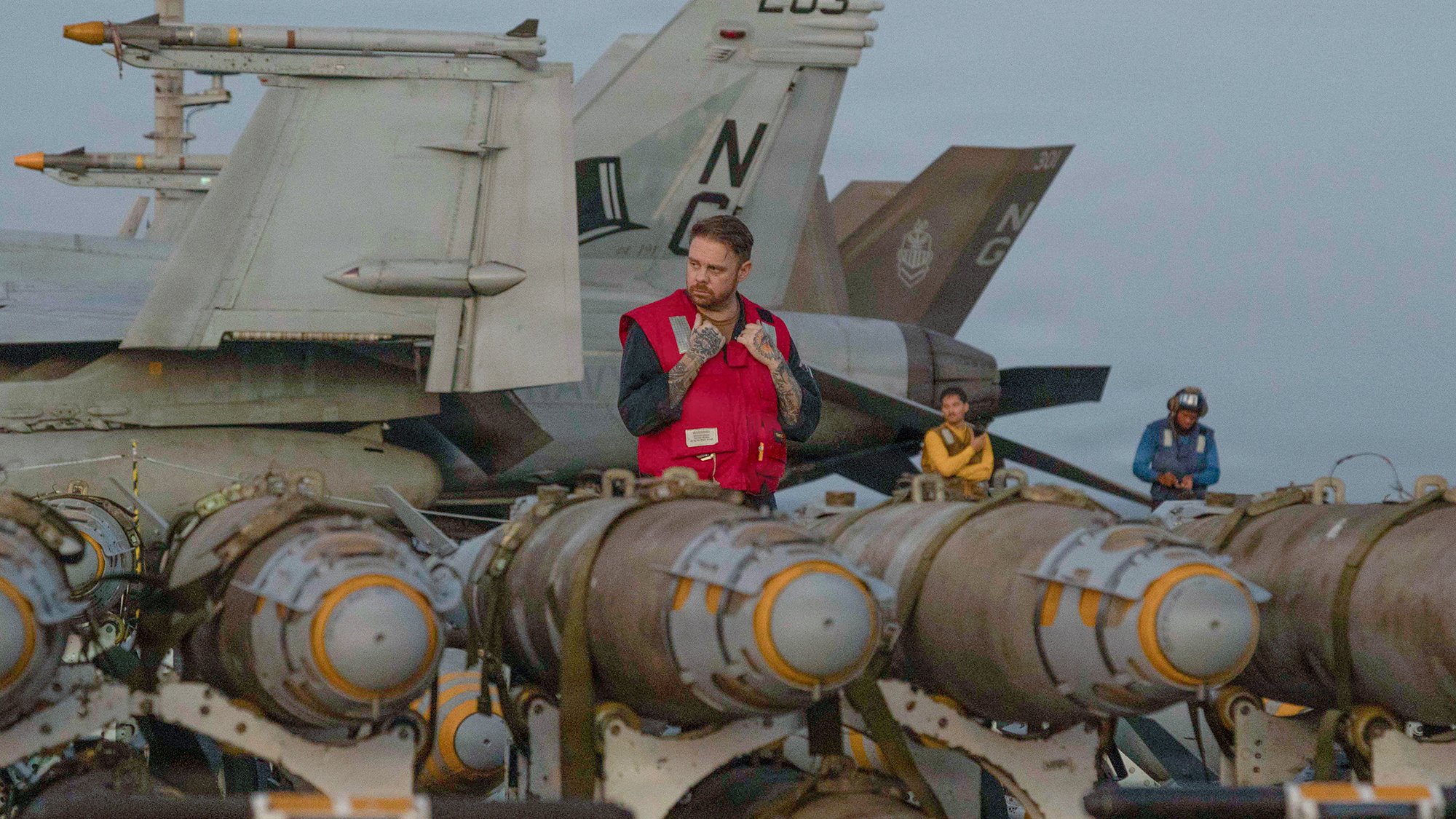 Sailors transfer ordnance on the flight deck of Nimitz-class aircraft carrier USS Abraham Lincoln, in the Arabian Sea, Feb. 27, 2026. Navy photo.
Votel said he is in favor of using AI as part of the target selection process because the technology can pore over huge amounts of data much faster than humans.
As AI’s role in combat operations grows, the most important policy and ethical issue is whether humans will continue to decide whether to strike targets or if AI systems will be empowered to make life-and-death decisions themselves, said retired Air Force Lt. Gen. David Deptula, dean of the Air Force Association’s Mitchell Institute for Aerospace Studies think tank.
“The critical distinction is between AI supporting the kill chain and AI controlling the kill chain,” said Deptula, who was the principal attack planner for the coalition air campaign in the 1991 Gulf War. “The U.S. military has long used automation in weapons and targeting processes, but the key policy and ethical issue is whether commanders and operators retain appropriate human judgment over the use of force. That is the standard that matters.”
The U.S. military has long used defensive weapons with some level of autonomy, such as land mines, said retired Air Force Lt. Col. Dean Korsak.
“Once emplaced, it cannot distinguish friend from foe and is difficult to control or recall,” said Korsak, who pressed his chain of command to investigate a 2019 deadly U.S. airstrike in Syria. “While modern systems are far more sophisticated, the landmine illustrates enduring challenges with autonomous capabilities. Data quality, robust validation processes, and appropriate human oversight are all essential.”
Top Stories This Week
While the U.S. military is not using AI to replace humans, other militaries, such as China, Russia, North Korea, and Iran, are aiming to do just that, said retired Lt. Gen. Ross Coffman, former deputy commanding general of U.S. Army Futures Command.
“An example would be a weapon system with a sensor enabled with artificial intelligence that can detect movement and the weapon would automatically fire,” Coffman told Task & Purpose. “That’s what our adversaries are developing.”
The post AI is meant to speed up ‘kill chain,’ not control it, commanders say appeared first on Task & Purpose.
Classification
Analytical Domain
Operational
Primary Category / Secondary Categories
Military Operations / Command & Control
Subcategory
Airstrike
SALUTE Report
Size
Over 2,000 munitions
Activity
Deployment of munitions to distinct targets using AI
Location
Arabian Sea
Unit
U.S. military
Time
Recent combat operations against Iran
Equipment
Munitions
Summary
The U.S. military deployed over 2,000 munitions to distinct targets in recent operations against Iran, utilizing AI technology to enhance targeting efficiency. Military leaders assert that AI is meant to assist in decision-making rather than replace human judgment. Concerns about the ethical implications of AI in combat operations have been raised, particularly regarding the potential for autonomous systems to make life-and-death decisions without human oversight.
Key Facts
- U.S. military deployed over 2,000 munitions to 2,000 distinct targets within 96 hours using AI.
- AI is intended to speed up the kill chain, not control it.
- Concerns exist regarding the ethical implications of AI in military decision-making.
- Other nations are developing autonomous weapon systems that could replace human decision-making.
- The U.S. military emphasizes the importance of human oversight in the use of AI for military operations.