
Air Force special ops trainees are graduating months faster in revised pipeline
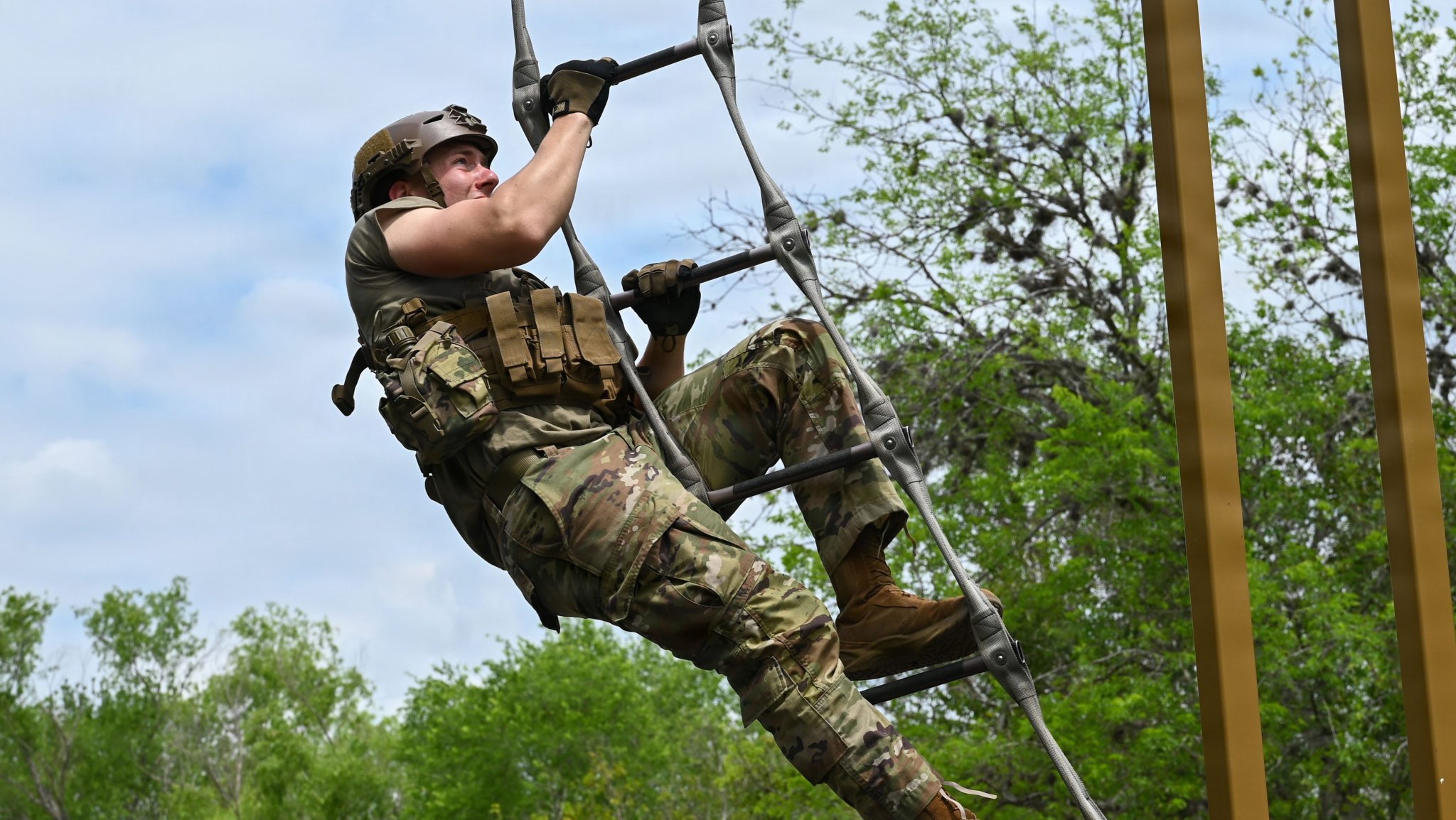
Airmen training to join the Air Force’s special operations roles are moving through the service’s training courses months faster and with less downtime, officials said.
Over the last year, the Air Force has changed its training pipeline for airmen who want to join pararescue, combat control, Tactical Air Control Party (TACP), or special reconnaissance fields, which the Air Force refers to as its special warfare roles.
Jennifer Gangemi, a spokesperson for the Air Force Special Warfare Training Wing, said that a revamped Special Warfare Assessment and Selection program, a new intro course, and new start dates for existing training have reduced the time that airmen spend in training for those jobs. The skills and standards required of the training, she said, have not changed.
“This reduced the average time to beret by nearly 70 days,” Gangemi told Task & Purpose, referencing the distinctively colored headgear airmen earn when they graduate the training pipeline for each job.
The changes to Air Force special operations training are part of the service’s Pipeline Optimization effort, which aims to eliminate bottlenecks and match the number of students to an available number of slots at each schoolhouse.
“The wing spent the past year optimizing its pipeline to reduce delays and maximize throughput within current constraints,” Gangemi said. “Optimization reduced unnecessary training pauses, Students Not in Training (SNIT), and multiple training redundancies. This cut man-years of time-out-of-training, [and] reduced SNIT by over 50%.”
To join one of the four Air Force special operations career fields, students first attend the challenging four-week assessment & selection Course. Then they move on to the Air Force’s new 16-week “Zulu” course at Lackland Air Force Base, Texas.
The Zulu course teaches airmen headed to any of the four special warfare jobs the basic skills of how to shoot, move, and communicate as a team, surface warfare skills, infiltration/exfiltration techniques, and the seven Air Force special warfare missions. In all, the course covers 100 training tasks that students previously had to be taught later in their training pipeline.
“This meant apprentice courses would reinforce the common skills learned in Zulu, rather than having to teach those initial skill sets late in their training, reducing apprentice course days,” Gangemi said.
About 1,200 airmen on average will go through the new course each year, according to the Air Force.
Once an airman headed into any of the Air Force’s four special operations specialties graduates from the selection and Zulu course, they enter a pipeline of as many as five training schools at bases around the country.
The pipelines vary for each job. Airmen training in pararescue, for instance, attend pre-dive, combat dive, and military free fall schools, while airmen headed to TACP do not. The final step in the training pipeline for all four special warfare jobs is a final apprentice school for each role.
Officials told Task & Purpose last year that the training pipelines for each of the distinct career fields will not change.
Gangemi said the new pipeline has “drastically” decreased the amount of time that airmen wait around between courses, or continuing on in their training journey after rehabbing from an injury.
Previously, students had more downtime between courses because they were treated as a “first-come, first-served process,” but now trainees have set start dates for each course. Under the old way of doing things, students could have gaps between courses that could add up to two months or more of downtime during a training pipeline. With the new structure, Gangemi said, the course dates are scheduled to keep that downtime closer to two weeks.
Gangemi said airmen can finish their special operator training between six and 18 months “faster” with the same necessary requirements that they need to graduate. The six- to 18-month range, she said, depends on the career field because each has different graduation requirements.
The post Air Force special ops trainees are graduating months faster in revised pipeline appeared first on Task & Purpose.
Airmen are graduating from the Air Force's special operations training pipeline months faster due to recent changes implemented by the Air Force Special Warfare Training Wing. The revised training structure has reduced the average time to earn a beret by nearly 70 days and decreased downtime between courses to about two weeks. Approximately 1,200 airmen will complete the new Zulu course annually, which covers essential skills for special warfare roles.
- Airmen are moving through training months faster due to a revised pipeline.
- The average time to earn a beret has been reduced by nearly 70 days.
- About 1,200 airmen will go through the new course each year.
- The new training structure minimizes downtime between courses.
- Graduation time can be reduced by 6 to 18 months depending on the career field.