
Air Force tanker tore up asphalt at Alaska airport with engine test
Source: Task & Purpose
Loading...ConfirmedCredibility: 81%
Report Content
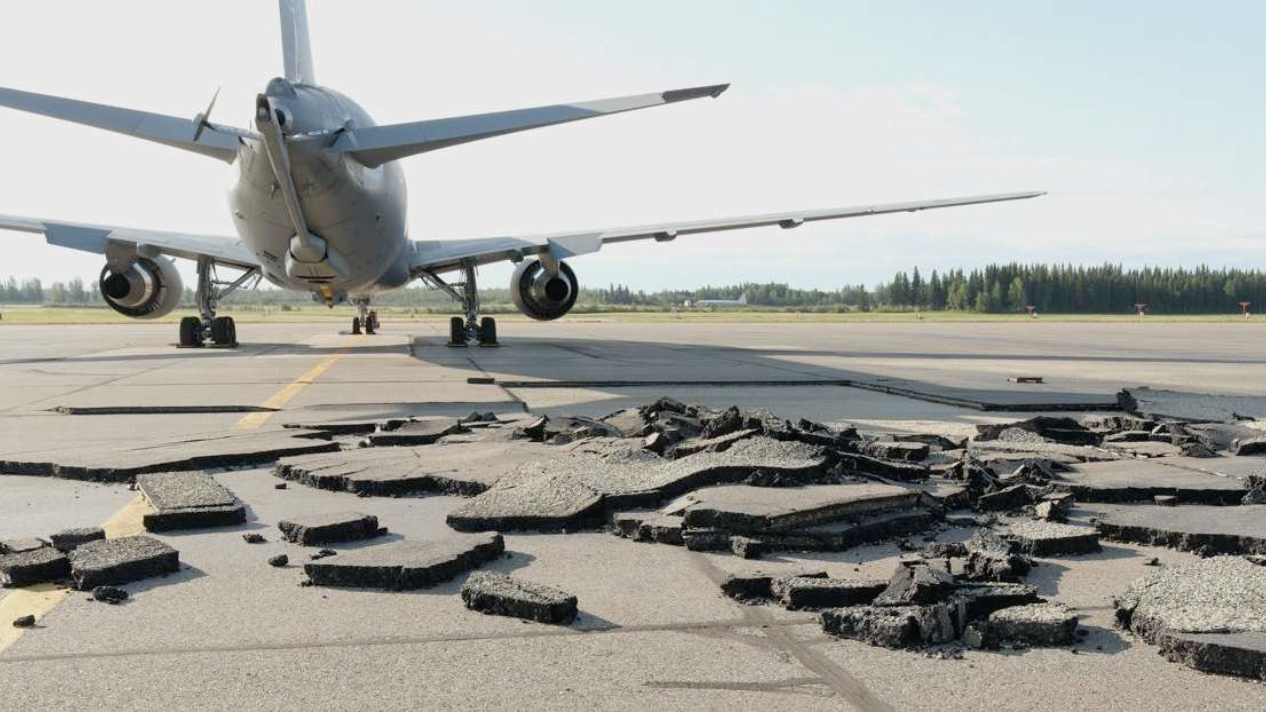
The revving engines of an Air Force refueling tanker blew a 25-foot-wide hole in an Alaskan airport last summer, flinging chunks of asphalt 100 feet away during an engine test. The mishap did not damage the Air Force jet, but left Fairbanks International Airport with a $147,044 hole to fix.
The ill-fated test occurred in July 2025. The service released a formal report on the incident earlier this month.
The president of the investigation board, Air Force Lt. Col Michael Raynor, wrote that the heat and high winds of the engine test caused the pavement to break free after 10 “high-power engine runs,” which maintenance crews ran to diagnose and fix vibration issues cited by the crew. The plane’s pilots and aircrew were not present during the engine tests, and the report did not cite any errors by the maintenance team running the tests.
The mishap involved a New Hampshire Air National Guard KC-46 tanker from the 133rd Air Refueling Squadron. The plane was returning to New Hampshire from Yokota Air Base, Japan, a route that takes it over Alaska. After performing aerial refueling operations, the plane landed at Fairbanks International Airport after the crew reported “abnormal engine vibration indications” in both of the plane’s engines.
The vibrations were severe enough that the jet could not fly, and a special team of maintenance experts was dispatched from McConnell Air Force Base, Kansas, arriving two days after the tanker. The crew waited two more days for favorable weather to begin work on the engines.
Top Stories This Week
With each engine test, the report said, maintenance specialists ran both of the plane’s engines at up to 83% power for between 20 and 30 minutes. Even when testing a single engine, the report said, crews run both to avoid damaging the plane with unequal, or non-symmetric, force from only one side.
At that power level — the same power level the jet uses during take-offs — the engines produce exhaust “approximately 1,170 degrees Fahrenheit. The high temperature of an operating engine can be felt more than one hundred feet behind the exhaust,” reads the report.
The repeated tests, investigators found, created “persistent high temperatures in combination with repeated high engine exhaust” that melted the sealant used on the asphalt.
During the tenth test, a slab of concrete approximately 25-feet by 25-feet lifted off from behind the plane’s right engine, tumbling backwards and shattering across an area roughly two-thirds of an acre behind the plane.
“After a comprehensive investigation into this mishap, I find by a preponderance of the evidence the cause of the mishap was persistent high temperatures in combination with repeated high engine exhaust from the [KC-46’s] right engine,” Raynor wrote. “These conditions severely affected the sealant holding the asphalt together [which] ultimately failed, allowing the blocks to lift into the air and break apart upon impact with the ground.”
Though Eielson Air Force Base is just outside Fairbanks, the plane landed at the city’s international airport, which has several parking ramps designed for planes as large as the KC-46, a militarized version of the Boeing 767 widebody jetliner. Though remote from the continental U.S., Fairbanks’ northern location has long made it a refueling hub for international flights between North America and Asia, particularly among large cargo jets. The airport even once hosted a summit between then-President Ronald Reagan and Pope John Paul II, who met briefly at the airport as both leaders stopped for fuel on international trips. Though the tarmac remained intact after their meeting.
The post Air Force tanker tore up asphalt at Alaska airport with engine test appeared first on Task & Purpose.
Classification
Region
North America
Analytical Domain
Tactical
Primary Category
Military Operations
SALUTE Report
Size
1 KC-46 tanker
Activity
Engine test caused asphalt damage
Location
Fairbanks International Airport · Alaska · United States
Unit
New Hampshire Air National Guard 133rd Air Refueling Squadron
Time
July 2025
Equipment
KC-46 tanker
Summary
An Air Force KC-46 tanker caused significant asphalt damage at Fairbanks International Airport during engine tests in July 2025. The tests, aimed at diagnosing engine vibration issues, resulted in a 25-foot-wide hole and $147,044 in repair costs. The investigation attributed the damage to persistent high temperatures and exhaust from the right engine, which melted the asphalt sealant.
Key Facts
- An Air Force KC-46 tanker caused a 25-foot-wide hole in the asphalt at Fairbanks International Airport during an engine test.
- The incident occurred in July 2025 and resulted in $147,044 in damages.
- The engine tests were conducted to diagnose vibration issues reported by the crew.
- The maintenance team ran the engines at up to 83% power for 20-30 minutes during the tests.
- The investigation concluded that high temperatures and exhaust caused the asphalt to fail.