
American Naval Blockade on Iran on July 14 and the Use of Corsair USV Changes the Rules of Deterrence in Hormuz
 Ahmed Al-Rashid
American Naval Blockade on Iran on July 14 and the Use of Corsair USV Changes the Rules of Deterrence in Hormuz
At 4 PM Eastern Time on July 14, 2026, an announced American naval blockade on all Iranian ports, oil stations, and coastal areas comes into effect, according to a notification from the Joint Maritime Information Center led by the U.S. Navy. The short text in the notification is more significant than its size: any vessel entering or leaving the blockaded area without authorization may be subject to interception, diversion, or detention, and may be forcibly compelled to comply if it refuses, with confirmation that neutral passage through the Strait of Hormuz to non-Iranian destinations will not be hindered.
This is not ordinary diplomatic phrasing. Militarily, we are witnessing a shift from intermittent air and missile strikes to daily maritime management of ship movements near Iran. The difference is substantial. A strike ends within minutes, while a blockade requires ships, patrol aircraft, drones, rules of engagement, maritime law, and the ability to distinguish between a regular oil tanker and a tanker carrying what Washington wants to prevent.
From the Maritime Notification to the Testing Ground
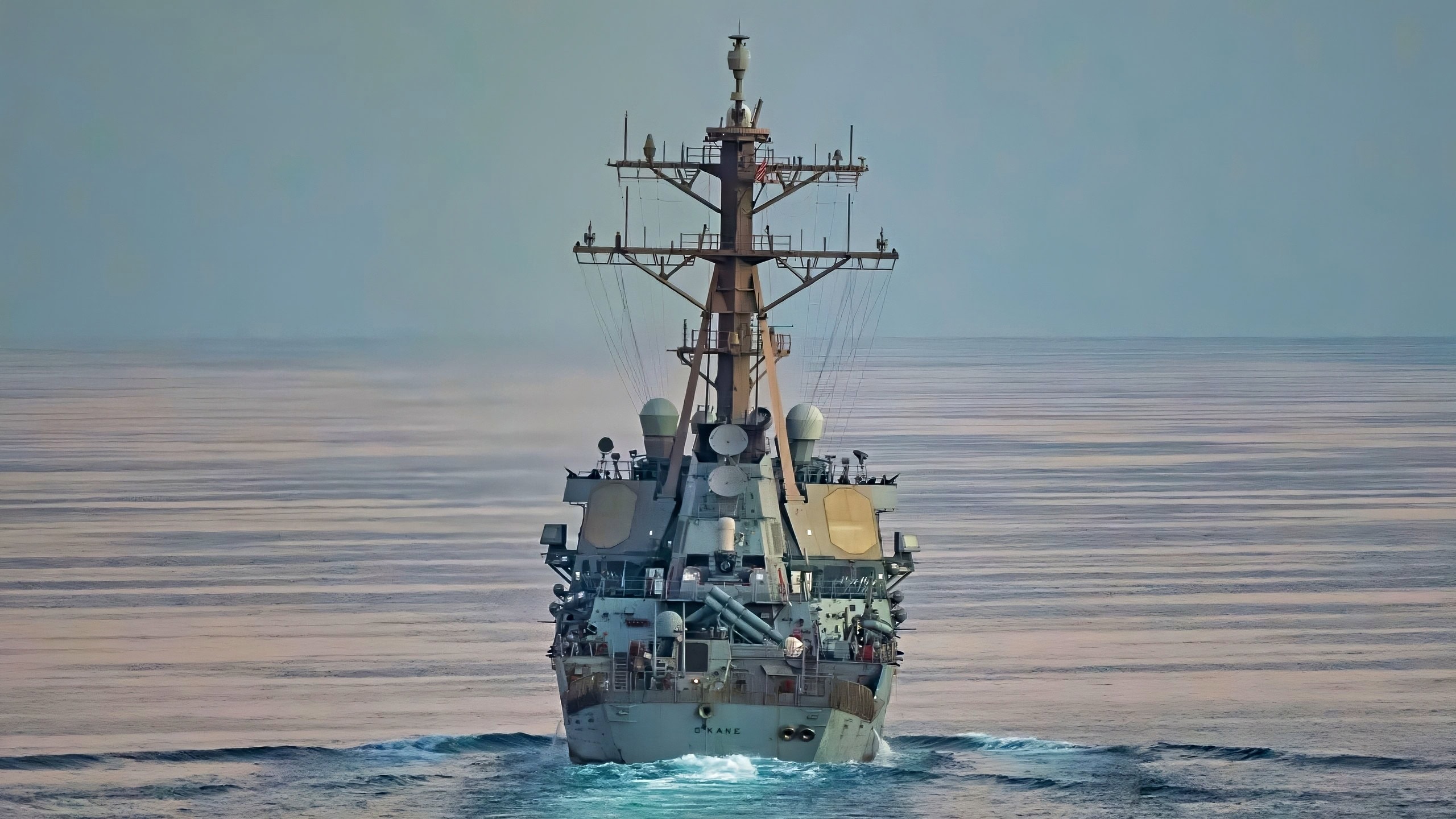
The announcement of the blockade came just one day after U.S. Central Command confirmed the use of three unmanned surface vessels of the Corsair type to strike a submarine and ship maintenance facility at the Bandar Abbas naval base. According to a report by Defense News, Central Command described the operation as the first U.S. combat use of unmanned maritime vessels. Drones in the air have become familiar in regional wars, but introducing an unmanned vessel into an Iranian port and striking a maritime maintenance target carries a different meaning: the United States is not only testing a new weapon but also testing a new way to impose control in narrow waters.
The published specifications of the Corsair help to understand the choice. The vessel is 24 feet long, has a range exceeding 1,000 nautical miles, a payload of about 1,000 pounds, and can reach speeds of 35 knots. This is not a massive platform comparable to a destroyer, but it is sufficient for reconnaissance, limited attack, and continuous surveillance missions. When operating within the Fifth Fleet network and Task Force 59 in Bahrain, its value lies in quantity, deployment, and reducing human risk, not in individual firepower.
Hormuz is No Longer Just an Oil Chokepoint
In Western articles, the Strait of Hormuz is often summarized by the percentage of global oil that passes through it. This is economically true, but militarily incomplete. Those who have served in the region know that Hormuz is a psychologically narrow space before it is geographically narrow: the Iranian coast is close, the islands are sensitive, commercial ships are numerous, and any mistake in identification can turn into a political crisis. Therefore, Washington's announcement not to hinder neutral passage is not a detail; it is an attempt to legally isolate Iran without choking off global trade entirely.
However, the United States' ability to say this does not mean it is easy to implement. A successful naval blockade requires three elements: precise monitoring, a present interception force, and a rapid decision-making chain that does not get bogged down at every tanker. This is where unmanned systems come into play. Drones do not replace destroyers, but they fill the gaps between large ships, monitor maritime life patterns, and provide a continuous picture of the corridors. This is the real transformation: from a sea seen by radars as dots to a sea that algorithms and unmanned systems attempt to read its behavior.
What This Means for Iran
Iran has built part of its maritime deterrence on imposing high costs in nearby waters: fast boats, mines, coastal missiles, drones, and a constant threat to navigation. This system does not need to sink the U.S. fleet to be effective; it is enough to make insurance companies, tankers, and Gulf states think twice about every crossing. The use of Corsair against Bandar Abbas targets this idea from two angles. First, it strikes Iranian maritime infrastructure without exposing American personnel directly. Second, it sends a message that Washington can transfer part of the risk to cheaper, more replaceable machines.
But Iran is not a foe without memory. Tehran will treat the blockade as a propaganda and political opportunity and will look for gray areas: ships flying third-country flags, nighttime movements, transferring cargo from one ship to another, or using proxies in waters farther from the center of gravity. Therefore, the first test may not be in Bandar Abbas, but at the first ship that refuses a U.S. order to stop and claims it is not violating anything. At that moment, legal rules become more important than the speed of the vessel.
The Gulf's Dilemma Between Protection and Involvement
The Gulf states will read the news with both relief and concern at the same time. Relief because the United States shows readiness to defend navigation, and concern because any broad blockade around Iran places Gulf ports, bases, and the insurance market in the line of fire. Saudi Arabia, the UAE, Qatar, and Kuwait are not just spectators; they are countries that rely on keeping the passage open, but they do not want to appear as direct parties in an American-Iranian blockade war.
Here again, the problem of the capability triangle I often talk about emerges: equipment, training, and institutions. Gulf states have purchased air defenses, ships, and surveillance systems worth billions of dollars, but they still rely on the American center at the critical decision moment. If intercepting a suspicious vessel near Iran requires an American image, an American base, and an American officer to interpret the rules of engagement, then the meaning of Gulf maritime independence remains limited. Buying radar does not mean possessing maritime control.
Politics Inside Washington Pressures Operations
The timing of the blockade coincides with pressure in Congress to release the results of the investigation into the February 28 strike on a school in the Iranian city of Minab, a strike that Reuters sources say a preliminary investigation indicated was the responsibility of U.S. forces, while Tehran speaks of more than 175 dead, including children and teachers. This issue is not marginal. Any blockade operation relies on American legitimacy in the eyes of allies and adversaries, and legitimacy erodes when Washington is unable to explain its past mistakes.
Practically, the more automation at sea increases the need for clear human accountability. The unmanned vessel does not write a political report after the operation, nor does it convince a neutral state that its ship was detained for a legal reason. The officer, commander, and politician are the ones who bear that responsibility. Therefore, the algorithmic war in Hormuz will remain linked to humans' ability to control it, not merely to our admiration for the technology.
Conclusion
The American naval blockade on Iran on July 14 is not just another escalation in a prolonged war. It is an announcement that Hormuz is entering a phase where legal interception, unmanned vessels, precision strikes, and the oil market become part of a single equation. Washington can tighten the screws on Iran without closing the strait entirely, but this requires rare military and political discipline.
The deeper irony is that the Gulf states seeking American protection from Hormuz's turmoil may find themselves more dependent on an automated American network that does not have the final decision in its hands. As the old military saying goes: those who ask others to guard the gate must accept that the key will not remain in their pocket.
The U.S. Navy initiated a maritime blockade on Iranian ports and oil facilities on July 14, 2026, utilizing three Corsair unmanned surface vessels in military operations. The blockade permits neutral passage through the Strait of Hormuz, while the U.S. seeks to enforce maritime control without completely closing the strait. Iran is expected to respond with asymmetric tactics to counter the blockade.
- U.S. Navy announced a maritime blockade on Iranian ports on July 14, 2026.
- Three Corsair unmanned surface vessels were used in a military operation against an Iranian naval facility.
- The blockade allows neutral passage through the Strait of Hormuz.
- The U.S. aims to enforce maritime control without fully closing the strait.
- Iran may respond to the blockade with asymmetric tactics.