
Ammunition in Short Supply? Decreasing Missile Defense Stocks, Tight Guided Weapon Supplies, How Long Can the U.S. Sustain Airstrikes Against Iran?
[Global Times Special Correspondent Chen Yang] On the 3rd, U.S. Central Command Commander Cooper claimed that the military actions by the U.S. and Israel against Iran have lasted nearly 100 hours, with U.S. forces having dropped over 2,000 munitions targeting nearly 2,000 Iranian sites, destroying hundreds of ballistic missile launchers and drones, as well as 17 Iranian naval vessels, including one submarine. However, while the U.S. boasts of its achievements, there are increasing doubts about the sustainability of its combat capabilities—whether it is the large number of air defense interceptors fired to intercept Iranian missiles and drones, or the massive amounts of precision-guided munitions used in airstrike missions, all of which are rapidly depleting U.S. military stockpiles. Whether the U.S. truly has the capability to sustain high-intensity airstrike operations for four weeks or even longer, as claimed by President Trump, has become a focal point of concern.
Missile Defense Systems Under Great Pressure
Al Jazeera reported on the 3rd that leaked information from the Pentagon indicates that if attacks on Iran continue for more than 10 days, the stockpiles of some key U.S. missiles may begin to run low. U.S. Central Command stated that during the ongoing military operations against Iran, U.S. forces have utilized over 20 types of weapon systems in the air, at sea, on land, and in missile defense units. These include B-1 strategic bombers, B-2 stealth bombers, F-35 Lightning II stealth fighters, F-22 Raptors, F-15 fighters, and EA-18G Growler electronic warfare aircraft, as well as various unmanned combat systems and long-range strike weapons, including the low-cost "Lukas" drones, MQ-9 Reaper drones, HIMARS rocket systems, and Tomahawk cruise missiles. Additionally, U.S. forces stationed in the Middle East have employed land-based Patriot and THAAD systems, as well as sea-based Standard-2, Standard-3, and Standard-6 missile defense systems to intercept ballistic missiles and suicide drones launched by Iran.
Insiders told the U.S. Washington Post that senior U.S. leaders are concerned that a prolonged strike against Iran could further exacerbate the pressure on America's limited air defense reserves. One insider stated, "I don't think people fully realize how much of an impact this has on equipment reserves; it typically takes two to three air defense missiles to ensure the interception or destruction of an incoming missile." Adam Smith, a Democratic representative on the House Armed Services Committee, described the current state of U.S. reserves as "tight." "Now that operations have commenced, we can't tell Iran, 'Hey, Iran, our missile defense systems are running low, so can you pause for a moment?'" Smith said, "This will put further pressure on our ability to defend all necessary targets."
Al Jazeera's website cited the 12-day conflict between Israel and Iran from June 13 to 24 last year as an example, stating that to assist Israel in intercepting Iranian missiles and drones, the U.S. deployed two THAAD missile defense systems in Israel, while its manufacturer, Lockheed Martin, stated that there are only nine operational THAAD systems worldwide as of mid-2025. Pentagon reports indicate that during last year's conflict between Israel and Iran, U.S. forces launched over 150 interceptors from the THAAD missile defense system, accounting for about 25% of its total munitions. The report also mentioned that due to slow production, previous strikes against the Houthi forces in Yemen, and assistance to Israel in defending against Iranian ballistic missile attacks, the inventory of interceptors for the U.S. Navy's Standard-3 missile defense system has been depleted.
Worse still, during last year's conflict between Israel and Iran, the Israeli-made Arrow-2/3 missile defense systems and David's Sling air defense systems had nearly exhausted their interceptor missiles, which was one of the key reasons Israel ultimately agreed to a ceasefire. The massive consumption of munitions by the Israeli air defense systems makes it difficult to replenish their reserves in the short term, which also means that the U.S. will need to take on more responsibility in intercepting Iranian missiles and drones during this operation. Although prior to the outbreak of this conflict in the Middle East, the U.S. military had transported a large number of missile defense systems and interceptors to the region using transport aircraft, there is a general belief that the consumption of munitions by U.S. missile defense systems during Iran's high-intensity counterattacks far exceeds expectations.
According to statistics from the U.S. and Israel, during last year's conflict, Iran launched approximately 550 ballistic missiles and 1,000 drones within 12 days. Commander Cooper of U.S. Central Command revealed that as of March 3, Iran had launched over 500 ballistic missiles and more than 2,000 drones in this counterattack.
U.S. Secretary of State Rubio admitted at a press conference on March 2 that the number of offensive weapons Iran can produce far exceeds the number of interceptors produced by the U.S. and its allies to stop these weapons. "It is estimated that Iran produces over 100 missiles per month. In contrast, we can only produce six or seven interceptors per month, not to mention they have thousands of suicide drones."
Christopher Preble, a senior research fellow at the Cato Institute, told Al Jazeera that although the U.S. has a trillion-dollar defense budget capable of bearing the financial costs of war, the real limiting factor is the inventory of interceptors, such as the Patriot and Standard series interceptors. Preble warned that the current high interception rates of U.S. and Israeli forces against Iranian ballistic missiles and drones cannot be sustained indefinitely, "perhaps only for a few weeks at most." South Korea's Chosun Ilbo revealed that the U.S. is considering redeploying Patriot and THAAD systems from U.S. forces stationed in South Korea to the Middle East as an emergency measure.
Offensive Operations Face Ammunition Supply Issues
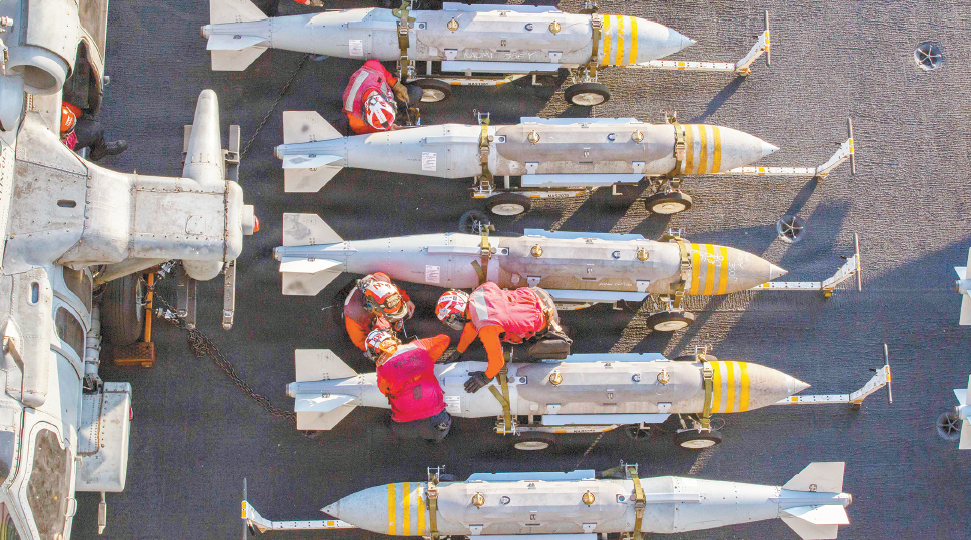
In addition to the air defense system munitions consumed in responding to Iranian missiles and drones, the precision-guided munitions stored in the U.S. arsenal are facing similar dilemmas. Although Cooper claimed that U.S. forces have dropped over 2,000 munitions targeting nearly 2,000 Iranian sites, this also indicates a significant consumption of offensive munitions by the U.S. military. According to the U.S. Washington Post, even before Trump announced military action against Iran, Chairman of the Joint Chiefs of Staff Milley warned that if the U.S. launched a large-scale military operation against Iran, it could face risks of ammunition shortages, personnel casualties, and getting embroiled in a prolonged conflict. The Financial Times reported that Israeli intelligence believes that if the U.S. were to launch a large-scale airstrike against Iran, the existing precision-guided munitions could only sustain operations for 4 to 5 days.
In comparison, according to a report submitted by U.S. Central Command at the end of May 2003, U.S. aircraft dropped a total of 19,269 precision-guided munitions during military operations against Iraq. Iran covers an area of over 1.6 million square kilometers, about four times that of Iraq, and its armed forces are in a much better state than the Iraqi military, which suffered from sanctions and attacks in 2003. The U.S. plans to strike hundreds of targets spread throughout Iran, including many well-camouflaged and rapidly mobile missile launchers, which means that U.S. operations could last for several weeks or even months, and the number of precision-guided munitions dropped would also multiply.
However, the reality is that the U.S. military's stockpile of offensive precision-guided munitions is severely inadequate. The New York Times previously warned that the seemingly insignificant naval battles between the U.S. Navy and the Houthi forces in Yemen have greatly depleted U.S. ammunition stockpiles. In previous conflicts between Israel and Palestine and between Israel and Iran, the U.S. also urgently delivered tens of thousands of small diameter bombs (SDB) and Joint Direct Attack Munitions (JDAM) from domestic stockpiles to Israel. In several operations against the Houthis, the U.S. military heavily utilized Tomahawk cruise missiles launched from ships, AGM-154 Joint Standoff Weapons precision-guided glide bombs, and AGM-158 Joint Air-to-Surface Standoff Missiles (JASSM), which were originally prepared for large-scale conflicts in the Western Pacific. Mackenzie Eaglen, a senior defense researcher at the American Enterprise Institute, stated that in January 2024, the number of Tomahawk cruise missiles fired by the U.S. military in a single day against the Houthis exceeded the total number procured by the U.S. Navy in the previous year. U.S. Defense News reported that war game simulations conducted by think tanks indicate that U.S. precision-guided munitions are in a long-term "outflow" situation; for example, the total production of JASSM is only about 3,000 units, and the U.S. military has already used hundreds in years of actual combat; another type of Long Range Anti-Ship Missile (LRASM) has an inventory of about 120 units, with an annual production of only a few dozen. Despite repeated warnings from think tanks in recent years that the U.S. military needs to reduce the use of these precision-guided weapons and increase stockpiles, the U.S. military's continuous involvement in localized conflicts around the world has made it impossible to implement such warnings.
Financial Pressure is Also Significant
In addition to the actual consumption of weapon munitions, if the conflict with Iran becomes prolonged, the enormous war expenditures will also be a significant burden on the U.S. economy. The daily expenses of over 50,000 U.S. troops gathered near Iran are not a small sum. Reports from Turkey's Anadolu Agency indicate that the U.S. spent approximately $779 million on the first day of military action against Iran, with an additional $630 million spent on pre-strike preparations—deploying fighter jets, dozens of naval vessels, and mobilizing regional resources. The U.S. think tank New America Foundation estimates that operating a carrier strike group like the USS Ford costs $6.5 million per day.
The interceptors expended by the U.S. military to intercept Iranian drones and cruise missiles are also extremely costly; to shoot down one Iranian drone or missile worth several thousand or tens of thousands of dollars, the U.S. military typically needs to use two interceptors worth millions or even tens of millions of dollars. Even reports from the U.S. Congress candidly state that such interception operations are difficult to sustain financially.
Moreover, Iran's counterattacks have also caused significant losses to U.S. forces and their allies. According to Al Jazeera's report on March 3, commercial satellite images show that Iran successfully struck the AN/FPS-132 "Cobra Dane" radar deployed in Qatar, which is valued at up to $1.1 billion; Iranian missiles also destroyed the AN/TPY-2 radar positions of the THAAD systems deployed in Jordan and the UAE. Reports indicate that the entire THAAD system costs approximately $1 billion to $1.8 billion.
U.S. Central Command has conducted extensive military operations against Iranian targets, deploying over 2000 munitions in nearly 100 hours. Concerns are growing regarding the sustainability of these operations due to depleting munitions stocks, particularly in missile interceptors. Iran has responded with over 500 ballistic missiles and 2000 drones, escalating the conflict. The financial burden of these operations is substantial, with daily costs estimated at over $6 million.
- U.S. has conducted nearly 100 hours of military operations against Iran, using over 2000 munitions.
- Concerns raised about the sustainability of U.S. military operations due to depleting munitions stocks.
- Iran has launched over 500 ballistic missiles and 2000 drones in response to U.S. actions.
- U.S. military leaders warn of potential shortages in missile interceptors if operations continue for weeks.
- The cost of military operations against Iran is significant, with estimates of daily expenses exceeding $6 million.